CH 28: Non-intestinal protozoa
 Call Kai
 Learn
 Practice Test
 Spaced Repetition
 Match
 Flashcards
 Knowt Play
1/38

There's no tags or description
Looks like no tags are added yet.
39 Terms
Naegleria fowleri
ubiquitous in environment
causes primary amoebic meningoencephalitis (PAM)
fresh, untreated water entering nasal cavity
usually fatal
identification
trophozoites found in CSF and brain tissue
single nucleus w/ large, dense karyosome

Acanthamoeba spp.
causes amoebic keratitis and encephalitis
identification
trophozoites or cysts visible in corneal scrapings or brain tissue
cysts have 2 walls, a large nucleus, and large dense karyosome
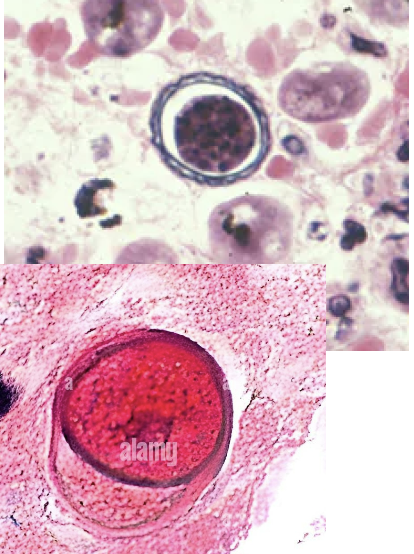
Trichomonas vaginalis
sexually transmitted flagellate - mostly causes vaginitis
identifcation
trophozoites found in urine and vaginal wet prep
‘jerky,’ non-directional motility
pear-shaped, 1 nucleus, 4 flagella

Hemoflagellates
flagellates that inhabit the blood and tissue of humans
principle pathogens:
Leishmania spp.
Trypanosoma cruzi
Trypanosoma brucei
Leishmania spp.
causes leishmaniasis - cutaneous or disseminated infx contracted from bite of SANDFLY
identification
flagellated form or nonmotile stage found in blood or tissue
flagellate: long, straight, single flagella
non-motile: many organisms infecting human WBC

Trypanosoma cruzi
Chagas dx - contracted from feces and bite of REDUVIID (kissing) bug
identification
flagellate found in peripheral blood smears
C-shape, large, dark posterior kinetoplast
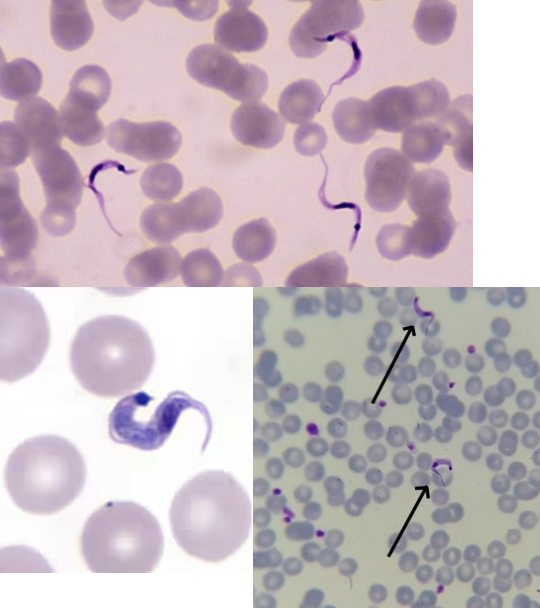
Trypanosoma brucei
causes African sleeping sickness - contracted from TSETSE FLIES
identification
flagellate found in peripheral blood smears
delicate curve w/ smaller kinetoplast

Plasmodium spp.
sporozoa that cause malaria
life-threatening illness that is one of most clinically impactful dx in world
250 million new cases and over 600,000 deaths each year
vaccine developed in 2021
principle pathogens:
P. falciparum
P. vivax
P. ovale
P. malariae
Plasmodium spp. identification
diagnosis made primarily through thick and thin blood smears to view developmental stages of life cycle
ALL Plasmodium have ring from and diagnose malaria
P. falciparum: double ring form and large banana-shaped gametocyte
P. malariae: band form trophozoite
P. ovale and P. vivzx: Schuffner’s dots difficult to distinguish from each other

Plasmodium falciparum
large, banana-shaped gametocyte
multiple rings per RBC
‘double dot’ or ‘headphones’ ring form

Plasmodium malariae
single ring form, NO Schuffner’s dots
band form trophozoite

Plasmodium ovale and vivax
ring and trophozoite forms w/ Schuffner’s dots

Babesia microti
sporozoa that causes babesiosis
bloodborne, usually self-limiting infx spread thru tick bites
identification
ring forms similar to Plasmodium and trophozoites in blood smears
usually multiple ring forms per cell
‘plus sign’ or ‘maltese cross’ morphology

Toxoplasma gondii
causes toxoplasmosis
associated w/ cat feces and ingestion of undercooked meat, especially in pregnant women
identification
mostly serological testing
organisms can be found, but not easily
large, curved structures that can be found in CSF, blood, or tissue samples

Trematodes
flukes
flat, hemaphroditic w/ at least 2 suckers
life cycles
eggs usually pass thru feces into water where hatch into free-living organisms
can infect many organs
intestines, liver, lungs
Schistosoma spp.
blood flukes
eggs found in feces or urine are diagnostic
principle pathogens:
Schistoma mansoni
Schistoma japoriicum
Schistoma haemtobium
Schistoma mansoni
eggs have large lateral spine

Schistoma japoriicum
eggs have small lateral spine

Schistoma haemtobium
eggs have terminal spine
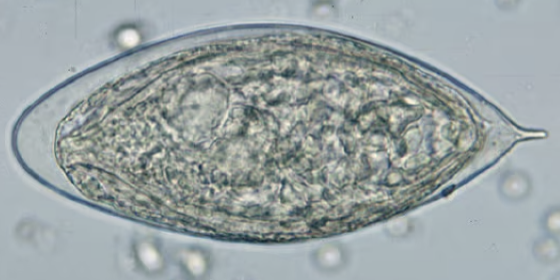
Paragonimus westemani
long fluke
identification
eggs is feces or sputum
eggs have shouldered operculum (top)

Clonorchis sinensis
intestinal fluke
identification
eggs in feces
eggs have dome shaped, shouldered operculum opposite small knob

Fasiola hepatica
liver fluke
identification
eggs in feces
eggs are rounded w/ non-shouldered operculum

Cestodes
tapeworms
adult worms live in humans who shed eggs, which infect an intermediate host
host produces larvae which infects humans by consumption of meat
diagnosis usually made by eggs or proglottid segments in feces
Taenia saginata
beef tapeworm
diagnosis
eggs indistinguishable from T. solium
proglottid segments are wide w/ more lateral segments
scolex has 4 suckers and smooth surface

Tenia solium
pork tapeworm
diagnosis
eggs indistinguishable from T. saginata
proglottid segments are more narrow w/ fewer later segments
scolex has 4 suckers and hook like projections on surface
Diphyllobothrium latum
fish tapeworm
identification
eggs are oblong and smooth
smooth operculum w/ small knob opposite
proglottids are wide w/ central uterine segments
Hymnenolepis nana
dwarf tapeworm - accidental ingestion of infected arthropods
identification
eggs have 2 layers
3 hooklets inside egg, w/ polar thickening at one end
Nematodes
roundworms
wide variety of infxs, and life cycles can be very complex
Enterobius vermicularis
pinworms - common infx in school age children
pruritus and itchiness around anus
diagnosis
gravid females deposit eggs in perianal folds
best egg visualization by tape prep from around anus at night
eggs have thin shell that is oval-shaped w/ one flattened side
Trichuris trichiura
whipworm
intestinal infections, mostly in children
diagnosis
eggs in stool
barrel shaped eggs w/ transparent plugs at each end
Ascaris lumbricoides
giant intestinal tapeworm
diagnosis
larger worms are so big they can cause intestinal blockages
visualized coming out of anus or stool
eggs in stool have a thick shell w/ bumpy outer layer
Strongyloides stercoralis
threadworm
burrow into intestinal tissue
infx occurs when worms in water sources penetrate through skin
diagnosis
eggs rarely in stool
feces contain rhabditiform larvae
larvae very similar to hookworms, but have short buccal (mouth) cavity and prominent genital primordium
Necator americanus
hookworms
adults infect the small bowel
infx occurs when worms in water sources penetrate through skin
diagnosis
eggs found in stool w/ translucent wall and clusters of spherical embryos
rhabditiform larvae also found in stool have long buccal cavity
Trichinella spiralis
infx of skeletal muscle that causes edema and swelling in muscle tissue
contracted from ingestion of undercooked pork
diagnosis
encysted larvae and worms seen in skeletal muscle
Dracunculus medinensis
guinea worm infxs
migrate to skin and cause ulcers
diagnosis
adult worms found in ulcerations
treated by removing worms around a stick, 1 inch per day
Filariae
subset of nematodes that are small, thread-like worms
mainly inhabit circulatory and lymphatic systems, but can also invade sinus cavities and skeletal muscles
elephantiasis
diagnosis made by identifiying organisms in blood samples
Wuchereria bancrofti
causes elephantiasis
contracted thru bite of mosquitoes
diagnosis
adults worms have no tail nucleu
Brugia malayi
causes elephantiasis
contracted through bite of mosquitoes
diagnosis
adult worms have 2 distinct tail nuclei
Loa loa
migrate to eyes
diagnosis
adult worms have nuclei that go all way to tip of tail