1.0 Breast Cancer
 Call Kai
 Learn
Learn Practice Test
 Spaced Repetition
 Match
Match Flashcards
 Knowt Play
1/51

There's no tags or description
Looks like no tags are added yet.
Name | Mastery | Learn | Test | Matching | Spaced | Call with Kai | Chat |
|---|
No analytics yet
Send a link to your students to track their progress
52 Terms
Breast Cancer
The most common cancer in FEMALES
Numerous etiologies implicated
ok
Breast Cancer is second only to lung cancer as cause of deaths in american women.
somatic cell genes
Cancer involves the abnormal multiplication and spread of cells in the body.
It is usually caused by mutations in________ that regulate cell growth.
Almost every tissue in the body can produce cancer; some even generate many different types of cancer.
However, cancer mostly occurs in cells that divide and reproduce more than other cells.
Lobules
Breast Cancer occurs when a mutation takes place in the cells that line the _______that manufacture milk or more commonly in the ducts that carry it to the nipple.
Breast Cancer
The area around the center of the breast is where most cancers occur.
It is fairly rare for cancers to form in the fat or non-glandular tissues of the breast.
ok
The causes of breast cancer are not completely understood and are not set in stone. But certain women are more susceptible of developing one form of cancer.
Race
Menstrual Cycle
Estrogen
Risk Factors that cause Breast Cancer
Factors that cannot be prevented
Gender
Aging
Genetic Risk Factors (inherited)
Family History
Personal History
-
-
-
Oral contraceptives
not having children
not breastfeeding
Hormone replacement therapy
Risk Factors that cause Breast Cancer
Lifestyle Risks
-
-
-
-
Alcohol Use
Obesity
High Fat Diets
Physical Inactivity
Smoking
Exposure to estrogen
Radiation
Electromagnetic fields
Xenoestrogen
Exposure to chemicals
Environmental Factors
Hormonal Replacement Therapy
Oral Contraceptives
Exogenous Estrogen
-
-
Hormonal replacement therapy
Exogenous Estrogen
30% increased risk with long term use
Oral Contraceptives
Exogenous Estrogen
risk slight
risk returns to normal once the use of OC’s has been discontinued
Atpyical Hyperplasia
Intraductal carcinoma in situ
Intralobular carcinoma in situ
RISK FACTORS FRO BREAST CANCER
Radiation exposure
Breast disease
-
-
-
Obesity
Diet
Fat
Alcohol
BRCA 1
BRCA 2
P53, Rb1
Her-2/neu
c-erB2
c-myc
Genetics
BRCA 1 and 2
Ovarian Cancer
Prostate Cancer
Both of these genes code for DNA repair.
If a woman has a mutation on either one of these genes, the risk of her getting breast cancer increases from 10% to 80% in her lifetime.
Mutations in_____ or _____ account for 40-50% of all cases of inherited breast cancer.
These genes are also associated with _______ in women and _______ in men.
These genes can be inherited either from the mother or the father.
ok
PROTECTIVE FACTORS
1. Exercise
2. Breast feeding
3. Pregnancy before 30 yo
ok

Upper outer quadrant
NON-tender
Skin dimpling
Nipple retraction
Peau d’orange
ASSESSMENT FINDINGS
1. MASS- the most common location is the ________
2. Mass is ______. Fixed, hard with irregular borders
3. _______
4. _______
5._______
Ductal Carcinoma in situ
Invasive Ductal Carcinoma
Invasive lobular carcinoma
3 types of breast cancer
Ductal Carcinoma In Situ
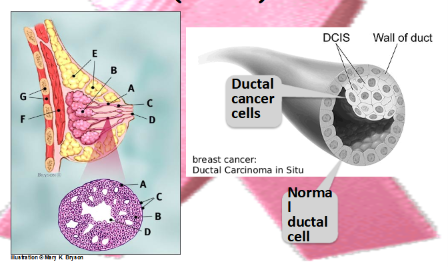
Invasive Ductal Carcinoma
The cancer has spread to the surrounding tissues
Carcinoma refers to any cancer that begins in the skin or other tissues that cover internal organs
80%
Invasive Lobular Carcinoma
Lobular cancer cells breaking through the wall
ok
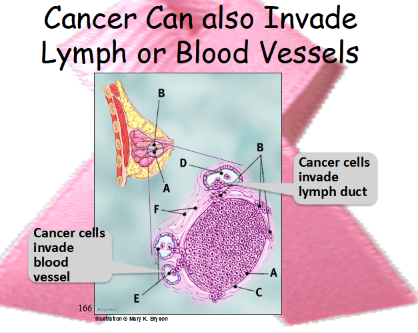
Tumor size
Node
Metastasis
The American Joint Committee on Cancer (AJCC) has designated staging by
Stage 1
Tumor < 2.0 cm in greatest dimension
No nodal involvement (N0)
No metastases (M0)
Stage 2
Tumor > 2.0 < 5 cm
or
Ipsilateral axillary lymph node (N1)
No Metastasis (M0)
Stage 3
Tumor > 5 cm (T3)
or ipsilateral axillary lymph nodes fixed to each other or other structures (N2)
involvement of ipsilateral internal mammary nodes (N3)
Inflammatory carcinoma (T4d)
Stage 4
Any T
Any N
Metastasis (M1)
Breast Self-examination
Opportunity for woman to become familiar with her breasts
Monthly exam of the breasts and underarm area
May discover any changes early
Begin at age 20, continue monthly
ok
WHEN TO DO BSE
Menstruating women- 5 to 7 days after the beginning of their period
Menopausal women - same date each month
Pregnant women – same date each month
Takes about 20 minutes
Perform BSE at least once a month
Examine all breast tissue
Breast Exam
The doctor will check both of your breasts, feeling for any lumps or other abnormalities. Your doctor will likely check your breasts in varying positions, such as with your arms above your head and at your side.
Mammogram
is a X-ray of the breast that takes pictures of the fat, fibrous tissues, ducts, lobes, and blood vessels.
ok
When should a mammogram be performed?
If a lump has been found during self-examination or by a physician
Younger women who have a strong history of breast cancer in their family
All women over forty
Women who have had previous diagnosis of breast cancer.
Breast Ultrasound
Ultrasound uses sound waves to produce images of structures deep within the body. Your doctor may recommend an ultrasound to help determine whether a breast abnormality is likely to be a fluid-filled cyst or a solid mass, which may be either benign or cancerous.——— is helpful to guide radiologic biopsy to get a sample of breast tissue if a solid mass is found.
Breast Biopsy
Needle Biopsy
is necessary to confirm or rule out cancer. _______ can provide a core of tissue or a fluid aspirate, but ______ biopsy should be restricted to fluid-filled cysts and advanced malignant lesions.
Breast Biopsy
Lumpectomy
provides a complete tissue specimen, which can be sectioned to allow more accurate evaluation.
or _______
all part of lump is removed and tested for malignancy
Vital Signs
Ice packs
Supportive bra
Report bleeding
Emotional support
Breast Biopsy: Nursing Interventions
Breast MRI
uses a magnet and radio waves to create pictures of the interior of your breast. Before a ______, you receive an injection of dye. This test may be ordered after a breast biopsy confirms cancer, but before surgery to give your doctor an idea of the extent of the cancer and to see if there's any evidence of cancer in the other breast.
Chemotherapy
Radiation Therapy
Drugs
Surgery
Treatment for Breast Cancer
Chemotherapy
destroying cells that are dividing and multiplying all the time.
used for treatment of breast cancer because there is a possibility of the cancer to spread to other parts of the body.
works better for premenopausal women.
prevent the spread of cancer.
drugs are administered intravenously.
Radiation
at high energy levels, has the ability to destroy what is in its path, including normal and abnormal cells
Fortunately new technologies have found a way to battle cancer with __________.
________ usually destroys rapidly dividing cancerous cells.
Normal cells have the ability to repair themselves.
Drugs
Usually drugs used to battle cancer are taken while receiving some other type of treatment.
Most of the time as well, three or four drugs are used at the same time, so there is an overlapping effectiveness.
There are four drugs that are commonly used to battle breast cancer.
Alkylating Agents
Antimetabolites
Natural Products
Hormones
Types of Drugs used to treat Breast Cancer (4)
Alkylating Agents
Cytoxan
______
These types of drugs usually damage the programs that control the growth in tumor cells.
Antimetabolites
_______ and ______
This type of drug interferes with the making of nucleotides, which are the substances that make up DNA.
Natural Products
_______ (Oncovin and vinblastine (Velban) come from the periwinkle plant.
These drugs interfere with cell structure as well as cell division.
Hormones
_________
affect the growth of hormones and usually enhances the effects of other cytotoxic drugs.
Lumpectomy
Surgery to remove a tumor (lump) and a small amount of normal tissue around it.
Partial Mastectomy
Surgery to remove the part of the breast that has cancer and some normal tissue around it. This procedure is also called a segmental mastectomy.
Total Mastectomy
Surgery to remove the whole breast that has cancer. This procedure is also called a simple mastectomy. Some of the lymph nodes under the arm may be removed for biopsy at the same time as the breast surgery or after. This is done through a separate incision.
Modified radical mastectomy
Surgery to remove the whole breast that has cancer, many of the lymph nodes under the arm, the lining over the chest muscles, and sometimes, part of the chest wall muscles.
Radical Mastectomy
Surgery to remove the breast that has cancer, chest wall muscles under the breast, and all of the lymph nodes under the arm. This procedure is sometimes called a Halsted radical mastectomy.