CPPS 302 Effect of venous return, length-tension relationship on stroke volume
 Call Kai
 Learn
 Practice Test
 Spaced Repetition
 Match
 Flashcards
 Knowt Play
1/31

There's no tags or description
Looks like no tags are added yet.
32 Terms
Compare the ventriuclar volume in a normal vs a dilated heart thats under the same End-Diastolic Pressure (EDP)
The dilated heart is more compliant meaning more blood can fill the ventricle, leading to increased ventricular volume
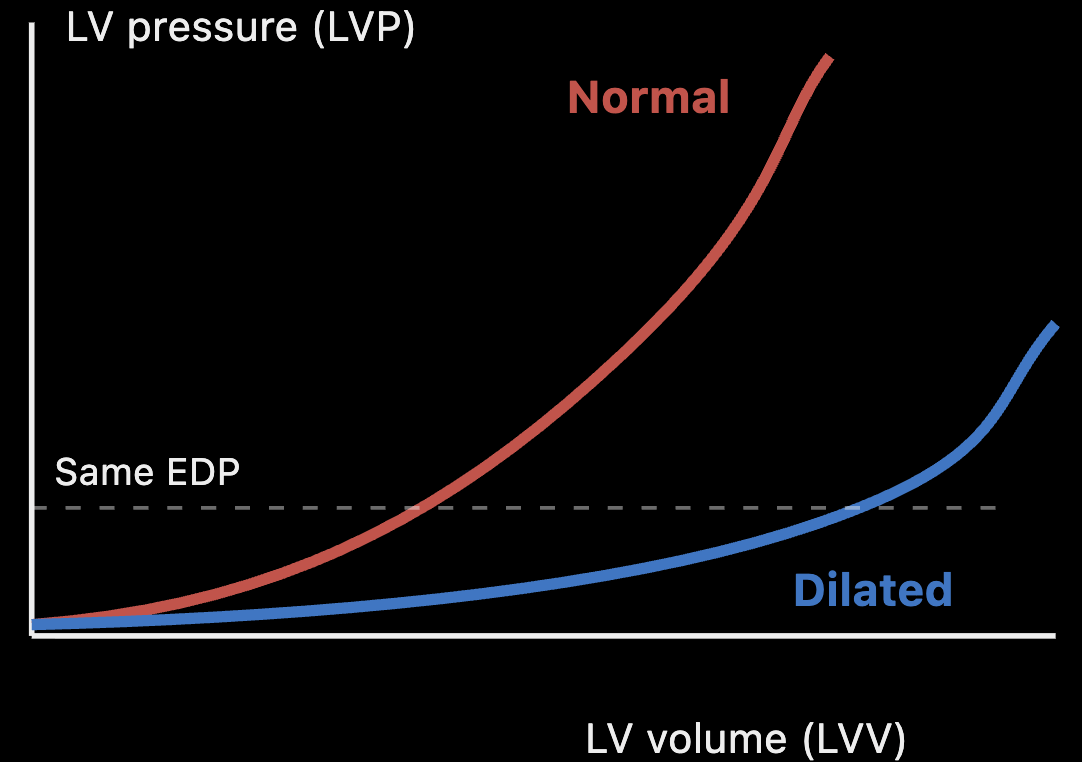
Compare ventricualr pressure between a normal heart vs a dilated heart that has the same ventricular volume
Normal heart = higher ventricular pressure
Dilared heart = lower ventricular pressure
Dilated ventricle can accomodate that same volume more easily
What is ventricular dilation,and how does it affect ventricular compliance
Ventricular dilation is enlargment of the ventricular chamber. According to the lecturem it increases ventricular compliance, allowing the ventricle to strethc and accommodate more blood during diastole.
Linear relationship between ventricular dilation and compliance
How does EDPVR slope compare between a normal and dilated heart?
Normal heart: steeper EDPVR slope (lower compliance)
Dilated heart: Flatter EDPVR slope (higher compliance)
How does ventricular dilation affect venous return and preload (EDV)?
Increased compiance in the dilated ventricle allows easier filling with a smaller increase in EDP, facilitating venous return and potentially increasing EDV (preload)
With the same volume of venous retuns, how does EDP change in a dilated heart compared with a normal heart?
The dilated heart experiences a smaller increase in EDP because of its higher ventricular compliance
How does ventricular hypertrophy lead to increase in EDP
Ventricular hypertrophy → increased wall thickness
Increased wall thickness → decreased compliance → greater resistance to ventricular filling
What is ventricualr hypertophy and how does it affect ventricular compliance?
Ventriucalr hypertrophy is an increase in ventricular wall thickness, which decreases ventricular compliance and makes the ventricle stiffer.
How does EDPVR slope compare between a normal vs hypertrophic heart
Normal heart = relatively flatter EDPVR slope (higher compliance).
Hypertrophic heart = steeper EDPVR slope (lowerc ompliance)
At the same EDV, how does EDP compare between a normal vs hypertrophic heart
The hypertrophic heart has a higher EDP because its decreased compliance causes a greater increase in pressure for the same ventricular volume
At the same EDP, how does EDV compare between a normal and hypertrophic heart
The hypertrophic heart has a lower EDV because its decreased compliance limits ventricular expansion and filling
How does ventricular hypertrophy affect venous return and preload (EDV)?
Ventricular hypertrophy → ↓ Compliance (stiffer ventricle).
↓ Compliance → ↑ EDP for a given EDV.
↑ EDP → Greater resistance to ventricular filling, potentially impeding venous return.
Reduced ventricular filling → ↓ EDV (preload).
How does an increase in venous return affect EDV and EDP
↑ venous return → ↑ ventricular filling → ↑ EDV (preload)
↑ EDV → ↑ EDP for a given heart
increase in EDP depends on ventricular compliance
How does increased EDP affect ventricular contraction and stroke volume
↑ EDP = heart ↑ its force of contraction to overcome the ↑ filling pressure and eject blood
However ↓ compliance = ↓ EDV = ↓ SV and ↓ CO
How does increased venous return affect stroke volume (SV) and cardiac output (CO)
↑ Venous return → ↑ Preload (EDV) → ↑ Stretching of myocardial contractile myocytes → ↑ Force of contraction → ↑ SV → ↑ CO (at a given HR).
What is the main purpose of the Frank-Starling mechanism
To ensure the outputs of BOTH ventricles are matched over time and prevent the shifting or accumulation of blood between pulmonary and systemic circulation
How does an increase in EDV affect ventricular developed force?
Increasing EDV stretches myocardial fibres, allowing the ventricle to develop greater force during contraction, which increases SV
↑ EDV = ↑ developed force
Does increasing EDV always increase ventricular developed force
NO. Increasing EDV increases ventricular developed force ONLY UP TO A LIMIT. Beyond the optimal fibre length, excessive stretching can decrease force development

What do the ascending and descending portions of the Frank-Starling curve represent?
Ascending portion: ↑ EDV = ↑ Myocardial fibre stretching = ↑ ventricular developed force = ↑ SV
Descending poriton: Excessive stretching beyond optimal fibre length causes a decrease in ventricular developed force, reducing SV (Beginning of heart failure)
How does sarcomere length affect tension development in the length tension relationship?
Too short: excessive actin-myosin overlap = ↓ Tension
Optimal length: ideal actin-myosin overlap = maximum tension
Too stretched: insuficcient actin-myosin overlap = ↓ Tension
For a given heart at a given time, how does an increase in LVEDC affect LVEDP
An increase in LVEDV will icnrease LVEDP because greater ventricular filling stretches the ventricular walls, increasing pressure
What does the ventricular function curve demonstrate about the relationship between LVEDP and SV

Under normal physiological conditions, ↑ LVEDP (reflecting increased EDV/preload) → ↑ SV, up to a physiological limit
When venous return alone increases preload (EDV), what happens to SV, ESV, and CO
Assmuning afterload contractility, and hR remain constant:
↑ EDV → ↑ SV
ESV remains unchanged
↑ SV → ↑ CO
How does an increase in preload alone affect the ventricular pressure-volume loop?
The right boundary shifts right due to increased EDV, while the left boundary (ESV) remains unchanges. This widens the loop, indicating increased SV
Does the Frank-Starling mechanism increase myocardial contractility (inotropy) when preload increases? Explain
No. increased preload stretches cardiac myocytes, allowing them to develop greater force and increase SV wihtout changing intrinsic myocardial contractility
The F-S mechanism is an intrinsic property of the heart under a given physiological condition
Why does an increase in SV caused by increased venous return (preload) alone NOT indicate an increase in myocardial contractility?
If contractility increased, the ventricle would eject more blood and leave less blood behind, resulting in a decrease in ESV.
HOWEVER, when venous return alone increases
↑ Venous return → ↑ EDV (preload) → ↑ myocardial stretching → ↑ developed force → ↑ SV
ESV remains unchanged
Myocardial contractility remains unchanged
How does an increase in myocardial contractility affect SV and ESV?
Increased myocardial contractility allows the ventricle to contract more forcefully and eject more blood for a given preload (EDV).
↑ Contractility → ↑ Force of contraction → ↑ SV.
ESV decreases because more blood is ejected, leaving less blood behind after systole.
EDV remains unchanged if preload is held constant.
Reminder: If venous return alone increases, SV increases due to increased preload (Frank-Starling mechanism), while ESV remains unchanged in the lecture's model.
What is the length-tension relationship of the ventricle
The relationship between the initial length of a cardiac myocyte (preload) and the contractile force (active tension) developed by the heart muscle. It is the biophysical basis of Frank-Starling’s Law
How does increasing preload affect active tension and muscle shortening?
↑ Preload (EDV) → ↑ Myocyte stretching → ↑ Active tension development → ↑ Velocity of muscle shortening → ↑ Force of contraction and SV.
How does increasing preload affect active and passive tension in ventricular muscle
Increasing preload stretches the muscle, increasing both active tension developed during contraction and passive tension from stretching
Hlw does increased preload affect the slope and duration of tension development
The slope becomes steeper (tension develops fasteR), but the overall duration of contraction and the time form peak tension back to baseline remain approximatelty unchanged.
How does the length-tension relationship explain increased SV without changing ESV?
↑ EDV → ↑ Myocyte stretching → ↑ Active tension → ↑ SV. In the lecture's simplified model, ESV remains unchanged because intrinsic contractility has not increased.