Cell Bio E1 Ch 8
 Call Kai
 Learn
Learn Practice Test
 Spaced Repetition
 Match
Match Flashcards
 Knowt Play
1/19

There's no tags or description
Looks like no tags are added yet.
Name | Mastery | Learn | Test | Matching | Spaced | Call with Kai | Chat |
|---|
No analytics yet
Send a link to your students to track their progress
20 Terms
Aquaporin → ↑ water permeability →
↑ rate of water transport
hypothesis
If aqp13a encodes an aquaporin, then Xenopus oocytes expressing aqp13a will have an increased rate of water uptake when placed in hypotonic solution compared with oocytes that do not express aqp13a.
Hypotonic solution creates
driving force
Aquaporin = _______ rate of water movement
increases but does not determine the direction of water movement
What is electrophysiology used for?
measure resting membrane potential or measure current at various membrane potentials
Whole-Cell Patch Clamp
You have a:
recording micropipette/electrode recording electrical activity.
↓
approach plasma membrane
↓
form a tight seal
↓
brief strong suction breaks the membrane underneath the pipette
↓
pipette becomes continuous with the cytoplasm
↓
whole-cell configuration
Now you're able to measure electrical properties across the whole cell membrane.

What can whole-cell patch clamp measure?
Whole-cell membrane potential or whole-cell ionic current
What does voltage clamp do?
Change membrane potential and record currentI-V curve
X-intercept = Veq for the ion
equilibrium potential.
Why does current switch directions at Veq?
At one side of Veq, the electrochemical driving force pushes K⁺ one direction and at exactly Veq there is no net electrochemical driving force, so i = 0 and the other side the driving force reverse so current can reverse.
Voltage-INSENSITIVE K⁺ Channel
essentially available/open regardless of Vm, whose current changes with electrochemical driving force.
Voltage-SENSITIVE K⁺ Channel
Where I-V curve is flat → voltage-sensitive channels are closed. x-value where the I-V curve increases linearly → threshold potential for that channel.
Voltage-Sensitive Na⁺ Channel
orange U-shaped-looking curve.
At negative voltages before threshold:
Na⁺ channel is closed
↓
GNa ≈ 0
↓
current ≈ 0.
Then threshold is reached:
voltage-sensitive Na⁺ channels open. Na conductance increases and inward Na+ current plotted so downward below zero than driving force gets smaller and Na current decreases at I = 0 so curve returns to x-axis
Below x-axis
inward cation current
Above x-axis
outward cation current
How would acute hyponatremia affect the I-V curve for Na+?
↓ extracellular Na⁺
then
Na⁺ gradient becomes smaller
then
Na⁺ Veq becomes less positive.
Remember: x-intercept = Veq.
Therefore, the Na⁺ I-V curve's x-intercept shifts LEFT to a less-positive voltage.
Draw the I-V curve for a ligand-gated Na⁺ channel when ligand is always present.
channel is ligand-gated so channel stays available/open, behaves like a voltage-insensitive channel with respect to Vm. linear I-V curve (starting at negative then postive)
How about when absent?
No ligand means the channel is closed so I = 0 at every voltage.
shown as a flat line along I = 0.
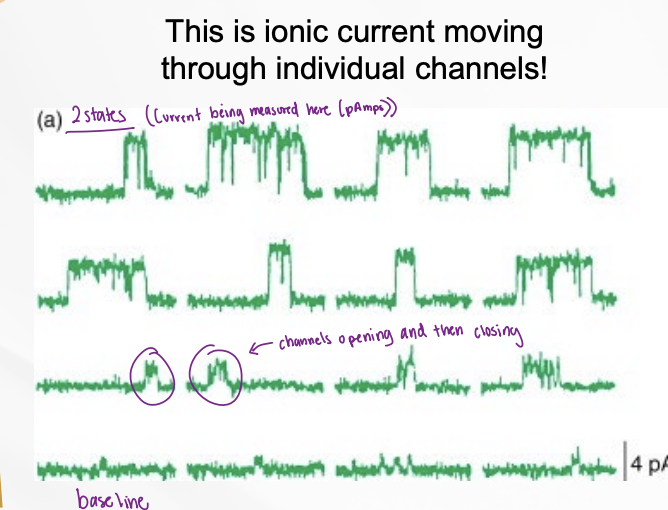
Cell-attached patch clamp
measures SINGLE CHANNEL events, shown as little jumps that represent individual channels switching between closed and open.
Channel Inhibitor
fewer opening events, inhibitor reduces the frequency/probability of channels being open so there would be less peaks