Cardiopulm - Post-Op Management
 Call Kai
 Learn
 Practice Test
 Spaced Repetition
 Match
 Flashcards
 Knowt Play
1/53

There's no tags or description
Looks like no tags are added yet.
54 Terms
Cardiothoracic surgery incisions include
- Median sternotomoy
- Thoracotomy
- Clamshell
- VATS
- Thoracoabdominal
- Abdominal
- Pacemaker
Cardiothoracic surgery results in
- Protective posture (flexed forwards and laterally towards side of incision)
- Decreased inspiratory effort and chest expansion
- Impaired cough
- UE limitations
How is a median sternotomy done
A skin incision is made from the midpoint between the sternal notch and angle of Louis to below the xiphoid process and the sternum is divided using a sternal saw
The most used procedure for cardiac patients is the
Median sternotomy
How is the incision of a median sternotomy closed
- 2 wire sutures around manubrium
- 4 wire sutures around body of sternum
Valve replacement is done when
There are valves that are not functioning properly
What are the types of valve replacement
- Mechanical
- Tissue/bioprosthetic
What does a CABG do
Reroutes blood flow around blocked coronary artery and improves blood supply/oxygen to the myocardium
What are the indications for CABG
- L main coronary artery stenosis >50%
- >70% stenosis in proximal left anterior descending (LAD) and circumflex
- Triple vessel CAD
What are the graft options for CABG
- Internal mammary artery
- Radial artery
- Saphenous vein
Arterial vs venous CABG graft differ in that
Arteries are more open compared to veins and get clogged less often
What are the variations of CABG
- Mid CAB
- Off pump CABG
How is a Mid Cab CABG done
Through smaller incisions between the ribs (thoracotomy)
Recovery for a Mid Cab CABG is
Less painful and more rapid
Mid Cab CABG only works for
Anterior lesions
How is an off pump CABG done
Without a heart lung bypass machine and the heart is held steady with a mechanical device
What complications can arise from a median sternotomy
- Superficial skin infections
- Mediastinitis (inflammation)
- Dehiscence (separation of wound)
- Sternal instability
What are traditional sternal precautions
- 6 to 8 weeks
- No shoulder flex/abd above 90
- No lifting more than 5-10 lbs
- Avoid UE WB
- No BLT
What movements are avoided in move in the tube precautions
Unilateral UE movments
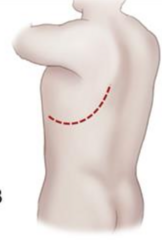
What are the different types of thoracotomy
- VATS
- Posterolateral
- Median sternotomy
- Clamshell
VATS
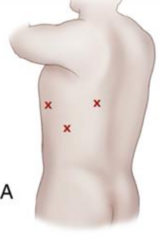
Posterolateral thoracotomy
Median sternotomy thoracotomy

Clamshell thoracotomy
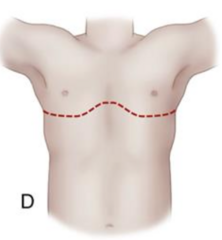
What are the characteristics of a VATS surgery
- Performed under general anesthesia
- Ribs are not spread
- Length of stay is shorter compared to thoracotomy
What are VATS precautions
- Avoid lifting >10 lbs for 1 to 2 weeks
- Encourage shoulder and scapular ROM in all directions
What are abdominal incision precautions
- Avoid straining abdominals
- Log roll bed mobility
- Avoid lifting >10 lbs for 6 to 8 weeks
- Splinted mobility/cough
What is the purpose of splinted cough/mobility
To support the incision area and surrounding tissues, minimizing pain when moving or coughing
What are the indications of a pacemaker
- Malignant arrhythmias
- Sick sinus syndrome causing syncope
- Heart block
- Heart failure
An ICD is
An implanted cardioverter defib
What is the purpose of a defib
To deliver a therapeutic dose of corrective electrical pulses or shocks to treat heart rhythm disturbances
What are pacemaker/ICD precautions
- Check for contraindications for arm lifting (Per MD)
- Avoid heavy lifting/pushing/pulling >10lbs for 2-4 weeks
- Avoid contact sports or activities with potential for trauma
- Avoid EMG interference (cell phones >6 inches away from device)
- Carry ID indicating implant
- Notify airport security screeners
What are the implications for PT with pacemaker patients
- Use BORG scale
- Atrial vs ventricular spike on EMG
- Maintain a margin of 10% BPM for ICD HR threshold for defibrillation
What are general post op complications
- Prone to aspiration and atelectasis
- Phrenic nerve irritation or compression
- PE or DVT
As soon as your post op patient is hemodynamically stable you should
Begin mobility as soon as possible (within 24 hours)
If your patient is required bedrest after surgery, you should implement
Bed exercises
Timing of PT should be coordinated with
Meds and other tests/procedures
Hemodynamic stability is characterized by
- Systolic >90
- No unstable angina
- No serious arrhythmias
- No 2nd or 3rd degree heart block
- Resting HR
What is the general progression for physical activity
1. Bed mobility
2. Transfers
3. Seated exercises
4. Standing exercises
5. Ambulation
Physical activity should be combined with
Breathing control, thoracic mobility, and coughing
Prescribing physical activity and mobility should be based on
- Patient history
- Labs and precautions
- Assessment
In order to progress your patient post op, they must
Be exposed to gravitational stress and exercise stress
What are treatment parameters for mobilization post op
- Start with 10 min 6x/day
- Progress by duration then intensity
- Aim for 1:1 work to rest ratio
Central line (CVP) purpose
Approximates R atrial pressure
What does a Swan Ganz do
- Measures pulmonary artery pressure
- Indirect measure of L atrial pressure
If a patient has a Swan Ganz then PT should not be done if
It is in a wedge position
PA wedge

Respiratory distress is characterized by
- RR >35
- Paradoxical breathing, accessory use, or dyspnea
- Desaturation O2
Artificial airways include
Endotracheal tubes and trachestomy tube
What are the characteristics of endotracheal tube
- Oral or nasal
- Quick and easy
- Emergent
- Short term
- Last resort
What are the characteristics of a tracheostomy tube
- Inserted below vocal cords
- Surgical procedure
- Usually follows prolonged intubation
What is a circuit positive pressure ventilator
Wide-bore tubing that connects patient to ventilator via ETT
What is a trigger positive pressure ventilator
Variable that causes breath to be delivered by ventilator
48