Chapter 6: Interaction of Sound and Media
 Call Kai
 Learn
 Practice Test
 Spaced Repetition
 Match
 Flashcards
 Knowt Play
1/80

There's no tags or description
Looks like no tags are added yet.
81 Terms
What is the basis of creating images for ultrasound
the weak reflections created when a sound beam strikes a boundary between 2 different medias
What happens to sound waves as they travel through the body
they weaken, or attenuate
What is a logarithm
a method of rating numbers.
log of a number represents the number of 10s that are multiplied to create the original number (ex: 100=10×10, therefore the 100 is 2 (2 10s multiplied))
When the logarithmic scale increases by 1, how does the actual number increase
it increases tenfold (a logarithmic increase of 2 means the signal is 100 times larger)
What is log101000
3 (10×10×10)
What is an easy way to determine logarithm of an even power of ten
count the zeros (ex: 1,000,000 = 6)
What is decibels (dB)
the quantity of the strength of sound beams as they are created/travel through the body, and the electrical signal strength and brightness of an image
What does it mean that decibel notation is logarithmic
decibel notation does not measure absolute numbers, rather, they report relative changes (ex: strength has doubled/halved)
What 2 intensities does decibels require
the reference (starting level) and the level at the time of measurement
How are decibels measured/reported
as a ratio. measured level is divided by starting level
What do positive decibels report
signals that are increasing in strength, or getting larger
What intensity change corresponds to +3 dB
the intensity doubles
What intensity change corresponds to +10 dB
the intensity increases tenfold
What do negative decibels report
signals that are decreasing in strength, or getting smaller
What intensity change corresponds to -3 dB
the intensity is reduced to half
What intensity change corresponds to -10 dB
it is reduced to 1/10
What is attenuation
sound waves weakening as they propagate in a medium (decreases in intensity, power, and amplitude)

What is attenuation determined by and their relationship
path length: distance and attenuation are directly related
frequency of sound: frequency and attenuation are directly related
What creates more attenuation
longer distances the beam needs to travel and higher frequency
What creates less attenuation
shorter distances the beam needs to travel and lower frequency
How is attenuation measured/reported
measured in decibels and reported as relative change, not an absolute change (ex: wave propagates and intensity is reduced to 1/10 of original level, we say it attenuated 10dB because attenuate means decrease, which is why the number value isn’t negative)
What 3 processes contribute to attenuation
reflection, scattering, and absorption
What is reflection
A portion of the waves energy that is redirected, or reflected back to the sound source as sound strikes a boundary

What occurs in response to reflection
The portion of the waves energy that that continues to travel forward (transmission) is weakened
What is specular reflection
When a boundary is smooth, sound is reflected in only one direction in an organized manner
What is a limitation to specular reflection
If the wave is slightly off axis, the reflection does not return to the transducer

What is diffuse reflection or back-scatter
When a wave reflects off an irregular surface, it radiates off more than one direction (most interfaces in the body are not smooth/have some irregularities)

Advantage and disadvantage of diffuse reflection/backscatter
A: interfaces at suboptimal angles to the sound beam can still produce reflections that will return to the transducer
D: backscattered signals have lower strength than specular reflections
What is scattering and when does it happen
It is random redirection of sound in many directions. It happens when tissue interface is small (less than or equal to the wavelength of the sound beam)

Scattering and frequency relationship
They are directly related (high frequency sound beams scatter much more that lower frequencies)
What is Rayleigh scattering
Scattering that occurs when the structures dimensions are much smaller than the beams wavelength. It redirects the sound wave equally in all directions

Rayleigh scattering and frequency relationship
Rayleigh scattering ∝ frequency^4
What is absorption
When ultrasonic energy is converted into another energy form, such as heat
Absorption and frequency relationship
absorption is directly related to frequency
What 2 things can occur because of absorption
higher frequency waves attenuate more than lower frequency
Sound traveling in bone undergo extensive absorption

What is attenuation coefficient and it’s units
The number of decibels of attenuation that occur when sound travels one centimeter. Units are dB/cm
What is the advantage of describing sound weakening with attenuation coefficient, and how to calculate total attenuation
The value will always remain the same no matter how far the sound travels (if a tissue is 2dB/cm, you just multiply 2 to the depth).
Total attenuation (dB) = attenuation coefficient (dB/cm) x distance (cm)

Attenuation (and attenuation coefficient) and frequency relationship in soft tissue
They are directly related.
Attenuation coefficient is ½ the frequency (dB/cm = frequency (MHz)/2)
This makes sense because as frequency increases, scattering/absorption increases

What is the attenuation rate of air and why
it is high because of absorption
When does sound attenuate entirely
when there is a frequency above 1MHz
What is the attenuation rate of lungs and why
it is high because of scattering and absorption

What is the attenuation of bone and why
bone absorbs ultrasound energy to a large extent, resulting in substantial attenuation
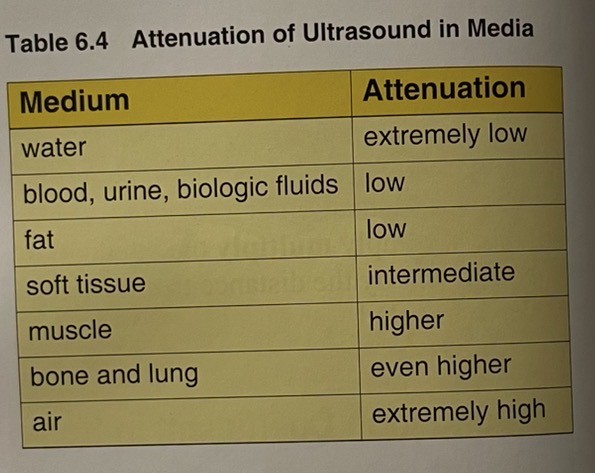
What is attenuation like with biologic fluids (blood, urine, amniotic fluid)
they all attenuate sound but far less than soft tissue

What is attenuation like with frequencies <10MHz in water
there is no noticeable attenuation in this situation

What is attenuation like in muscle and the fibers
sound attenuates twice as much when traveling across fibers as when traveling along the length of the fibers

What is half-value layer thickness (aka penetration depth, depth of penetration, or half-boundary layers) and it’s units
The distance sound travels in a tissue that reduces the intensity of sound to ½ its original value. May also be described as depth of tissue that results in 3dB of attenuation to the intensity.
Units are centimeters or any units of length
Half-value layer thickness typical clinical values
Range from 0.25-1cm
what does half-value layer thickness depend on and what creates thin/thick layers
The medium and frequency of sound.
Thin/low half-value layer: tissue that attenuates sound to a great deal (lung/bone) and higher frequency
Thick/high half-value layer: tissue that attenuates sound just a little (fluids) and lower frequency

What forms the basis for the ultrasonic imaging
The reflection produced as sound moves from one medium to another

What is Transmission and what is it critical for
The process of sound energy traveling through a medium rather than being reflected/absorbed. It is critical to ultrasound ability to image structures deep in the body
What is impedance (acoustic impedance or characteristic impedance) and it’s units
The acoustic resistance to sound traveling in a medium.
Reported in units of rayls or Z
How is impedance calculated (not measured)
multiply the density of a medium by the speed that the sound travels
impedance (rayls) = density (kg/m3) x propagation speed (m/s)

What does reflection on ultrasound depend on
the difference in acoustic impedance of 2 medias at a boundary
What is the typical biological media values for impedance and what is it determined by
it ranges from 1,250,000-1,750,000rayls (1.25-1.75Mrayls).
it is determined by/associated with medium only
What is incidence
the angle at which the wave strikes the boundary
What are the 3 types/categories of incidence
acute: <90 degrees
right: 90 degrees
obtuse: > 90 degrees
oblique angles are anything other than 90 degrees

What is normal incidence (aka perpendicular, orthogonal, or right angle)
when the incidence of a sound beam strikes a boundary at exactly 90 degrees

What is oblique incidence (aka not perpendicular/right angle)
incident sound beam strikes boundary at any angle besides 90 degrees

What is incident intensity
sound wave intensity immediately before it strikes a boundary

What is reflected intensity
intensity of the portion of the incident sound beam that is reflected back after striking a boundary
What is transmitted intensity
intensity of the portion of the incident intensity that continues forward after striking a boundary

What is intensity reflection coefficient (IRC)
the percentage of the intensity that bounces back when a sound beam strikes a boundary

IRC Clinical imaging value
very little (1% or less) sound wave intensity os reflected at a boundary between 2 soft tissues.
a greater % is reflected when sound strikes a boundary such as bone/air with soft tissue.
What is intensity transmission coefficient (ITC)
the percentage of intensity that passes forward after striking a boundary

ITC Clinical imaging value
most (99% or more) of a sound waves intensity is transmitted at a boundary between 2 soft tissues.
a smaller % is transmitted at a boundary between bone and soft tissue
What needs to be present for a reflection to occur at a 90 degree angle
the media on the other side needs to be a different impedance

What affects does impedance have on reflection
no reflection: 2 medias have identical impedance
small reflection: impedances are slightly different
large reflection: impedance are substantially different
Calculating IRC with normal incidence
this equation

When is all sound transmitted
with normal incidence and 2 media with the same impedance
calculating ITC
ITC = (transmitted intensity / incident intensity) x 100
ITC = 1 - IRC

Reflection and transmission with oblique incidence
The physics of this concept is so complex that it cannot be predicted. there could be reflections when impedances of 2 media are identical or reflection may be absent when impedance are different

2 physical principles that always apply to reflection with oblique incidence
conservation of energy
reflection angle = incidence angle
What is conservation of energy in regards to oblique incidence
100% = reflection coefficient + transmission coefficient
incident intensity = reflected intensity + transmitted energy
how is reflection angle and incident angle related with oblique incidence
direction of reflected echo is equal and opposite to direction of incident beam

What is refraction and what is it associated with
A change in direction of wave propagation when traveling from one medium to another.
it is associated with transmission

What 2 conditions need to be satisfied for refraction to occur
oblique incidence and different propagation speeds of the 2 media.
if these conditions are met, sound will never travel in a straight line, it will bend

Clinical imaging conditions of refraction
sound will bend at most a few degrees at soft tissue/fat interface, muscle/blood interface, or soft tissue/fluid interface because speed of sound in the medias are similar.
bending is exaggerated at bone/soft tissue interface because speed of sound in bone is about 3x more that in soft tissue
What is Snells Law
An equation that quantifies the physics of refraction.
medium 1 is the medium that sound is currently traveling and medium 2 is the medium that sound is entering

Under what conditions will transmission angle equal incident angle
when speed of both medias are equal.
no refraction will occur and the beam travels straight ahead

Under what conditions will transmission angle be greater than incident angle
When speed of medium 2 is greater than speed of medium 1

Under what conditions will transmission angle be less than than incident angle
When speed of medium 2 is less than speed of medium 1
