Unit 1 Kahoot
 Call Kai
 Learn
 Practice Test
 Spaced Repetition
 Match
 Flashcards
 Knowt Play
1/24

There's no tags or description
Looks like no tags are added yet.
25 Terms
When overhauling electrical equipment, all necessary information should be obtained from
A. the aircraft maintenance manual.
B. maintenance instructions published by the equipment manufacturer.
C. illustrated parts manual for the aircraft.
B. maintenance instructions published by the equipment manufacturer.
installations made in accordance with Supplemental Type Certificate data require approval for return to service
A. by the holder of an inspection authorization.
B. by a field approval from the FAA.
C. by an airframe and powerplant mechanic.
A. by the holder of an inspection authorization.
Electric wire terminals for most aircraft applications must be what type?
A. Ring.
B. Hook.
C. Slotted.
A. Ring.
For general electrical use in aircraft, the acceptable method of attaching a terminal to a wire is by
A. crimping and soldering.
B. soldering.
C. crimping.
C. crimping.
Grounding is electrically connecting a conductive object to the primary structure. One purpose of grounding is to
A. prevent current return paths.
B. allow static charge accumulation.
C. prevent development of radio frequency potentials.
C. prevent development of radio frequency potentials.
What is normally used to bond noncontinuous stainless steel aircraft components?
A. Stainless steel jumpers.
B. Copper jumpers.
C. Aluminum jumpers.
B. Copper jumpers.
Bonding connections should be tested for
A. resistance value.
B. reactance.
C. amperage value.
A. resistance value.
The most common method of attaching a pin or socket to an individual wire in an MS electrical connector is by
A. crimping.
B. soldering.
C. crimping and soldering.
A. crimping.
The pin section of an AN/MS connector is normally installed on
A. the power supply side of a circuit.
B. the ground side of a circuit.
C. either side of a circuit (makes no difference)
B. the ground side of a circuit.
If it is necessary to use an electrical connector where it may be exposed to moisture, the mechanic should
A. coat the connector with grease.
B. spray the connector with varnish or zinc chromate.
C. use a special moisture proof type.
C. use a special moisture proof type.
The primary considerations when selecting electric cable size are
A. the voltage and amperage of the load it must carry.
B. the system voltage and cable length.
C. current carrying capacity and allowable voltage drop.
C. current carrying capacity and allowable voltage drop.
Which of the following copper electrical cable sizes should be selected to replace a No. 6 aluminum electrical cable?
A. No. 6.
B. No. 8.
C. No. 4.
A. No. 6.
In the AWG system of numbers used to designate electrical wire sizes, the number assigned to a size is related to its
A. current carrying capacity.
B. combined resistance and current carrying capacity.
C. cross sectional area.
C. cross sectional area
When considering an alteration, the criteria upon which the selection of electric cable size should be based are
A. applied voltage and allowable voltage drop.
B. current carrying capacity and applied voltage.
C. current carrying capacity and allowable voltage drop.
C. current carrying capacity and allowable voltage drop.
Aluminum wire must be stripped very carefully because
A. stripping nicks can cause short circuits.
B. individual strands will break easily after being nicked.
C. high resistance will develop in stripping nicks.
B. individual strands will break easily after being nicked.
The maximum number of splices permitted between any two connectors os
A. one.
B. three.
C. two.
A. one.
What is the minimum bend radius for an electrical wire bundle?
A. Ten times the outside diameter of the bundle.
B. Five times the outside diameter of the bundle.
C. Fifteen times the outside diameter of the bundle.
A. Ten times the outside diameter of the bundle.
The circuit breaker in the instrument lighting system protects the
A. wiring from too much voltage.
B. lights from too much current.
C. wiring from too much current.
C. wiring from too much current.
In a P-N-P transistor application, the solid state device is turned on when the
A. base is negative with respect to the emitter.
B. emitter is negative with respect to the base.
C. base is positive with respect to the emitter.
A. base is negative with respect to the emitter.
In an N-P-N transistor application, the solid state device is turned on when the
A. emitter is positive with respect to the base.
B. base is positive with respect to the emitter.
C. base is negative with respect to the emitter.
B. base is positive with respect to the emitter.

Which illustration is correct concerning bias application and current flow? (Needs Picture)
A. 3
B. 1
C. 2
B. 1.
Forward biasing of a solid state device will cause the device to
A. turn off.
B. conduct via zener breakdown.
C. conduct.
C. conduct.

Which statement concerning the depicted logic gate is true?
A. All inputs must be 1 to produce a 1 output.
B. Any input being 1 will produce a 1 output.
C. Any input being 1 will produce a 0 output.
B. Any input being 1 will produce a 1 output.
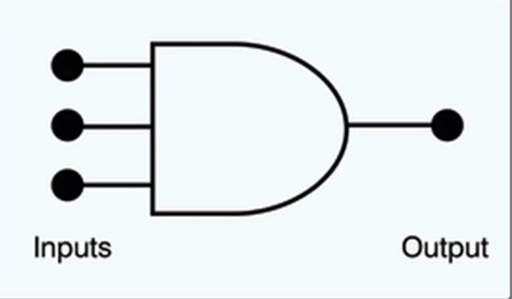
n a functional and operating circuit, the depicted logic gate’s output will be 0
A. when one or more inputs are 0.
B. when all inputs are 1.
C. only when all inputs are 0.
A. when one or more inputs are 0.
When referring to an electrical circuit diagram, what point is considered to be at zero voltage?
A. The ground reference.
B. The switch.
C. The circuit breaker.
A. The ground reference.