Neoproterozoic Oxygenation Event and Ediacaran Biota
 Call Kai
 Learn
Learn Practice Test
 Spaced Repetition
 Match
Match Flashcards
 Knowt Play
1/8

There's no tags or description
Looks like no tags are added yet.
Name | Mastery | Learn | Test | Matching | Spaced | Call with Kai | Chat |
|---|
No analytics yet
Send a link to your students to track their progress
9 Terms
When did the Neoproterozoic oxygenation event take place
~800–540 Ma
What happens to the Neoproterozoic carbon isotope excursions
This event coincides with Snowball Earth and rise of Ediacaran biota, with multiple large δ¹³C excursions in Neoproterozoic. Shuram and Bitter Springs events stand out. Potential links to oxygenation and biological innovation. Complexity in linking carbon cycles to oxygenation
Positive excursions: enhanced organic burial
Negative excursions: ocean anoxia or methane release
What are metazones
Early representatives of modern phyla or extinct phyla in the fossil record
When is the first appearance of metazoans
~600 Ma
When did the Ediacaran Biota flourish
~635–541 Ma
What are Ediacaran Biota
First unambiguous evidence of complex multicellular organisms – worldwide distribution. They have fractal-like body plans and lack of clear internal organs or feeding structures with predominantly soft-bodies. Suggested to represent an evolutionary ‘dead end’ unrelated to modern animals
What is the fossil plan on Ediacaran Biota like
Debatable evidence of some modern phyla. Primarily sessile, no preserved hard parts (e.g. no shells). Fossils are mostly impressions on shallow depth sandstone beds and largely vanish from the fossil record by the early Cambrian
What are Vendobiota
Ediacaran organisms as a distinct kingdom of life
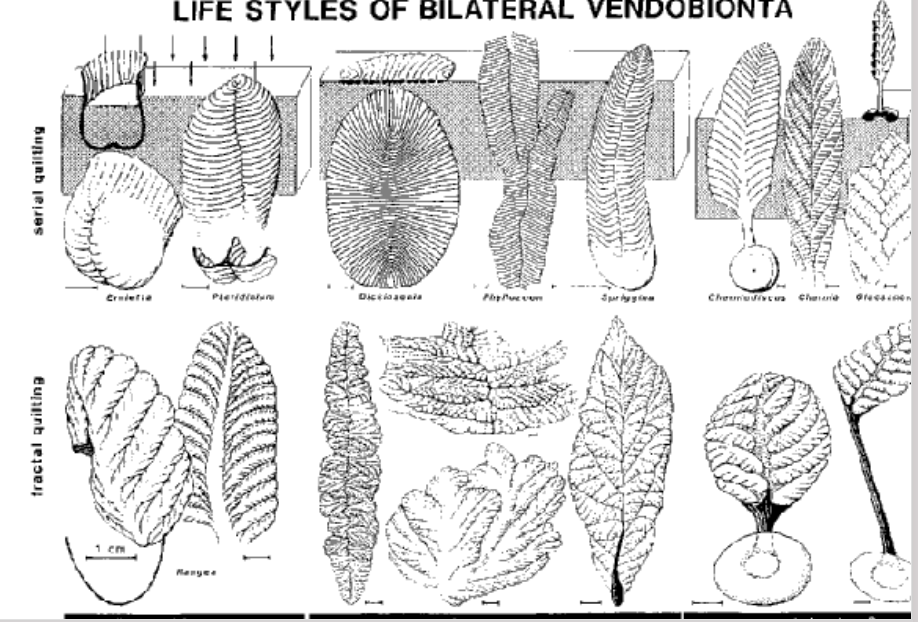
Why was the Vendobiota concept rejected
-Improved fossil evidence shows some Ediacaran taxa share features with early animals.
-Taphonomic studies reveal previously overlooked anatomical details.
-Phylogenetic advances link some taxa (e.g., Dickinsonia) to early metazoans.
-The term ‘Vendobiota’ is now seen as overly restrictive and inconsistent with new insights into Ediacaran diversity.