Macromolecules Exam 2
 Call Kai
 Learn
 Practice Test
 Spaced Repetition
 Match
 Flashcards
 Knowt Play
1/160

There's no tags or description
Looks like no tags are added yet.
161 Terms
What are the three classes of membrane lipids?
Phospholipids, sphingolipids, and linear isoprenoids
What are 2 examples of phospholipids?
Glycerophospholipid and lysophospholipid

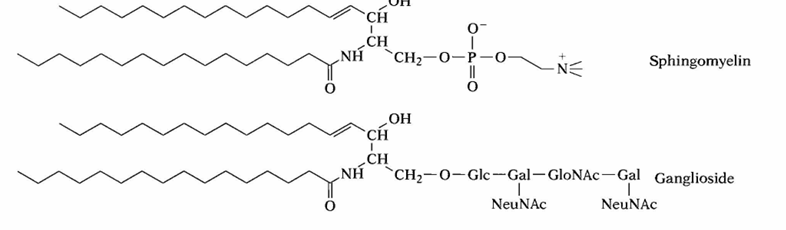
What are two examples of sphingolipids?
Sphingomyelin and ganglioside
What are three types of linear isoprenoids?
Sterol, farnesyl, and geranylgeranyl

What type of molecules are lipids?
Amphiphilic
What makes up a lipid?
A hydrophobic domain and a hydrophilic headgroup
What effect/rule causes lipids to form structures?
Hydrophobic effect
What are types of phospholipid structures in water?
Micelles and bilayers
What type of shape does a micellar lipid have?
Conical
What type of shape does a bilayer lipid have?
Cylindrical
What are detergents?
Surfactants/surface active molecules that reduce surface tension
Are detergents amphipathic?
Yes; they have both polar and apolar components
What lipid structure do detergents form?
Micelles
Properties of ionic detergents
carry a net charge
Example of anionic and cationic detergents
Anionic (negative): SDS (straight alkyl chain)—> denatures proteins and deoxycholate (steroid ring)
Cationic (positive): CTAB (straight alkyl chain)
What classifications are detergents?
Ionic, non-ionic, zwitterionic, and bile salts
Properties of non-ionic detergents
uncharged hydrophilic head groups (often more mild)
Examples of non-ionic detergents
Triton X-100 (stabilizes proteins), B-OG, C8E5

Properties of zwitterionic detergents
Carry both charges (even out to zero)
Examples of zwitterionic detergents
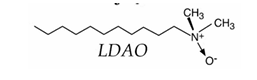
Amine oxides: LDAO (dimethyl amine head group, dodecyl C12 tail)
Properties of bile salts
Tetracyclic steroid structure
Examples of bile salts
Sodium cholate, deoxycholate
What is CMC (critical micelle concentration)?
Lowest concentration of detergent above which monomers form micelles or max attainable chemical potential (concentration of the monomer)
IOW: How low or high the concentration of a detergent can be to form micelles
What is the aggregation number?
Number of detergent monomers in a single micelle

What factors cause the CMC to decrease?
Alkyl chain length, counterions (ionic detergents) (increase hydrophobic interactions)
What factors cause the CMC to increase?
Additives that break water structure (e.g. urea), introduction of double bonds (decrease hydrophobic interactions)
What molecules tend to be found on/outside of the interfaces of lipid bilayers?
Bulk water, carbonyls, glycerol, phosphate, choline
What molecules tend to be found in the hydrocarbon core?
Methylenes, double-bonds, methyls
What is the Born energy/Born solvation energy?
Electrostatic energy cost of moving a charged particle from high to a low dielectric environment (e.g. from water to the core); for charged molecules/ions ONLY!
Think ion pumps/channels; it takes more energy to move a Ca2+ than an Na+. Don’t get confused with overall dG!
Which amino acids are favorable (dG<0) for partitioning into the membrane?
Isoleucine, leucine, phenylalanine, valine, cysteine, methionine
Which amino acids are unfavorable (dG>0) for partitioning into the membrane?
alanine, tryptophan, threonine, tyrosine, glycine, serine, asparagine, histidine, proline, methionine, arginine, glutamate, lysine, aspartate
How to study membrane proteins in vitro?
Detergents, proteoliposimes (to reconstitute the membrane proteins into lipid vesicles), nanodiscs (mimics high density lipoprotein; provides a native-like bilayer environment in which to study membrane proteins)
Membrane protein structure formation is dominated by ___.
Hydrogen-bonding interactions
What part of the bilayer are nonpolar amino acids in membrane-spanning alpha helices found?
With side chains pointing to the hydrophobic region of the bilayer
What happens to acidic/basic residues in nonpolar membrane domain of integral membrane proteins?
Remain uncharged, form ion pairs, or play special roles
What happens to residues that form hydrogen bonds in the nonpolar membrane domain of integral membrane proteins?
Link their side chains to backbone carbonyl groups (can provide helix end caps)
What two residues are frequently found in transmembrane helices?
Glycine (allows for close packing) and proline (can act as molecular hinges, found in alpha helices near the center of the bilayer)
What do the flat rigid rings and aromaticity of Trp and Tyr allow the amino acids to do?
Play a special role at the interface between the hydrophilic and nonpolar domains of helical and barrel integral membrane proteins

What type of integral membrane protein architecture is this?
Alpha-helical bundles
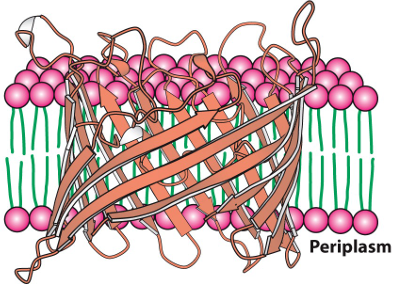
What type of integral membrane protein architecture is this?
Beta barrels
How many amino acids (at minimum) are required for a helix to span the bilayer?
At least 20
What type of amino acids make up the majority of helical bundles?
Hydrophobic (not all have to be though!)
What are the only secondary structures that can be reliably predicted from sequences?
Transmembrane helices
Where are beta barrel membrane proteins found in gram-negative bacteria?
Outer membrane
How many residues do beta strands need to cross the non-polar domain of the membrane?
7 (typically contain 9-11)
How many beta strands typically form a beta barrel?
8 to 24
What conformation do the beta strands see in the beta barrel?
Anti-parallel
What purpose do porins serve?
Channels that permit passive diffusion of important solutes (both general and specific)
What are the predominant tertiary structures utilized by integral membrane proteins?
alpha-helical bundles and beta barrels
What are amyloids?
Abnormal aggregates of proteins deposited in organs
How would you describe an amyloid?
Fibrous in nature and insoluble
What are amyloids dominated by?
Beta sheet structure
What diseases are associated with amyloidosis?
Alzheimer, Parkinson, type II diabetes, dialysis-related amyloidosis
What is the process/dogma of amyloidosis?
Protein aggregation—> amyloid fibrils—>deposition into plaques

What point in the amyloidosis process is a potential site of drug intervention?
Any or all steps
What must occur for protein aggregation to initiate?
Soluble proteins/peptides must be unfolded, misfolded, and/or intrinsically disordered
What are symptoms of Alzheimer’s disease?
memory loss, impaired ability to learn/reason and carry out daily activities, anxiety, suspicion, hallucinations
What’s the difference between amyloid plaques and neurofibrillary tangles?
Amyloid plaques are extracellular and consist of amyloid-beta peptide, neurofibrillary tangles are intracellular and consist of hyper-phosphorylated tau proteins
How do amyloids interact with cell surface receptors?
Oligomers interact with presynaptic and postsynaptic membranes
What protein is important for endocytic import of fibrillar species?
Lymphocyte activation gene 3 protein (LAG 3)
What are the four FDA-approved drugs available to treat symptoms due to Alzheimer’s disease?
Galantamine, rivastigmine, donepezil, and aduhelm
What are lewy bodies?
Insoluble aggregates of alpha synuclein that are seen in Parkinson’s
What techniques are commonly used to study amyloids?
Cryo-EM, X-ray diffraction, FTIR, ssNMR, Congo Red dye, light-scattering spectroscopy
What have X-ray diffraction patterns indicated about amyloid fibrils?
They have a cross-beta structure
What can protein mass spectrometry be used for?
Discovery (unknown protein identification and modification site protein mapping) and analysis (biomarker detection, enzymatic assays, and structural characterization)
What is the X-axis value in a mass spectrum?
m/z (mass to charge ratio), sometimes given in units of thomson (Th)
What unit is the mass in mass spectroscopy?
Daltons (Da) or atomic mass units (u)
Who built the first mass spectrometer?
Joseph Thomson
What is the Y-axis value in a mass spectrum?
Intensity (normally in relative abundance)
What is resolution in mass spectroscopy?
The ability to distinguish peaks of different m/z
Do you want higher or lower resolution in mass spec?
Higher resolution
How to calculate the resolution in mass spec?
m/dm (m= m/z value of the peak, dm= full width at half maximum)
What is mass accuracy?
The difference between measured and theoretical masses
What does a higher resolution mean in terms of mass accuracy?
Higher resolution=higher mass accuracy
What does charge state mean?
The different charges ions can exist in, which affect where they are detected in a spectrum
What is an isotope cluster?
Peptides that exist as clusters of peaks representing differences in the distribution of isotopes (e.g. 13C). The spacing between different isotope peaks is used to determine the charge state
What are the basic parts of a mass spectrometer?
Ionization source, mass analyzer, detector, and vacuum system
What is an ionization source in mass spec?
The mechanism for introducing sample into the instrument; must generate gas phase CHARGED molecules (MALDI and ESI)
What is a mass analyzer?
Separates gas phase ions based on m/z ratio. In tandem mass spec, some act as mass filters
What is a detector in mass spec?
Senses the arrival of ions and transmit signals to a computer for interpretation and presentation
Why use MALDI and electrospray?
High sensitivity and soft methods (thermal vaporization not required)
What two types of ionization are used in Mass spec?
MALDI and electrospray
What does MALDI stand for?
Matrix-assisted laser desorption ionization
How does MALDI work?
Proton transfer from matrix molecules that have been excited by absorption of laser energy
How does ESI work?
Applies voltage to a highly purified aqueous sample with significant organic acidic content
Why use formic or acetic acid to ESI samples?
To lower pH and encourage protonation of basic amino acids
What do mass analyzers do?
Separate ions based on their m/z values
How does time-of-flight (TOF) work?
Pushing ions into flight tube at the same time with same energy; velocity becomes dependent on m/z—> smaller m/z= faster ion travel
What is the most common analyzer used with MALDI instrumetns?
TOF
What are quadrupoles?
Two sets of parallel metal rods to which electrical potentials containing DC and RF components are applied
Varying the voltages= ion trajectory alteration
Can use to act as a mass filter

What is orbitrap?
Use static electric potential and a specially shaped central electrode
Why analyze peptides?
They’re smaller (and easier) to ionize, the spectra are easier to interpret, you get greater sequence coverage, and the ability to reduce a complex protein into simpler fractions for analysis
What are the commonly used site-specific endoproteinases used to generate peptides for MS?
Trypsin, Lys-C, Glu-C (V8), and Asp-N
What does Trypsin target?
Arg and Lys (except for Arg/Lys-pro)
Why is trypsin so commonly used?
It’s cheap and specific and works equally well for solution and in-gel digest formats
What are the disadvantages of trypsin?
May be impossible to see some sequences within a protein using trypsin alone (MS observation is dependent on amino acid sequence)
What are 2 methods for identifying unknown proteins by mass spec?
Peptide mass fingerprinting and tandem mass spectrometry
What is tandem MS?
A specific ion is selected and isolated in the instrument then fragmented—> fragment ion spectrum is acquired
What’s the generic run through of tandem in space MS?
Mass filter (analyzer 1)→ fragmentation → mass analysis (analyzer 2)
Where do peptides preferentially fragment?
Along the peptide backbone (mostly random positions)