exam 2 | part 3 | gene mutations
 Call Kai
 Learn
 Practice Test
 Spaced Repetition
 Match
 Flashcards
 Knowt Play
1/80

There's no tags or description
Looks like no tags are added yet.
81 Terms
gene mutations
affect single genes
usually small changes in DNA sequence
chromosome mutations
affect structures of entire chromosomes
require movement of large chromosomal regions within or btwn chromosomes
genome mutations
changes in # of chromosomes
euploid and aneuploid
euploid
a cell or cell population with a normal complement of chromosomes
aneuploid
increased or decreased total # of chromosomes
protective properties of genetic code that help prevent adverse events due to mutations
redundancy and wobble
redundancy
more than one codon can code for the same amino acid
wobble
base pairing is more flexible in third base of codon
gene mutations: point mutations
affect a single nucleotide base pair
two types: substitution and frameshift
substitution mutation
nucleotide replaced by a diff one
frameshift mutations
insertions or deletions
types of point mutations
silent
missense
nonsense
frameshift insertion/deletion
missense mutations
change in nucleotide results in encoding for a diff aa
conservative and nonconservative
conservative mutation
change the aa for one w/ similar biochemical properties
nonconservative mutation
change the aa for one w/ a completely diff biochemical profile
nonsense mutation
when nucleotide change codes for stop codon, halting translation
frameshift insertion or deletion
result in missense and nonsense mutations
mutations and disease
some diseases associated w/ many possible mutations in a single gene
CFTR mutation associated w/ >600 diseases
what does the detection of mutations require?
screening thousands of bps to detect a single altered nucleotide
detection of gen emutations
biochemical methods (looking at phenotype of patient)
nucleic acid analyses
biochemical methods
enzyme immunoassay
immunohistochemistry
HPLC
gas chromatography
mass spec
nucleic acid analyses
hybridization based
sequencing (polymerization)-based
enzymatic and chemical cleavage
nextgen sequencing
biochemical methods (in-depth)
used to directly analyze the change in protein structure or function
does not directly detect gene mutations
test the proteins themselves rather than their nucleotide sequence
what are we testing in immunoassays?
hormones,drugs, antibodies, cancer biomarkers, other metabolites
what are we testing in immunohistochemistry?
detects protein abnormalities in situ
what are we testing in HPLC and mass spec?
can analyze multiple proteins at once - proteomics
enzyme immunoassays (EIA) - standard protocol (biochemical method)
use specific antibodies to detect presence or absence of target molecules
multiple formats: plate, wells, strips, capillaries
steps for enzyme immunoassays (EIA)
sample added to wells
washing
addition of secondary antibodies (detection Abs)
washing
development - substrate adition
label is ligand
variations of enzyme immunoassays
direct ELISA
indirect ELISA
sandwich ELISA
competitive ELISA

immunohistochemistry (IHC)
performed on thin slices of fixed tissue
fixed in formalin to preserve morphology
frozen tissues can be used
section on microtome
then stain
process of immunohistochemistry
add primary antibody
add secondary antibody conjugated to HRP
add chromogen, HRP catalyzes rxn to produce colored precipitate
colored precipitate accumulates around location of antigen, visualize using brightfield microscopy

process of immunofluorescence
add primary antibody
add secondary antibody conjugated to fluorophore
visualize using fluorescence microscopy
ovarian carcinoma IHC example
tend to look for:
PD-L1
B7-H4
cytokeratin
PD-L1
rabbit mAb, targets surface receptors that regulate T cell activation
B7-H4
rabbit mAb, targets cell surface ligand
cytokeratin
pan keratin mouse mAb; binds to keratin on cells
interfering substances in IHC
for fluorescence signaling, cause noise
endogenous peroxidases, nonspecific antibodies cause interference
ways to mitigate interfering substances in IHC
hydrogen peroxide
blocking solution: serum proteins (albumin or casein) and detergent (Tween 20) will minimize nonspecific binding
washing steps
use correct Ab dilutions
use counterstains
run parallel controls
HPLC polarity
the farther the colors are, the more attracted they are to mobile phase
HPLC components - mobile phase
mixture of analyte (sample) in solvent
organic solvents injected w/ syringe
pumps force sample through column
HPLC components - stationary phase
column w/ chromatographic packing material
size-exclusion columns
separation based on hydrophilicity
ion exchange
HPLC reading
as mobile phase passes through column, detector produces readout of signal peaks as sample components elute
HPLC detectors
light scattering, fluorescence, refractive index, UV absorption, mass spectra
ultra HPLC (uHPLC)
uses smaller columns of particles 1.7 um at pressures >1,000 bar
makes faster, more sensitive, and use smaller sample volumes
gas chromatography - mobile phase
inert gas, He or N
gas chromatography - stationary phase
high-bp liquid that is absorbed to an inert solid
process of gas chromatography
sample introduced to column and vaporized into gas
strength of interxn or dissolution of sample components into liquid phase will result in varying retention times
effluent from the gas chromatography column is read by what?
a detector, such as a flame ionization detector
what is gas chromatography used for?
detection of drugs
mass spectrometry
converts molecules to ions that move in magnetic field based on their charge and mass
ion source sends high-energy electrons that hit target sample molecules separating them
collection of particles in a mass spec is accelerated and focused into beam through what?
magnetic field
deflects ions according to their mass and charge
x-axis in mass spec
mass/charge value
y-axis in mass spec
abundance of the ion
electrospray ionization (ESI)
test sample converted into spray of charged droplets
matrix-assisted laser desorption/ionization (MALDI)
produces ions by firing laser pulse into sample coated w/ matrix
ions fly to detector at speed based on its mass and charge (MALDI-TOF)
nucleic acid analyses
used to further characterize mutated region
hybridization-based methods
single-strand conformation polymorphism (SSCP)
allele-specific oligomer hybridization
melt-curve analysis
heteroduplex analysis
array technology
how to detect noninherited mutations?
use noninvasive specimen material
single-strand conformation polymorphism (SSCP)
based on preference of DNA to exist in ds state
in absence of complementary strand, DNA forms intra-strand duplexes to attain ds condition
folded strand forming a 3D structure
conformer
shape depends on nucleotides
steps of single-strand conformation polymorphism (SSCP)
amplify first
dilute concentration of PCR products to sample
denature samples: NaOH, formamide, heat
resolve in PAGE
bands analyzed
reading a single-strand conformation polymorphism (SSCP)
mutant bands match → suspectible

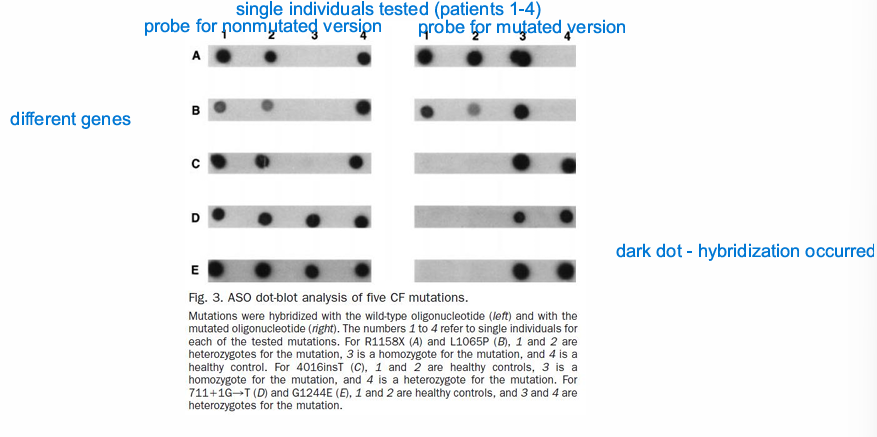
allele-specific oligomer hybridization (ASO)
utilizes differences in melting temp of short sequences w/ mismatches vs those with no mismatches
synthetic ss-probes w/ normal or mutant target DNA sequence are used
at specific annealing temps of allele-specific oligomer hybridization (ASO)
probe will not bind to near complementary target sequence w/ one or two mismatched bases
probe with perfect complementary sequence will bind
what is allele-specific oligomer hybridization (ASO) mostly used for?
identify frequently occurring mutations of well-characterized genes (e.g BRCA1)
use dot-blot analysis
dot-blot analysis for allele-specific oligomer hybridization (ASO)
dark dot means hybridization occurred
melt-curve analysis (MCA) graph
incubate DNA w/ fluorescent probe
at 50%, fluorescence stops
melt-curve analysis (MCA)
post amplification step of RT-PCR
as temp increases, dsDNA denatures into ss state
sequence differences result in diff melting characteristics and melting temps (Tm)
melt-curve analysis (MCA) findings
specimens w/ identical sequences should yield overlying peaks at expected Tm
specimens containing diff sequences will yield 2+ peaks at diff temps
high resolution MCA (HR-MCA) vs. MCA
regular MCA uses nonspecific dyes that are not sequence specific
does not distinguish btwn target amplicon and extraneous products
high resolution MCA (HR-MCA)
uses fluorescent resonance energy transfer (FRET) probes that hybridize next to one another across the sequence position
probes fluoresce only when bound to target sequence
what indicates a mutation in high resolution MCA (HR-MCA)?
Tm lower than that of the probe and its perfect complement indicates presence of mutation
heteroduplexes
nonidentical ds DNA duplexes
homoduplexes
identical ds DNA duplexes
heteroduplex analysis
mixing sample amplicons w/ a reference amplicon, denaturing, and slowly renaturing
structures resolved by gel electrophoresis
if sample contains mutant sequences w/ a fraction of the renatured products, sample will be what?
heteroduplexes
heteroduplexes migrate more slowly
if sample identical to reference amplicon, what will form?
homoduplexes
clinical application for single-strand conformation polymorphism (SSCP)
identify TP53 gene
point mutation
colorectal, breast, lung cancers
clinical application for allele specific oligomer (ASO) hybridization
identify CTFR gene
3-base pair deletion
when homozygous, produces cystic fibrosis symptoms
clinical application for melting curve analysis (MCA)
identify F5 gene
point mutation
factor V Leiden disease
clinical application for heteroduplex analysis
identify BRCA1 gene
deletion
increased breast cancer risk