PK Exam 2 high level points
 Call Kai
 Learn
 Practice Test
 Spaced Repetition
 Match
 Flashcards
 Knowt Play
1/63

There's no tags or description
Looks like no tags are added yet.
64 Terms
Henderson hasselback equation for acids and bases
[A-]/[HA]=1q0^(pH-pKa)
For acid: % unionized = 100 / (1 + 10^(pH − pKa))

When are bases / acids unionized?
Bases: at high pH (When pH>pKa)
Acids: at low pH (when pH<pKa)
SLC vs ABC transporters
SLC (uptake): PEPT1
ABC (efflux): P-gp, BCRP, MRP2
P-gp inhibitors AND inducers AND substrates
pgp pumps pump away from protected area (to bile in liver, to urine in kidney, to lumen in GI)
Inhibitors: Amiodarone, verapamil, clarithromycin, cyclosporine, Ritonavir (CCRAV)
Inducers: Rifampin, St John's wort, carbamazepine (SCR)
Substrates: Digoxin, dabigatran, loperamide, many anticancer drugs
Effect of Food, PPIs, and H2 blockers on gastric pH
RAISE
matters most for weak bases which need acid to dissolve
Why enteric coatings?
Only dissolve at pH above 5.5-6
Phase I and Phase II
Phase 1: Functionalization- Oxidation, reduction, hydrolysis. Adds or exposes a functional group - CYP450
Phase II: Conjugation- Glucuronidation (UGT), methylation (TPMT), acetylation (NAT2), sulfation (SULT), glutathione (GST). Increases size and polarity.
Grapefruit juice mech
furanocoumarins in grapefruit irreversibly inactivate intestinal CYP3A4
Repeated grapefruit dosing increases effect
Spacing doses does NOT prevent (24 hr effect)
Classic substrates: Felodipine, Simvastatin
Kidney filtration parts
Glomerulus: unbound drug is filtered into the tubule
Proximal tubule: OAT, OCT, P-gp and MRP2 actively secrete drug from the peritubular capillaries
Distal tubule: the unionized form diffuses back into blood; pH-sensitive, so ion trapping is possible
Most polymorphic cyps
CYP2D6, 2C19 and 2C9:
prodrugs
codeine, clopidogrel, tamoxifen, azathioprine
OAT
Organic anion transporters - 12 transmembrane domains with large intracellular loop
OA1 and OAT3 on the basolateral side swap an organic anion for a dicarboxylate
Powered indirectly by the Na⁺ gradient that Na⁺/K⁺-ATPase builds (tertiary active process)
Out to urine: apical efflux by MRP2, MRP4 and BCRP
Substrates: penicillins, methotrexate, loop diuretics, tenofovir, cidofovir
OAT / URAT1 inhibition
(Probenecid, NSAIDS)
→ ^ methotrexate and penicillin levels
Via OAT1/3 and URAT1
Probenecid itself treats gout via URAT1
Organic Anions vs Cations
Anions: OAT1/3 in, MRP2/4 out
Cations: OCT2 in, MATE1/2-K out. Metformin is a key substrate.
Pearl: trimethoprim, cimetidine and dolutegravir block creatinine secretion, so serum creatinine rises without a true fall in GFR (via OCT2 / MATE inh).
CL=IV dose/ AUC and CL=k*Vd and t1/2 depends on Vd / CL
Clinical trial phases
1:Safety, PK and bioavailability; often healthy volunteers
2:Efficacy signal and dose finding in patients
3: Large confirmatory trials
4: postmarketing surveillance
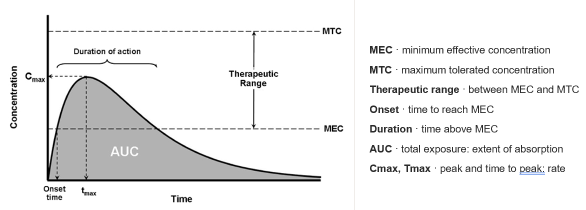
Reading the plasma concentration–time curve
Bioavailability vs bioequivalence
BA: The rate (Cmax/Tmax) and extent (AUC) to which the active ingredient is absorbed and becomes available at the site of action.
BE: A comparison of bioavailability between formulations, products or batches: no significant difference in rate and extent.
Application types
NDA 505(b)(1) | A new drug, with full safety and efficacy data | Human PK and bioavailability of the marketed formulation |
NDA 505(b)(2) | A changed product (new formulation, route) relying partly on existing data | Bridging BA/BE study to the listed drug |
ANDA 505(j) | A generic copy of a reference listed drug (RLD) | Bioequivalence to the RLD; no new efficacy trials HATCH-WAXMAN act |
BLA 351(k) | A biosimilar to a licensed biologic | Analytical, PK and clinical similarity (Purple Book) |
Four kinds of "equivalent"
Pharmaceutical equivalents: Same active ingredient (same salt or ester), dosage form, strength and route; meet the same standards. Inactive ingredients may differ.
Bioequivalent: Equivalents or alternatives whose rate and extent of absorption show no significant difference at the same molar dose.
Pharmaceutical alternatives: Same therapeutic moiety, but a different salt, ester, dosage form or strength. Example: doxycycline hyclate vs monohydrate.
Therapeutic equivalents: Pharmaceutical equivalents that are also bioequivalent. Expected to give the same effect and safety: substitutable.
what BE tests
•Formulation and manufacturing variables
•Particle size of the drug
•Chemical form (salt, polymorph)
•Drug solubility
•Compaction pressure during tableting
•Type and amount of excipients
CROSSOVER DESIGN w Healthy individuals, washout period
AUC Cmax Tmax
AUC: Extent, total exposure. Area under the concentration–time curve, time zero to infinity after one dose. Proportional to the amount absorbed.
Cmax: Rate, peak intensity. Peak plasma concentration. Related to the intensity of response and to peak-related toxicity.
Tmax: Rate, speed - Time to peak. Shorter when absorption is faster; hints at how fast the effect begins.
Dosage form absorption speed comparison
Solution>Suspension>Capsule>Tablet> Coated or MR
CI (ci) rule
90% CI sits within 80-125%
Geometric mean ratio for AUC and Cmax
the whole 90% confidence interval for the ratio of average exposure must fall between 80% and 125%
true difference estimated to be 3.5-4% diff AUC/Cmax
BCS
Biopharmaceutics Classification System (for IR oral products)P
Aqueous solubility, intestinal permeability, dissolution
Noyes–Whitney equation is worth recalling: dissolution rate is proportional to surface area times the difference between saturation solubility and bulk concentration
Solubility high if: dissolves completely in ≤ 250 mL of aqueous media over pH 1.2–6.8 at 37 °C
Permeability high if : the extent of absorption in humans is ≥ 85% of the dose (mass balance or absolute bioavailability)
BCS Classes
Class I: High S, High P; limited by gastric emptying
Class II: Low S, High P; limited by dissolution »^ surface area/solvents/surfactants
Class III: High S, Low P; limited by permeability » ^permeability/ max lumenal C
Class IV: Low S, Low P; limited by both
(Solubility on X, Permeability on Y)

Log P
<0: Hydrophilic: dissolves well, crosses poorly
1-3: ideal balance
>5: Very lipophilic: solubility limits absorption
P=C(Octanol)/C(water)
Lipinski’s Rule of 5
<500Da, <5log P <5 H bond donors <10 h bond acceptors
(GREATER THAN OR EQUAL TO)
Exceptions for substrates for uptake transporters + natural products
Solubility Boundary + measurement
Highly soluble when: the highest single therapeutic dose dissolves completely in ≤ 250 mL of aqueous buffer, at every pH from 1.2 to 6.8, at 37 ± 1 °C
Thermodynamic (BCS):
•Shake-flask: excess solid drug in buffer at 37 °C
•pH 1.2, 4.5 and 6.8 (and at the pKa)
•Shake until equilibrium, then assay the dissolved drug
Kinetic (discovery)
•Predissolve in DMSO (under 1% final)
•Dilute into buffer at pH 6.5 (intestine) or 7.4 (blood) until it precipitates
•Read optically; high throughput, but can overestimate
Dissolution boundary
Rapid: >85 in 30 min
Very rapid: >85% in 15 min
Apparatus: USP I (basket) at 100 rpm or USP II (paddle) at 50 rpm
Media: ≤ 900 mL at pH 1.2, 4.5 and 6.8, 37 °C
Permeability boundary
High when: the extent of absorption in humans is ≥ 85% of the dose
Peff : Distance moved per unit time (cm/s) across the intestinal wall, from human intestinal perfusion
Permeability in vitro vs clinical human
In vitro: Caco-2 cells: Human colorectal adenocarcinoma cells that grow into an enterocyte-like monolayer with tight junctions and transporters.
Clinical human data: Mass balance, absolute bioavailability, intestinal perfusion. The gold standard, but costly.
Papp (cm/s) | Expected absorption |
< 1 × 10⁻⁶ | Poor (0–20%) |
1–10 × 10⁻⁶ | Moderate (20–70%) |
> 10 × 10⁻⁶ | Well absorbed (70–100%) |
Four ways to show BE, in order of preference
Pharmacokinetic study (drug levels in plasma or urine)>
Pharmacodynamic study (measurable drug effect)>
Comparative clinical study (clinical endpoints)>
In vitro
When dissolution can replace an in vivo BE study
Requirement | Class I | Class III |
Drug substance | High solubility, high permeability | High solubility, low permeability |
Dissolution | Rapid (≥ 85% in 30 min) in test and reference | Very rapid (≥ 85% in 15 min) in test and reference |
Excipients | Differences allowed, except those that can affect absorption | Qualitatively the same and quantitatively very similar |
EXCEPT: Class II and IV, narrow therapeutic index drugs, modified-release products, and products absorbed in the mouth (buccal, sublingual)
Rescuing poorly soluble Class II and IV drugs
Nanoparticles, More surface area, faster dissolution
Lipid-based systems, Drug stays dissolved in oil and surfactant; self-emulsifies in the gut
solid dispersions, Amorphous drug held in a polymer; dissolves faster than crystals
micelles, Surfactants solubilize drug inside micelle cores
cyclodextrins- Drug sits in a hydrophobic cavity of a soluble ring
What counts as a biological product?
generally large, complex molecules made in a living system - CANNOT BE EXACT COPIES, tested 250 times in production
Therapeutic proteins
Monoclonal antibodies
Vaccines
Blood products / allergenics, cell and gene therapies
VARIABILITY from post-translational cell-driven modifications
Two conditions define a biosimilar
1 · Highly similar 2 · No clinically meaningful differences
Biosimilar terms
Reference product The original FDA-licensed biologic (also called originator or innovator)
Biosimilar Approved under 351(k); can be prescribed by name
Interchangeable A biosimilar that may be substituted at the pharmacy, as state law allows
Outside the US "Biomimics" or non-regulated copies have not met a biosimilar pathway
biosimilar vs generic
Generic | Biosimilar | |
Made by | Chemical synthesis | Living cells |
Sameness | Identical active ingredient | Highly similar; no clinically meaningful differences |
Pathway | ANDA, FD&C Act 505(j) | BLA, PHS Act 351(k) |
Key evidence | Pharmaceutical equivalence + PK bioequivalence | Analytical, PK/PD, immunogenicity; clinical studies as needed |
Listed in | Orange Book | Purple Book |
Pharmacy substitution | AB-rated generics | Only interchangeable products |
biosimilar four-letter suffix
Tracks adverse events to the exact product, so pharmacovigilance works
Biologics get much longer protection than small molecules
reference biologic exclusivity: 12 yrs
before biosimilar application can be submitted: 4 yrs
small molecule exclusivity: 5 yrs
Small molecule and Biologic abbreviated pathways
Small molecules:
Food, Drug, and Cosmetic Act
Hatch-Waxman Amendments (1984) created the ANDA for generics
Biologics:
The BPCI Act (2010, part of the ACA) created the abbreviated 351(k) pathway
What a 351(k) application must show about the product
Biosimilar
Same mechanism of action
Same conditions of use
Same route, dosage form and strength
-Analytical studies Show the product is "highly similar" despite minor differences in clinically inactive components
-Animal studies Including toxicity, when needed
-Clinical studies Immunogenicity, plus PK or PD, enough to show safety, purity and potency
Interchangeability:
all biosimilars should be interchangeable; designation may become routine
Biologics Open questions and challenges
Immunogenicity Could small differences change anti-drug antibody rates? Compared directly in clinical studies.'
Switching Does alternating products provoke an immune response? Data so far say no.
Traceability Distinct suffixes and brand names so adverse events reach the right product
Uptake Prescriber and patient confidence, the nocebo effect, rebates
Pharmacogenomics vs pharmacogenetics
Pharmacogenomics The study of how genes, across the whole genome, affect a person's response to drugs
Pharmacogenetics The effect of variation in individual genes on drug response: disposition (PK), safety and tolerability, and efficacy
Star (*) alleles
*1 = reference function; numbered alleles = defined variants (PharmVar)
Mutation or polymorphism? Germline or Somatic?
Mutation A permanent change in DNA sequence that differs from most people; often rare
Polymorphism A variant present in at least 1% of a population; most PGx variants
Germline Inherited, in every cell, lifelong: guides dosing (CYP2D6, TPMT)
Somatic Acquired in a tumor only: guides targeted therapy (HER2, EGFR)
Germline variants with prescribing guidance
Gene | Example drugs | Gene | Example drugs |
CYP2D6 | Codeine, tramadol, tamoxifen, TCAs, atomoxetine | TPMT, NUDT15 | Azathioprine, mercaptopurine, thioguanine |
CYP2C19 | Clopidogrel, SSRIs, voriconazole, PPIs | DPYD | Fluorouracil, capecitabine |
CYP2C9, VKORC1 | Warfarin, phenytoin, NSAIDs, siponimod | UGT1A1 | Irinotecan, atazanavir |
CYP3A5 | Tacrolimus | HLA-B | Abacavir, carbamazepine, allopurinol |
SLCO1B1 | Simvastatin and other statins | G6PD | Rasburicase, primaquine, dapsone |
CYP2B6 | Efavirenz | CFTR | Ivacaftor |
CYP2D6 alleles
Allele | Change | Function | where |
1xN, 2xN | Gene duplication | Increased | mid east |
*4 | Splicing defect | None | euro |
*5 | Gene deletion | None | |
*10 | P34S, S486T | Decreased | E asia |
*17 | T107I, R296C | Decreased | African |
*41 | Splicing | Decreased | Afric/eur/M east |
Cyp 2D6 activity score/values
1: 1, 2 (normal)
0.5: 9, 17, 29, 41 (decreased)
0.25: *10 (decreased)
0: 3, 4, 5, 6 (none)
Duplication: multiply by copy number
Activity score | Phenotype |
0 | Poor metabolizer (PM) |
0.25–1 | Intermediate metabolizer (IM) |
1.25–2.25 | Normal metabolizer (NM) |
> 2.25 | Ultrarapid metabolizer (UM) |
Strong CYP2D6 inh
Paroxetine, fluoxetine, bupropion, quinidine: convert a normal metabolizer to a poor one
Clopidogrel
needs CYP2C19 to work
2* and 3* less active metabolite
CPIC (2022) recommends prasugrel or ticagrelor for intermediate and poor metabolizers with acute coronary syndrome or PCI, if not contraindicated.
Warfarin
CYP2C9 clears more potent S-warfarin -2*/3* reduce clearance
VKORC1- warfarin’s target- 1639G>A variant lowers expression- more sensitive EAST ASIANS
CYP4F2 - vit K clearance
VKORC1 -1639 | CYP2C9 1/1 | 1/2 | 1/3 | 2/2 | 2/3 | 3/3 |
GG | 5–7 | 5–7 | 3–4 | 3–4 | 3–4 | 0.5–2 |
AG | 5–7 | 3–4 | 3–4 | 3–4 | 0.5–2 | 0.5–2 |
AA | 3–4 | 3–4 | 0.5–2 | 0.5–2 | 0.5–2 | 0.5–2 |
HLA
HLA-B*57:01 · abacavir -Hypersensitivity syndrome. Test before every new start;
HLA-B*15:02 · carbamazepine - Stevens–Johnson syndrome and TEN. Test patients with Asian ancestry; also oxcarbazepine, phenytoin.
HLA-B*58:01 · allopurinol - Severe cutaneous reactions. Common in Han Chinese, Korean, Thai and African ancestry.
Transporters
SLCO1B1 (OATP1B1) - Liver uptake of statins. The 5 / 15 variants raise simvastatin levels and myopathy risk; CPIC guideline (2022).**
ABCB1 (MDR1, P-gp) - inconsistent results
ABCG2 (BCRP) - Q141K reduces rosuvastatin efflux - CPIC suggests lower dose
Treat the responders, spare the rest
Drug | Test | Type |
Trastuzumab | HER2 overexpression (breast, gastric) | Somatic |
Cetuximab, panitumumab | RAS wild-type (colorectal) | Somatic |
Osimertinib, erlotinib | EGFR activating mutation (lung) | Somatic |
Ivacaftor | Responsive CFTR variant | Germline |
Maraviroc | CCR5-tropic HIV | Viral |
Pharmacogenomics reaches every specialty

Where to look for PGx in drug labels
Boxed warning (clopidogrel, capecitabine, abacavir) · Indications · Dosage and administration · Warnings · Clinical pharmacology 12.5 Pharmacogenomics
Level | Meaning | Examples |
Testing required | Label states or implies the test must be done before use | Abacavir, eliglustat, ivacaftor, siponimod, rasburicase |
Testing recommended | Label recommends the test | Carbamazepine (HLA-B*15:02), thiopurines, capecitabine |
Actionable PGx | Label describes a dose or drug change but does not ask for testing | Codeine, clopidogrel, celecoxib, citalopram |
Informative PGx | Gene affects the drug, but no clinical action follows | Some CYP2D6 substrates with small effects |
Patisiran (Onpattro
1st siRNA drug
Patisiran silences transthyretin (TTR) mRNA in the liver for hereditary transthyretin amyloidosis with polyneuropathy
Editing tools
Nucleases: ZFNs, TALENs, CRISPR-Cas9 cut both strands
Repair: NHEJ disrupts a gene; HDR with a template corrects it
mRNA vaccines: the LNP platform at global scale
LNP delivers mRNA; cells make the antigen briefly; mRNA is degraded
Delivery materials
Lipid nanoparticles : Ionizable lipid, helper lipid, cholesterol and PEG-lipid; carry Cas9 mRNA plus guide RNA to the liver
Polymers: PEI, PLGA, chitosan: studied, less clinical success
Hard: Getting beyond the liver: eye, lung, bone marrow
Thiopurines and thiopurine S-methyltransferase
Thiopurines are purine antimetabolites used for acute lymphoblastic leukemia, autoimmune disease, inflammatory bowel disease and transplantation. Azathioprine is a prodrug converted to 6-mercaptopurine (6-MP). 6-MP has two inactivating routes, TPMT methylation and xanthine oxidase, and one activating route through HGPRT to thioguanine nucleotides, which are incorporated into DNA. With little TPMT, more drug goes down the activating path. Interaction point: allopurinol and febuxostat block xanthine oxidase and cause the same problem, so azathioprine doses must be cut by about 75% with allopurinol.
1 is the normal allele; 2, 3A and 3C are the main nonfunctional alleles
