Metabolic Processes - Quiz 1
 Call Kai
 Learn
 Practice Test
 Spaced Repetition
 Match
 Flashcards
 Knowt Play
1/53

There's no tags or description
Looks like no tags are added yet.
54 Terms
What is metabolism? What is a metabolic pathway
All the enzyme-catalysed reactions in a cell or organism.
A metabolic pathway is any chain or cycle of linked reactions catalyzed by enzymes
Write the word equation for aerobic respiration.
Glucose + oxygen → carbon dioxide + water, with energy released.
Where in the cell does most of aerobic respiration happen?
In the mitochondria
Linear or cyclical?
Linear pathway: Reactions occur in a sequence, with the final product at the end.
Example: Glycolysis
Cyclical pathway: Reactions form a cycle, so the starting molecule is regenerated.
Examples: Krebs cycle, Calvin cycle
Each step in a metabolic pathway has a specific enzyme because each enzyme’s active site fits its substrate.
Cells can control the pathway by switching individual enzymes on or off (e.g., feedback inhibition).
Intra Vs. Extra Cellular + ex for each
Intracellular reactions: take place inside the cell. Their enzymes are made by free ribosomes. Examples: glycolysis and the Krebs cycle.
Extracellular reactions: take place outside the cell. Their enzymes are made by ribosomes on the rough ER and secreted by exocytosis. Example: digestion in the gut
Why is heat always produced in a metabolic reaction?
No transfer of energy is ever 100% efficient.
In every metabolic reaction, some of the energy is lost as heat. This cannot be avoided.
Mammals and birds depend on this heat (warm blooded). It keeps their body temperature constant, and higher than their surroundings
What do cells use energy for?
Active transport: pumping ions and molecules across membranes, against the concentration gradient.
Anabolism: building macromolecules, such as proteins from amino acids and DNA from nucleotides.
Movement: of the whole cell, or of parts inside it, such as chromosomes during mitosis.
All three are powered by the same molecule: ATP.
ATP, how does ATP release energy?
ATP (adenosine triphosphate): A nucleotide made of adenine, ribose and three phosphate groups.
Hydrolysis of ATP:
ATP + water → ADP + phosphate.
Energy is released.
Making ATP:
ADP + phosphate → ATP + water.
Energy is required. This energy comes from respiration
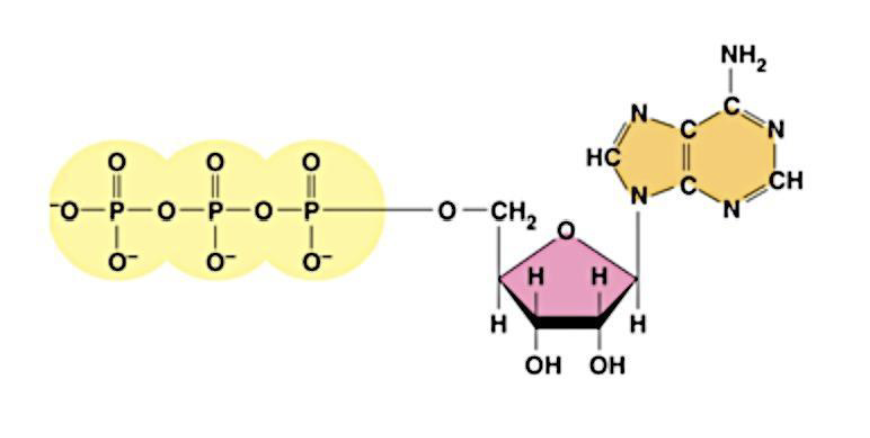
Why is ATP a good energy currency? (5)
It is soluble in water, so it can move anywhere in the cell.
It is stable at the pH of the cell, so it does not break down until an enzyme hydrolyses it.
It cannot pass through membranes, so it stays in the cell and its movement between compartments can be controlled.
Hydrolysis releases a small amount of energy: enough for many tasks in the cell, with little wasted as heat.
It is quickly made again from ADP and phosphate
What is cell respiration, What molecules make it happen?
The controlled release of energy from carbon compounds to produce ATP.
Glucose and fatty acids are the main substrates, but many other carbon compounds can be used.
What are oxidation and reduction? Redox reaction:
Oxidation: the loss of electrons.
Reduction: the gain of electrons.
In cells, electrons usually move together with a hydrogen atom. So removing hydrogen from a substrate oxidizes it.
oxidation and reduction happening together. When one molecule is oxidized, another is reduced
NAD VS. NADH
A hydrogen carrier. An enzyme removes hydrogen from the substrate and passes it to NAD. The substrate is oxidized and NAD is reduced
Reduced NAD carries hydrogen, and the energy that comes with it, from one part of respiration to another. It delivers the hydrogen to the electron transport chain, where most of the cell's ATP is made
Malate + NAD → oxaloacetate + reduced NAD
1. Which molecule is oxidized?
2. Which molecule is reduced?
3. What has moved from one molecule to the other
1. Malate. It loses hydrogen.
2. NAD. It gains hydrogen and becomes reduced NAD.
3. Hydrogen, and the electrons that go with it.
The map of cell respiration
- Cellular respiration: Breaks down glucose to produce ATP. Glycolysis occurs in the cytoplasm; the Krebs cycle and electron transport chain occur in the mitochondrion.
Glycolysis: Splits glucose into 2 pyruvate, producing a small amount of ATP and reduced NAD.
Link reaction + Krebs cycle: Break down pyruvate, releasing CO₂ and producing a small amount of ATP and lots of reduced NAD.
Electron transport chain: Uses electrons and hydrogen carried by reduced NAD to produce most of the ATP.
Distinguish between cell respiration and gas exchange
Cell respiration is the release of energy from carbon compounds to make ATP, inside cells. Gas exchange is the movement of oxygen into the body and carbon dioxide out.
Glycolysis? What is it? Why does it happen? What does it produce? What is needed? Steps?
Glycolysis: the conversion of glucose (6 carbon) into 2 pyruvates (3 carbon), in a series of small steps.
Glucose is too big and too stable to enter the mitochondrion and be used directly.
On the way it makes a small amount of ATP, and it loads NAD with hydrogen for the electron transport chain.
It does not need oxygen, and it happens in almost every living cell.
Each step is catalysed by a different enzyme
Steps of Glycolysis
Phosphorylation: adding a phosphate group to a molecule Glucose goes in at the top. Two ATP are used to add two phosphates to it. 2 ATP become 2 ADP. This makes the sugar less stable, so it is ready to split. This is the energy-investment phase.
Lysis: splitting. The 6-carbon sugar splits into two 3-carbon sugars, each with one phosphate. These are G3P, also called triose phosphate. From here on, everything happens twice. The dashed line is the end of the energy-investment phase
Oxidation: Hydrogen is removed from each G3P. This is dehydrogenation. NAD accepts the hydrogen. G3P is oxidized and NAD is reduced. One NAD is reduced on each side, so two reduced NAD are made.
ATP formation: Phosphate groups are passed from each 3-carbon molecule to ADP. 2 ADP become 2 ATP on each side, so four ATP are made. What is left at the bottom is pyruvate. There are two of them. This is the energy-payoff phase
Why spend ATP to make ATP? (Glycolisis)
This is an investment. Two ATP go in at the start (making glucose unstable w the two phosphates), and more come out at the end
Substrate-level phosphorylation:
making ATP by transferring a phosphate from a substrate molecule to ADP.
This is different from how most ATP is made later, in the electron transport chain.
Pi means
a free phosphate group
For one molecule of glucose (glycolisis)
ATP used: ______
ATP made: ______
Net ATP: ______
Reduced NAD made: ______
Pyruvate made
ATP used: 2
ATP made: 4
Net ATP: 2
Reduced NAD made: 2
Pyruvate made: 2
Where does the energy from glucose go after glycolysis?
Most energy remains in the 2 pyruvate molecules and 2 reduced NAD molecules; only a small amount is released as ATP.
What happens to pyruvate after glycolysis depending on env? What needs to happen to NAD?
If oxygen is available: pyruvate enters the mitochondrion for the link reaction and the Krebs cycle.
If there is no oxygen: pyruvate stays in the cytoplasm and is converted to lactate in humans, or to ethanol and carbon dioxide in yeast.
Either way, the reduced NAD has to be turned back into NAD. Glycolysis stops without it.
A cell runs out of NAD. Predict what happens to glycolysis.
It stops at the oxidation stage, because there is nothing to accept the hydrogen. No more ATP is made.
Where do pyruvate, the link reaction, and the Krebs cycle occur?
Pyruvate is made in the cytoplasm and transported into the mitochondrial matrix by a transport protein. The link reaction and Krebs cycle occur in the matrix, where their enzymes are dissolved.
Matrix
the fluid inside the inner membrane of the mitochondrion.
What is the link reaction? What does it do? How?
the conversion of pyruvate into an acetyl group, which is carried into the Krebs cycle.
It links glycolysis to the Krebs cycle.
Two things happen to pyruvate: it is decarboxylated and it is oxidized.
Decarboxylation
removing a carbon from a molecule as carbon dioxide.
Acetyl group
a 2-carbon group. It is what is left of pyruvate after one carbon is removed.
Coenzyme A (CoA)
a carrier molecule. It picks up the acetyl group and delivers it to the Krebs cycle. Together they are acetyl CoA
The link reaction equation
pyruvate + NAD + CoA → acetyl CoA + CO₂ + reduced NAD
No ATP is made.
Glycolysis made two pyruvate, so this happens twice for each glucose.
How do fats enter cellular respiration?
Fatty acids are broken into 2-carbon pieces, which form acetyl-CoA and enter the Krebs cycle. Both carbohydrates and lipids can provide acetyl-CoA.
For one molecule of glucose, how many of each does the link reaction make? Acetyl CoA: ______ CO₂: ______ Reduced NAD: ______ ATP: ______
Acetyl CoA: 2 CO₂: 2 Reduced NAD: 2 ATP: 0
Krebs cycle
a cycle of reactions in the matrix that breaks the acetyl group down to carbon dioxide.
It is a cyclical pathway.
The acetyl group is decarboxylated and oxidized. The hydrogen is collected by carriers, and a little ATP is made.
Steps of Kreb Cycle
1. The acetyl group joins the cycle: Acetyl CoA brings in the 2-carbon acetyl group. It is joined to oxaloacetate, which has four carbons. 2C + 4C makes citrate, which has six carbons. Coenzyme A is released. It goes back to pick up another acetyl group.
2. From 6 carbons to 5: Oxidative decarboxylation again, as in the link reaction. One carbon leaves as CO₂. Citrate is oxidized, and NAD is reduced. 6C becomes 5C.
3. From 5 carbons to 4: A second oxidative decarboxylation. One more CO₂ leaves and one more NAD is reduced. One ATP is made from ADP and phosphate, by substrate-level phosphorylation. 5C becomes 4C.
4. Back to oxaloacetate: The 4-carbon molecule is oxidized twice more. One pair of hydrogens reduces FAD, another hydrogen carrier. One reduces NAD. This regenerates oxaloacetate, ready for the next acetyl group.
What is the role of oxaloacetate in the Krebs cycle?
Oxaloacetate is regenerated and reused to combine with more acetyl groups. Two carbons enter as acetyl-CoA, while two carbons leave as CO₂.
Try it: one turn of the Krebs cycle Use the diagram. For one acetyl group: CO₂: ______ Reduced NAD: ______ FADH₂: ______ ATP: ______ Then work out the totals for one glucose
For one turn of the cycle: CO₂: 2 Reduced NAD: 3 Reduced FAD (FADH₂): 1 ATP: 1 One glucose gives two acetyl groups, so the cycle turns twice: CO₂: 4 Reduced NAD: 6 Reduced FAD: 2 ATP: 2
Try it: the running total for one glucose
Glycolysis: ____ ATP, ____ reduced NAD
Link reaction: ____ reduced NAD, ____ CO₂
Krebs cycle: ____ ATP, ____ reduced NAD, ____ FADH₂, ____ CO₂
Total so far: ____ ATP, ____ reduced NAD, ____ FADH₂, ____ CO₂
Glycolysis: 2 ATP, 2 reduced NAD
Link reaction: 2 reduced NAD, 2 CO₂
Krebs cycle: 2 ATP, 6 reduced NAD, 2 FADH₂, 4 CO₂
Total so far: 4 ATP, 10 reduced NAD, 2 FADH₂, 6 CO₂ Six CO₂. All six carbons of the glucose are gone.
Where is most of the energy from glucose after the Krebs cycle?
Most energy is carried by 10 reduced NAD and 2 FADH₂. Only 4 ATP have been made so far. The electron transport chain uses these carriers to produce most of the ATP, using oxygen.
State the number of decarboxylations and oxidations in one turn of the Krebs cycle, and the products for one acetyl group
Two decarboxylations and four oxidations. Products: 2 CO₂, 3 reduced NAD, 1 FADH₂ and 1 ATP.
What are cristae, and why are they important?
Folds of the inner mitochondrial membrane that increase surface area for more electron transport chains.
What is the intermembrane space?
The narrow gap between the inner and outer mitochondrial membranes.
What is the electron transport chain?
Electron transport chain (ETC): a series of proteins in the inner mitochondrial membrane that pass electrons from one to the next.
As electrons move along the chain, they lose energy.
That energy is used to pump protons (H⁺) across the membrane, from the matrix into the intermembrane space.
It uses electrons from reduced NAD and reduced FAD to produce about 30 more ATP, regenerates NAD and FAD so earlier stages can continue, and uses oxygen as the final electron acceptor.
Steps of the Electron Transport Chain
1. Reduced NAD hands over its electrons: Reduced NAD (NADH) gives two electrons to the first protein in the chain. Reduced NAD becomes NAD again, ready to go back and collect more hydrogen. The energy from the electrons pumps H⁺ up into the intermembrane space.
2. The electrons move from protein to protein along the membrane. At each pump, a little energy is used to move more H⁺ across. Reduced FAD gives its electrons a little later in the chain, so it pumps fewer H⁺. IB exams do not ask about FAD.
3. By the end of the chain, many H⁺ have been pumped into the intermembrane space.The space is narrow and H⁺ cannot cross the membrane on their own, so they build up. Proton gradient: a high concentration of H⁺ in the intermembrane space and a low concentration in the matrix. The inner membrane is the dam. The H⁺ are the water held back behind it. The water pushes to get through. It can only pass through the gates, where it spins the turbines.
4. ATP synthase The H⁺ have one way back into the matrix: through a channel protein called ATP synthase. As H⁺ flow through, part of ATP synthase spins like a turbine. The spinning joins ADP and a phosphate to make ATP. It takes about three H⁺ to make each ATP
Chemiosmosis
the flow of protons down their gradient, through ATP synthase.
Proton motive force
the push of the protons down that gradient, which drives ATP synthesis.
ATP synthase
he enzyme that uses the flow of protons to make ATP.
Oxidative phosphorylation
making ATP using energy from the oxidation of reduced NAD. Compare it with substrate-level phosphorylation in glycolysis.
What is the role of oxygen in the electron transport chain?
Oxygen is the final electron acceptor. It accepts electrons and H⁺ from the matrix to form water.
What happens to cellular respiration without oxygen?
The ETC stops, so H⁺ pumping and ATP production stop. Reduced NAD cannot release its electrons, so NAD runs out, causing the link reaction and Krebs cycle to stop.
Protons are pumped from the ______ to the ______ .
Matrix; intermembrane space.
Cyanide binds to one of the proteins in the electron transport chain and stops it working. Predict the effect on aerobic respiration.
It stops. Electrons cannot pass along the chain, so no protons are pumped and no ATP is made by ATP synthase. NAD is not regenerated, so the Krebs cycle stops as well.
Each reduced NAD gives about 3 ATP. Each reduced FAD gives about 2.
10 reduced NAD × 3 = ______
2 reduced FAD × 2 = ______
Glycolysis and Krebs cycle = ______
Total = ______
10 reduced NAD × 3 = 30
2 reduced FAD × 2 = 4
Glycolysis and Krebs cycle =
4 Total = 38
Process | Location | Carriers formed (per glucose) | Net ATP yield (per glucose) |
|---|---|---|---|
Glycolysis | |||
Link reaction | |||
Krebs cycle | |||
Electron transport chain | |||
ATP transport cost | |||
Total (approximate) |
Process | Location | Carriers formed (per glucose) | Net ATP yield (per glucose) |
|---|---|---|---|
Glycolysis | Cytoplasm | 2 reduced NAD | 2 ATP via substrate-level phosphorylation |
Link reaction | Mitochondrial matrix | 2 reduced NAD | 0 ATP |
Krebs cycle | Mitochondrial matrix | 6 reduced NAD, 2 reduced FAD | 2 ATP via substrate-level phosphorylation |
Electron transport chain | Inner mitochondrialmembrane and intermembrane space | No carriers formed; uses reduced NAD and reduced FAD | 3 ATP per reduced NAD; 2 ATP per reduced FAD |
ATP transport cost | Into and out of mitochondria | — | 4–8 ATP used |
Total (approximate) | — | — | 30–34 ATP |
Reduced FAD is not required for your exam