SESA 1019: Part 3 - Physical Chem
 Call Kai
 Learn
 Practice Test
 Spaced Repetition
 Match
 Flashcards
 Knowt Play
1/70

Earn XP
Description and Tags
Ms. Isha Gupta's part.
71 Terms
Which material property is most critical for a long-term operation at high temperatures?
Tensile strength
Hardness
Creep resistance
Thermal conductivity
Creep resistance
What kind of loads do turbine blades face?
Centrifugal load
Thermal loads
Diff between NH & C creep
NH - Through grain
C - Around grains / through GB
Pros of lightweight alloys
Higher specific strength
Higher specific stifness
Ti alloys can withstand temperatures similar to steels and certain superalloys: for less weight.
Pros of CFRP
Highest specific stiffness and specific strength
Cons of CFRP
Don’t work past T = 200C
Brittle
Subsurface damage - difficult to detect
Costly (complex, energy-intensive manufacturing and joining process)
Difficult to recycle
Not good at cryogenics
What is the advantage of Ni super alloys
Can be cast as a single crystal
↓ GB → ↓ creep (↑creep resistance)
What is a GB / GB defect
Region btn grains characterised by chaotic arrangment of atoms
What are the types of lattice packing (in full)
HCP (Hexagonal Close-Packed)
BCC (Body Centered Cubic)
FCC (Face Centered Cubic)
What is the main diff & similarity btn FCC & BCC
BCC
Whole atom in middle
FCC
½ atom on each face
Both
¼ atom on each corner
What is H embrittlement?
interstitial H → ↓plascticity
by ↓dislocations’ ability to move
What are the point defects? 0 Dimensions
Interstitial
Substitutional
Vacancies
What are the line defects? 1 Dimension
Edge dislocations
Screw dislocations
What are the area defects? 2 Dimensions
Grain boundaries
Phase boundaries
What are the volume defects? 3 Dimensions
voids
precipitates
“cracks”
What is the diff btn Grains & Phases?
Grains (region of uniform lattice, physical properties)
Phase ()
Cons of Al
Corrosion (with CFRPs)
Vulnerable to the combined effects of a) fatigue loading and b) environmental corrosion
Low mechanical properties at elevated temperature (softening occurs above 150 °C)
Pros of Ti
High op T (up to 500 - 600 °C)
Exceptional corrosion-resistance
Stiffer than Al alloys
What are the phases of Ti (with properties & pros)
α low T
↑ creep res
little heat strength
β high T
↑ fracture toughness
can be heat strengthened
Ti α+β
best of both
What is the process of obtaining Ti α+β
Heat up to T1 where all Ti is Ti β
Rapid quech to keep beta metastable
Raise to T<T1 to start ppt of Ti α
Hold for specified t to prevent ppt from becoming incoherent (too large)
Quench (normally)
What is a coherent vs incoherent ppt
Coherent
Ppt tries to fit into lattice
Due to ppt’s lattice being slightly diff, it acts like a substitutional point defect
Causes an elastic strain (misfit strain) in lattice
Distorts the dislocation line
Defects can’t easily move through
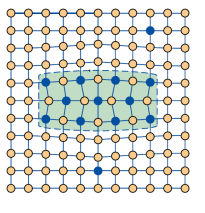
Incoherent
Ppt doesn’t try to fit in
Energy cost (Increased surface energy between precipitate and matrix)
Energy gain (Bigger ppts with more strain energy will make this transition)
Typically dislocations need to bow around incoherent precipitate (they can shear through). This creates new dislocations, as the old one remains, and a new one (a loop is formed)

What is GB strengthening?
Different grains with different crystal orientations: different slip directions
A dislocation moving into a diff grain must change its direction
Disordered region of GB’s act as barriers to dislocations
How do disordered region of GB’s act as barriers to dislocations?
Due to random nature of the region, atoms are further apart, making bond forming harder (dislocations move by breaking old bonds and forming new bonds, in direction of motion/stress).

In Hall-Petch Relationship, what is σ0 ?
Dislocation friction stress from:
Work hardening
Solution hardening
Precipitation hardening

In In Hall-Petch Relationship, what is the relationship btn grain size & yield strength (from ppt’s)
Yield strength is proportional to d1
What is the con of fine grains?
↑GB area per unit vol → ↑creep (↓creep res)
Transgranular Cracking Vs Intergranular Cracking
Transgranular Cracking:
Through grain
Brittle materials
Breaks atomic bonds
Intergranular Cracking:
Through GB’s
Results from weakening/embrittling GB regions

Why is the shear stress a lattice faces sinusoidal?
Larger energy (Q) to move from positions 1, 3 & 5, so for same Q, faces max shear @ position 2 & 4

What is a dislocation?
Extra half-plane (or row) of atoms that slips on a close-packed plane
The dislocation line is the edge of that plane

What is the burgers vector?
The magnitude and direction of the atomic slip when a dislocation moves.
Points in a close-packed direction
Magnitude equal to the interatomic spacing.
What is a close-packed direction?
The one where the distance btn atoms is least
And is also the slip direction
What is a close-packed plane
The one where all directions are close-packed directions
AND
All atoms touch
How many close-packed planes are in FCC, BCC and HCP?
FCC
4 (equivalent/identical)
BCC
None, only close-packed directions
HCP
3 (equivalent/identical)
What is the relationship btn close-packing & ductility?
Close-packing means its easier for dislocations to move to the next atomic plane
What & Why is DBT?
Ductile-to-Brittle transition
Due to lack of/few close-packed planes
Dislocation motion requires thermal activation
Become brittle at low T
BCC is a prime example (has no “truly close-packed planes“ bc no atoms touch)
What is diff btn Ductile & Brittle fracture?
Ductile
Cup-and-cone (necking) @ failure
Rough surfaces
Extensive plastic deformation before fracture
Brittle
Relatively flat (planar) fracture surfaces
Minimal plastic deformation
How many atoms (n) are in an FCC crystal structure?
corners (1/8) & faces (1/2)
81⋅8+21⋅6=4
How many atoms (n) are in a BCC crystal structure?
corners (1/8) & inside(1)
81⋅8+1=2
How many atoms (n) are in an HCP crystal structure?
corners (1/6), faces (1/2) & inside (1)
61⋅6+21⋅2+3=6
What is the diff btn “crystaline“, “poly-crystaline“ & “Amorphous“?
Crystalline
All unit cells are aligned in the same orientation
Perfect arrangement of atoms
Poly crystaline
Many grains (crystallites) and therefore several grain boundaries
Amorphous Materials
Disordered structure
Why do BCC crystal structure metals undergo DBT?
Dislocation motion in BCC metals relies on thermal activation, due to lack of truly close-packed planes.
Which crystal structures are symetrical?
BCC & FCC
What kind of stress does each point defect create on the lattice (3 defects)?
PS: stress is always refering to the lattice: not the spot with the defect but the region around it
Interstitial: Compressive
by adding itself to the “in btn” space, pushes away the atoms in the lattice, compressing them, they become closer (squashed with) to their neighbors
Vacancy: Tensile
Surrounding atoms are “pulled“ to fill the gap
Substitutional: Either, dep on relative size (to original atom)
If larger: Compressive, acts as interstitial
If smaller: Tensile, acts as vacancy
What is a phase?
region with uniform structure (hence physical properties) & composition (chemical properties) throughout
What is packing eff?
Measure of how well the atoms utilise the space of the unit cell of a lattice
=VunitVatoms
What is polymporphism / allotropy?
a material that can have diff forms in same physical state
Alloys can stabilize diff phases, altering properties (eg, alpha + beta Ti)
True/False Phase boundary (PB) = Grain boundary (GB)
False
PB
What are the pros & cons of pores?
Pro:
Increase insulation (low thermal conductivity λ)
Con:
Acts as a stress concentrator, reducing fatigue life.
What is Oxidation fatigue?
Oxidation attack at high stress areas (eg GB’s, cracks, voids (vacancies & pores))
This increases fatigue crack growth rates
Creep fatigue
Creep damage processes can add to fatigue processes, accelerating crack propagation
May redistribute crack tip stresses, making failure prediction difficult
Creep moves defects @ GB and can create & grow voids, existing cracks can join with these voids to grow suddenly.
What is the point of phase diagrams?
Tell us which phase is thermodynamically stable at a given temperature and composition (% weight aka %wt of alloys)
In a binary phase diagram what is shown?
Region of fully solid
Solidous line (one solid other becomes liquid)
Region of solid + fully liquid
Liquidous line (all becomes liquid)
Region of fully liquid
In that order as you go up from x axis (composition wt%)
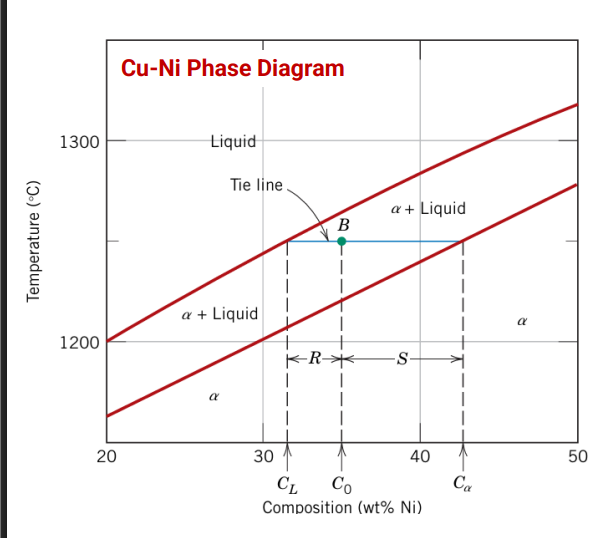
Given this image @ “B” what is weight fraction of liquid & of alpha phase?
@ “B“:
pure liquid at Cl (distance R)
pure alpha at Ca (distance S)
Liquid: S+RS
liquid (which is to the left) uses the right side “S“
alpha phase: S+RR
alpha (which is to the right) uses the left side “R“
What is a eutectic reaction?
Liquid converts to two different solids forming a lamellar microstructure
What happens under “hypo“ & “hyper“ eutectic conditions?
Primary solid forms
remaining liquid reaches eutectic composition (%wt) since some of the other element ppt’d out.
remaining liquid forms lamellar microstructure
Under Hypo, primary solid is ppt of original element (the one @ %wt=0)
Under Hyper, primary solid is ppt of alloying element (the one @ %wt=100)
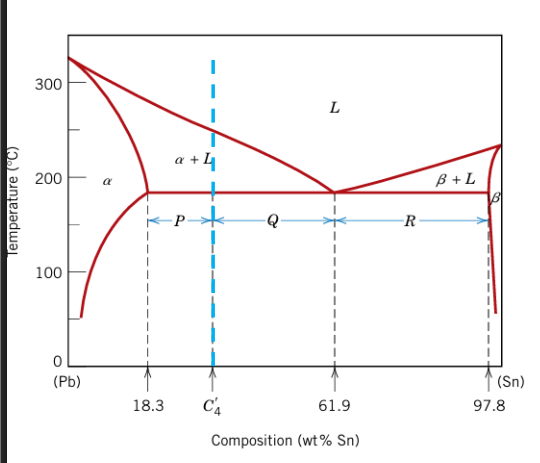
Given this image @ “C4” what is relative fraction of the micro constituents (alpha & eutectic) & the relative fraction of each phase (alpha & beta)
Micro constituents:
Wα=P+QQ WE=P+QP
Each phase:
Wα=P+Q+RQ+R Wβ=P+Q+RP
(which is to the left) uses the right side “Q (+R)“
(which is to the right) uses the left side “P“
For micro constituents, it is btn corner & eutectic %wt
For each phase, it is corner (max solubility of Sn in Pb-rich sol) to corner (max solubility of Pb in Sn-rich sol)
PS:
The eutectice relative fraction contains some alpha and some beta. So microconstituents are ppt’d alpha & lamellar structure.
And the relative fraction of alpha contains ppt’d (primary solid alpha) & eutectic
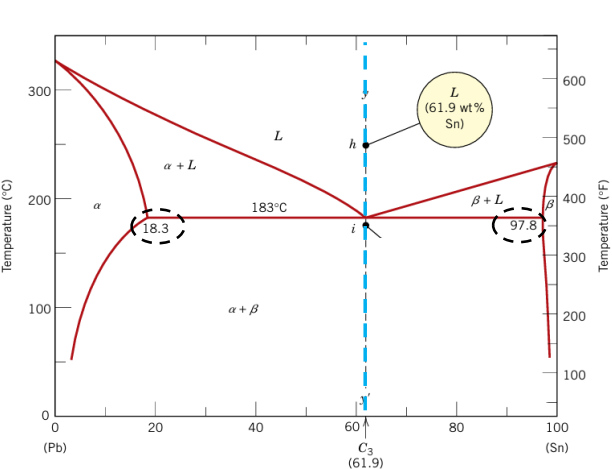
What is represented by the circled corners?
Max solubility of one (the one further from corner) in the other (the one at the corner)
max solubility of Sn in Pb-rich sol - 18.3%
max solubility of Pb inWha Sn-rich sol - 97.9%
What is the nose of a TTT diagram?
Where the transformation begins the fastest (phase 1 to phase 2 transformation)

What is the critical cooling rate (TTT)?
The closest line from the T1 (where all was phase 1) to the quench T (T2), without touching the TTT (without forming the equilibrium phase)

What happens within the inner curve of a TTT?
Secondary phase is at 100%, all has become phase 2
What happens in the outer curve (btn outer & inner curve) of a TTT?
Growth of secondary phase from 0 to some size (dep on time)
Why can a shear occur under normal load?
Due to diff orientation of grains in material

What is cold working?
Putting the material under stress to plastic deform it
Works by introducing new dislocations to the material, which tangle up and so can’t move easily
↑ dislocation desity → ↑yield stress
The material after unloading, will re-load via the un-load path, to a higher yield stress (the fracture stress is unchanged)
The material holds residual strain & energy
Dislocations can also repel each other (not always)
How and when do dislocations repel each other or attract (attract & annihilate)?
If dislocation is on opp sides = atttract,
if same side = repel

How do you undo cold-work? And what’s the pro & con?
Annealing:
Heat treatment at ~ 0.5Tm
Recovers ductility
Looses Tensile strength (yield strength)
What’s nice with Al 2xxx?
Al - Cu alloys
Better fatigue resistance and fracture toughness than Al 7XXX alloys
What’s nice with Al 7xxx alloys?
Al - Cu - Zn - Mg
Highest strength among all aluminum alloys
What’s wrong with Ti alloys?
Expensive:
High energy costs (purification, ingot melting)
Very reactive needs inert atmosphere to melt
Very hard, slow machiningEW
What’s nice & wrong with Ti intermetallics?
Higher specific stiffness than conventional Ti alloys
Good oxidation-resistance at elevated temperatures
𝛾-aluminide can operate at temperatures comparable to some Ni-based superalloys
Challenges:
brittle at room temperature,
difficult to manufacture and process.
What’s nice & wrong with Steel (Fe)?
High-temperature strength (so Less shielding required)
Easy to manufacture
Cheap
Strong and tough at cryogenic temperatures (don’t always have DBT, dep on crystal structure)
Can gain corrosion resistance by alloying (with Cr)
But:
They are very heavy
Hydrogen embrittlement (form brittle metal hydrides & interstitial H is always an issue)
Can have DBT (dep on crystal structure)
What’s nice & wrong with Ni alloys?
Can be cast as single grain = high creep resistance
Best stress at high temp
But:
Oxidation fatigue
Creep fatigue