Animal Behavior- Exam 2
 Call Kai
 Learn
Learn Practice Test
 Spaced Repetition
 Match
Match Flashcards
 Knowt Play
1/40

Earn XP
Description and Tags
Evolutionary Psychology
Name | Mastery | Learn | Test | Matching | Spaced | Call with Kai | Chat |
|---|
No analytics yet
Send a link to your students to track their progress
41 Terms
Evolutionary Psychology Definition
subfield of psychology that aims to understand how human thought, behavior, and feelings have been shaped by evolutionary forces
David Buss
Intellectual Leader in the field of Evolutionary Psychology
In Sociology, what does research focus on?
focus is on the difference across cultures
In Evolutionary Psychology, what does research focus on?
focus is on the similarities across cultures
What happened approximately 6-8 million years ago?
primates leave the trees and begin walking upright (bipedal locomotion)
What happened approximately 200,000 years ago?
Homo sapien species comes into the picture
What is the theory of “Sexual Selection” proposed by Darwin?
males and females differ both morphologically and behaviorally within a species

Kin Selection Theory
Animals treat individuals who are more closely related to them differently than those are are more distantly related (ground squirrel example)

Reciprocal Altruism Theory
“You scratch my back, I’ll scratch your back”

Parental Investment Theory
sex that invests more time in raising offspring will be more selective when finding a mate
Sociobiology
explains social behavior in all organisms through the lens of evolution theory and natural selection
What are the main findings of Harlow’s and Garcia’s studies?
The subjects in each study were “prepared” to act a certain way to the stimuli used- either the water paired with a variable, or the cloth mother vs. wired mother


Skinner vs. Chomsky Language Acquisition Debate
Humans do not acquire language through reward and punishment but rather the application of innate rules (“Intelligent Errors”)
All languages have a similar underlying structure

Daniel Khanaman
Thinking Fast and Slow

What is the theory behind our Human Ancestral Environment?
adaptations that solved problems in the ancestral environment still influence us today
Evolutionary Mis-match Theory
Culture has lead us to evolve in our environment much faster than our genes allow
Survival Related Behaviors
Emotion and Motivation

Reproduction Related Behaviors
Good genes and Good Health

Social Behavior
Dominance Hierarchies

What is Epistemology?
the philosophical study of knowledge
What are the two broad approaches for gaining knowledge in science?
Empirical Approach and Theoretical Approach

Empical Approach
systematic observation to predict and infer causation (using experiments/scientific method)

Theoretical Approach
Logic, math, and reasoning to stimulate and explain (receating a “model” of a phenomena)
Benefit
resourses gained that help animals survive and/or reproduce
Cost
expenses taken on that hurt animals’ ability to survive and/or reproduce
Profitability
benefit-cost (cost benefit analysis relates to reproductive success)
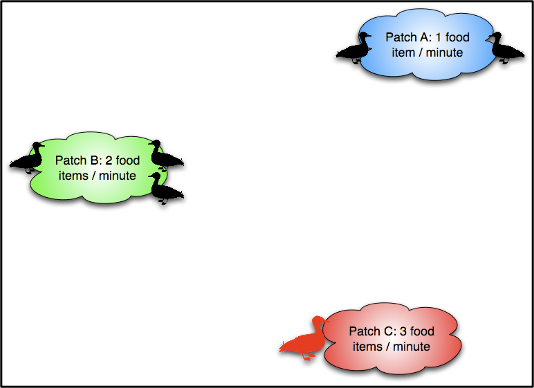
Resource Matching Rule
When resources (food) are distributed in local “patches”, the distribution of individuals within an environment adjusts to match the distribution of the resources

What are the assumptions for ‘Ideal Free Distribution’?
animals have perfect knowledge of the availability of food at different patches
animals are free to explore new patches whenever they wish and travel cost is negligible
animals have equal competitive ability
What does Marginal Value mean?
the point of greatest profitability along a rate graph (also known as the tangent)
How is the concept of a '“food patch” best explained?
A foraging individual will find resources that are distributed patchily in a system where resources are located
What does it mean for food to be patchily distributed?
animals collect food in one area, but need to travel from one area to another as a patch is depleted (this is one assumption of MVT)
What is another assumption utilized by the Marginal Value Theorem?
animals know the average distribution of food in their environment (this allows them to estimate the average food rate)
What is Niche Differentiation?
The exploitation of different resources by different species within the same environment (example of different species of finch eating different size seeds within the same environment)

Trait Co-option
a trait that was once used for some other purpose is adapted by an organism and helps them to survive and reproduce
Middle Ear
Evolved in mammals from the jaws of ancestors, allowing mammals to hear a wider range of frequencies (better hearing while stalking)
Outer ear
used by mammals that stalk their prey or by grazing mammals who need their ears to rotate independently of one another

How is it that humans are good at Endurance Running?
energetics (springy ligaments, larger glutes), stabilization (COM is more closely centered to the ground), thermoregulation (sweat through glands to cool down, instead of panting like a dog)
Why are humans good at Endurance Running?
Persistence hunting for food over 2 million years ago, scavange carcasses before other competitors, diurnal (daytime) carnivores

Evolutionary Byproduct
a non- or mal- functioning trait that results from evolutionary processes but does not solve an adaptive problem
What is an adaptation?
a functional trait that increases the fitness of an organism