Precipitation Reactions
 Call Kai
 Learn
 Practice Test
 Spaced Repetition
 Match
 Flashcards
 Knowt Play
1/47

There's no tags or description
Looks like no tags are added yet.
48 Terms
Precipitation occurs when a ___ antigen combines with a soluble ___ (in aqueous solution - nice n dissolved) to produce visible, ___ complexes (called a ___).
soluble; antibody; insoluble; precipitate
In agglutination, the antigen is located on a ___ and is NOT ___.
particle; soluble
Precipitation: Soluble + soluble → ___ precipitate
Agglutination: Antigens on ___ → visible clumping
insoluble; particles
For precipitation to occur, both antigen and antibody must have multiple ___ sites specific to one another.
This is important for ___ formation, which give us large complexes that can be ___. (Increases in size = more precipitate forms)
binding; lattice; visualized
Optimal precipitation occurs in the zone of ___, where the relative concentrations of antigen and antibody are ___.
equivalence; optimal
According to the lattice hypothesis, each antibody must have at least ___ binding sites, and the antigen must be ___ (multiple Abs can bind to it at the same time).
This produces a multimolecular ___ that increases in size and precipitates.
2; multivalent; lattice
Zone of equivalence – where ___ precipitation occurs; concentration of antigen and antibody in mixture is ideal/equal.
optimal
Prozone – ___ concentration is in excess. Not enough ___ to go around = no cross-linkage = no lattice.
Antibodies remain ___ in solution.
antibody; antigens; free
Postzone – ___ concentration is in excess; Not enough ___ to go around = no cross-linkage.
Small aggregates are surrounded by free ___ in solution.
antigen; antibodies; antigen
Both Prozone and Postzone cause ___ ___ results due to lack of cross linkage.
false negative
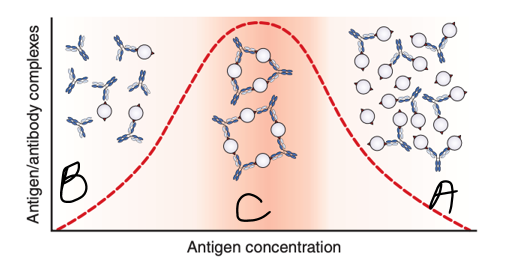
Precipitin ___ includes Prozone, Zone of Equivalence, and Postzone. Label the correct positions in the pic.
A -
B -
C -
curve; Postzone; Prozone; Zone of equivalence
In the prozone, when testing for patient antibodies, ___ the sample and repeat testing. (decreases excess antibodies to match antigens)
when testing for patient antigens, ___ the sample and repeat testing. (increases antigens to match excess antibodies).
dilute; concentrate
In the postzone, when testing for patient antibodies, wait approximately a ___ for a higher antibody ___ before repeating with a new sample. (allow time to increase antibodies via immune response to match excess antigens)
when testing for patient antigens, ___ the sample and repeat testing. (decrease excess antigens to match antibodies)
week; titer; dilute
Precipitation is measured by ___ scatter - used in both ___ analyzers and spectrophotometers!
Is it qualitative or quantitative?
light; chemistry; quantitative
Since precipitation methods give a quantitative result, the values must be compared to ___ solution values to get the concentration via a standard curve.
standard
The two methods of precipitation are ___ and ___. The only difference is where the ___ is located.
turbidity; nephelometry; detector
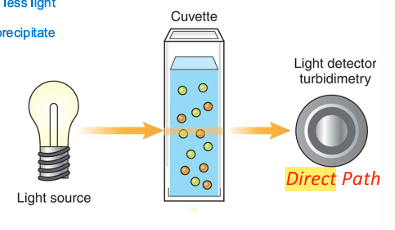
Turbidimetry is also called ___. It measures the turbidity or cloudiness of the solution.
It also measures the ___ in light intensity due to reflection, absorption, or scatter. The detector is at a 180-degree angle, in ___ line with incidence light.
immunoturbidimetry; reduction; direct
Turbidimetry has a ___ relationship between precipitate size and amount of light.
More precipitate = ___ light
Less precipitate = ____ light
inverse; less; more

Nephelometry measures light ___ at an ___ (10-90 degrees) from incident beam after passing through solution.
Amount of light scattered is an index of solution’s ___
___ relationship between precipitin size and light scatter amount
More ___ than turbidimetry
lower limit of detection = 1-10 mg/L
scattered; angle; concentration; direct; sensitive
Nephelometry can detect antigen or antibody:
Pt Ab + Reagent Ag OR Pt ___ + Reagent ___ (usually performed in this manner)
Ag; Ab
Nephelometry applications
Quantification of things that change ___ or are present in ___ numbers, tells at a finer degree what that concentration is.
___ quantification
Kappa/lambda ___ chain quantification
___ measurement
Clotting ___ measurement
fast; low; Immunoglobulin; light; CRP; factors

Passive immunodiffusion: ___ is the support medium that stabilizes the diffusion process. Inside this medium, there are ___ added.
no ____ current (passive method)
takes a ___ time
2 wells: ___ and ___ - molecules diffuse and precipitate (looks like lines)
gel; reactants; electrical; long; antigen; antibody

Radial Immunodiffusion (RID) is a ___ diffusion technique driven by ___ immunodiffusion.
Uses rectangular gel with ___ wells where the ___ is already uniformly distributed in gel that has high ___ and is monospecific (increases ___ of precipitation).
single; passive; multiple; antibody; affinity; clarity

In Radial Immunodiffusion (RID), Ag-Ab complex occurs until zone of equivalence is reached - where a visible stable ___ is formed in the gel (visible).
___ is formed where complex happens
area of ring = ___
____ - must compare to standard curve using controls w/ known concentrations
lattice; ring; concentration; quantitative
There are two types of Radial Immunodiffusion (RID): ___ ___ (Mancini) and ___ (Fahey and McKlevey)
End point; Kinetic
End Point (Mancini) subtype of Radial Immunodiffusion:
Antigen allowed to diffuse to ___
Disadvantage: ___ (___-72 hrs)
___ of diameter proportional to ___ of antigen
completion; slow; 24; square; concentration
Kinetic (Fahey and McKlevey) subtype of Radial Immunodiffusion:
measurements taken ___ point of equivalence in met (___, ~18 hrs)
Diameter is proportional to ___ of concentration
before; faster; log
Sources of Error in RID:
Overfilling/Underfilling wells
overfilling: falsely ___ result
underfilling: falsely ___ result
Nicking side of well
wells are small and difficult to pipet - requires steady hand
leads to potential error in ___ process
Spilling sample outside of well
incorrect ___, will not have steady precipitate ring - will be harder to get a standard value from it.
Improper incubation time and temperature
could lead to over or under diffusion, changing precipitate ___
Incorrect measurement
millimeters on ruler are difficult - it is important to measure and re-measure to ___ you have proper measurements.
increase; decrease; diffusion; diffusion; ring; ensure
Radial Immunodiffusion (RID) is a ___ assay good for testing: ___ (IgG etc.) and ___.
Advantages: ___ to perform and no ___ needed.
Disadvantages: ___ reagent gels and time ___.
quantitative; immunoglobulins; complement; simple; instruments; expensive; consuming
Ouchterlony double diffusion is a ___ diffusion technique driven by ___ immunodiffusion.
Both ___ and ___ diffuse into gel (we put these into gel - not like RID where Ab is purchased in gel ___).
Precipitate lines form
___ and ___ of lines tells us about the antigen itself
incubated for 12-48 hrs (time ___)
double; passive; antigen; antibody; already; density; formation; consuming

Ouchterlony double diffusion involves:
Plate with ___ well surrounded by outer wells.
central well contains ___-specific antibody
different antigens placed in ___ wells to detect shared ___ (1 ___ antigen, all others are ___ samples of other antigens)
Examine precipitate bands to ___ antigens
central; multi; surrounding; epitopes; patient; known; compare
Ouchterlony Double Diffusion applications:
Identify ___ antigens (Aspergillus, Blastomyces, Coccidiodes, Candida)
Detect ___ to extractable nuclear antigens
important for ___ diseases
detects autoantibodies by confirming the ___ to those autoantigens (pulls out specific components of your self-antigens)
Disadvantages:
___ intensive
requires ___ to read/interpret
patterns not always clear
fungal; antibodies; autoimmune; antigen; labor; experience
Sources of Error in Ouchterlony Double Diffusion:
Overfilling wells
Irregular hole punching
shape of well wrong → pattern of band ___
Nonlevel incubation
wrong temp or if things are literally non-level
Drying of ___
diffusion not working well
Inadequate time for diffusion
bands will look ___
Fungal or bacterial contamination of gel
contamination antigens can ___ w/ poly-specific antibody in central well
wrong; gels; weaker; react
Electrophoresis is where an electrical ___ is forced through gel.
molecules separated by difference in ___
applied to both single and double ___
Advantages: ___ up reaction and increases ___ of result
(passive diffusion takes too long! -> to make it faster, we shock w electricity)
current; charge; diffusion; speeds; clarity

Rocket Immunoelectrophoresis is a ___ dimensional electroimmunodiffusion. Where ___ is already distributed into gel. (similar to RID, but with current)
antigen is placed into wells ___ in gel
___ facilitates migration of antigens into precipitin line that is ___ in shape
one; antibody; cut; electrophoresis; conical
Rocket Immunoelectrophoresis interpretation:
Height of rocket = amount of ___ = amount of precipitate
Mainly used for ___ immunoglobulins.
must use standards with known concentrations and plot a standard curve
Advantage: ___ compared to RID (TAT = few hours)
Disadvantage: must determine net ___ of molecules at pH used for test (typically 8.6)
to determine ___ they will migrate
must place correct electrode (opposite charge of ___) on opposite side of gel
if incorrect, antigen migrates backward off of gel → nothing to measure
antigen; quantitative; speed; charge; direction; antigen

Which precipitin arc has the most antigen in it?
B

Immunoelectrophoresis (IEP) is a ___ diffusion technique using electrophoresis.
Antigens in serum (patient and ___) electrophoresed to ___ out main fractions (done at ___ time).
Trough ___ into gel parallel to direction of antigen migration
___ placed in trough and incubated for 18-24 hrs (but no ___ here - ___ diffused)
Precipitin lines ___ where Ab-Ag complexes form
compare patient vs ___
double; control; separate; same; cut; antiserum; electrophoresis; passively; develop; control

Immunoelectrophoresis (IEP) interpretation example with anti-human serum (___ antibodies in serum could form complexes w/)
normal = control
anti-Human Serum = antiserum
this case = patient
all

Immunoelectrophoresis (IEP) interpretation example with anti-IgA:
normal = control
anti-IgA = antiserum
this case = patient
Interpretation: large ___ because much darker, much ___ band.
increase; thicker
Immunoelectrophoresis (IEP) applications:
___ and ___-quantitative (can tell if more or less based on ___ of band)
no real value
arcs compared for shape, intensity, and location vs normal control to detect ___
Used as a screening tool for differentiation of serum ___ (like immunoglobulins).
Myelomas, Waldenstrom’s macroglobulinemia, malignant lymphomas, and lymphoproliferative disorders
Look for ___ of immunoglobulins and ___ proteins.
Disadvantages:
interpretation requires ___ - difficult (one of least used tools in immunology)
not as ___ as other techniques
Qualitative; semi; thickness; abnormalities; proteins; deficiencies; complement; experience; sensitive

Immunofixation electrophoresis (IFE) is similar to Immunoelectrophoresis, but ___ is applied ___ to gel instead of through a trough.
Add ___ antigen to wells in gel and ___ the sample’s proteins
Add ___
___ to each well and what you are testing for, includes the Ref/control tract that is fixed w/ ___-specific antibody
Ag-Ab complexes ___
___ gel and ___ to visualize complexes
antiserum; directly; patient; electrophorese; anti-sera; specific; poly; form; wash; stain
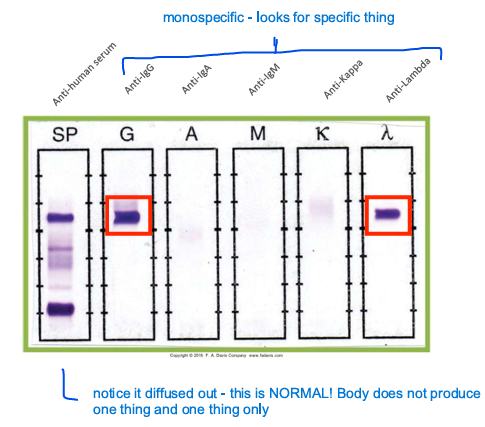
Immunofixation electrophoresis (IFE) is used to test for ___gammaglobulinema
Walden’s macroglobulinema
___ ___
Can also be adapted as a ___ blot test used for ___ confirmation.
___ and semi___ assay.
Advantages:
easy interpretation of ___ present in serum, urine, and CSF
more ___ than IEP
high resolution
decreased ___
Disadvantages:
___ to Ag-Ab ratios
CSF must be ___ to avoid ___
hyper; multiple myeloma; western; HIV; Qualitative; quantitative
antigens; sensitive; TAT; sensitive; concentrated; prozone
Immunofixation electrophoresis (IFE) sources of error:
applying current in ___ direction (in terms of electrodes and how they’re being pulled)
proteins migrate off gel
incorrect ___ of buffer
proteins wont migrate properly
Incorrect electrophoresis ___
Ag-Ab concentration (prozone vs postzone)
Amount of current applied
potential to ___ antigens with heat
Filling of wells
small wells, need loading dye to see
wrong; pH; time; burn
Which techniques use light scatter? Between the two, which is more sensitive?
Turbidity and Nephelometry; Nephelometry
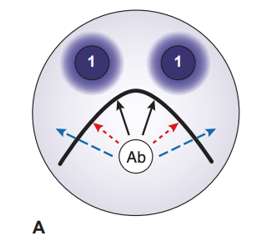
This Ouchterlony diffusion pattern displays the fusion of a line: ___, meaning that antigens are the ___. (presence of ___ epitopes)
identity; same; common
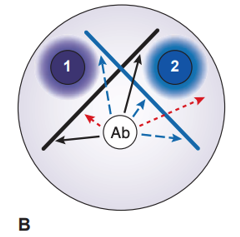
This Ouchterlony diffusion pattern displays bands that did not fuse: ___, meaning that they are ___ the same antigen (share ___ common epitopes)
non-identity; not; no
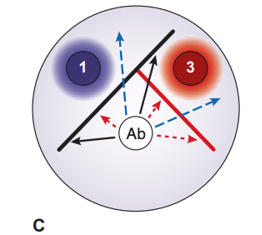
This Ouchterlony diffusion pattern displays ___ fusion. This means antigens share ___ of the same epitopes.
Some antibody molecules are not captured by the antigen and travels through the initial precipitin line to combine w/ epitopes found in the more ___ antigen.
Spur points to the ___ antigen!!! (in this case, well #3)
partial; some; complex; simpler