ITP Topic 7 Thinking and Intelligence
 Call Kai
 Learn
Learn Practice Test
 Spaced Repetition
 Match
Match Flashcards
 Knowt Play
1/52

There's no tags or description
Looks like no tags are added yet.
Name | Mastery | Learn | Test | Matching | Spaced | Call with Kai | Chat |
|---|
No analytics yet
Send a link to your students to track their progress
53 Terms
Cognition
The mental processes involved in acquiring knowledge and understanding.
Thinking
is the mental manipulation of representations of knowledge about the world.
In simpler terms: using and changing information in your mind to reason, solve problems, make decisions, etc.
Mental representations
Analogical representations
these have some of the physical characteristics of the objects they represent. they are usually images (e.g. a map, a clocks hand, or a realistic drawing of a violin
Mental representations
Symbolic representations
abstract representations that do not correspond to physical features of objects or ideas. these are usually words, numbers, or ideas (e.g the word “violin” or the number “5”)
Mental maps
Mental representations of where places or objects are located in relation to each other. They can combine visual (analogical) and symbolic information.
Normative decision theories
explain how people should make decisions rationally by considering the alternatives and choosing the best option
Descriptive decision theories
explain how people actually make decisions, which can involve heuristics, biases, irrelevant information, and emotions
What is a concept and what are the two main models to explain how we form them
is a category or class of related items
prototype model:
We categorize something by comparing it to a mental “best example” or most typical example of the category.
Example: Your prototype of a bird might be a robin. A new animal that resembles this typical bird is quickly categorized as a bird.
exemplar model:
We categorize new items by comparing them to all the examples of that category we have encountered before.
example: You recognize a new dog as a dog by comparing it with different dogs you've seen before.
Prototype = ONE typical/best example
Exemplar = MANY actual examples you've encountered
Schemas
Cognitive structures that organize our knowledge and expectations about people, objects, events, or situations based on past experience.
Scripts
a specific type of schema that directs behaviour over time within a situation (e.g the sequence of buying a ticket, getting a snack, and sitting quietly at a movie)
Consequences of schemas
while adapted for efficiency, schemas can lead to:
stereotypes: fast, automatic processing of information about people based on group membership
gender roles: prescribed behaviour for females and males
Decision making vs problem solving
decision making involves selecting among alternatives
problem solving involves overcoming obstacles to reach a goal
Heuristics
mental shortcuts that are fast and efficient but prone to error
Heuristics and biases
Anchoring
relying on the first piece of information encountered (the “anchor”) to make a judgement
Heuristics and biases
Framing (and loss aversion)
Framing: The way information is presented, emphasizing potential gains or losses, can influence how we perceive it and make decisions.
example: “90% survive” feels better than “10% die.”
Loss aversion: The tendency to be more concerned with potential losses than with equivalent potential gains.
example: losing €50 feels worse than gaining €50 feels good.
Heuristics and biases
Availability heuristic
making a decision based on the answer that comes most easily to mind (e.g fearing plane crashes more than car crashes because plane crashes are more memorable)
Heuristics and biases
Representativeness heuristic
Explain the librarian example and base rate neglect
Making a judgment or categorizing something based on how similar it is to the typical example (prototype) of a category.
For example, imagine someone is described as quiet, enjoys reading, and is very organized. You might assume they are a librarian because they match your prototype of a librarian — even if there are actually far more people in another profession.
That last part is where base-rate neglect can happen: you focus on “How much do they seem like a librarian?” and ignore “How common are librarians actually?”
Heuristics and biases
Confirmation bias
focusing only on information that support existing beliefs
Heuristics and biases
Hindsight bias
creating after-the-fact explanations for events (e.g “I knew it all along”)
Emotion and decision making
Integral vs incidental emotions
integral emotions: emotions caused by the choice itself, which help signal how good or bad an option feels (choice value)
emotions caused by something unrelated to the choice, but which can still influence the decision
Emotional decision making
Affective forecasting heuristic
the tendency for people to overestimate how events will make them feel in the future (positive or negative)
Emotional decision making
Endowment effect
the tendency to value things we own more than things we don’t
Emotional decision making
Appraisal tendency framework
Different emotions create specific ways of thinking and interpreting situations, which can carry over and influence unrelated judgments and decisions.
The paradox of choice
when too many options are available, specially when all of them are attractive, people experience conflict and indecision
Maximisers vs satisficers
maximisers: seek the absolute best choice. they often get objectively better results but are less happy and more prone to regret
satisficers: seek a “good enough” choice that meets minimum requirements. they are generally more satisfied either their decision
Strategies for good decisions
adopt a satisficer mindset
make decisions irreversible (promise to stick with that)
maintain realistic expectations
practice an attitude of gratitude
Intelligence
the ability to use knowledge to reason, make decisions, solve problems, and adapt to challenges
when you talk about intelligence you are concerned about peoples individual differences, this is differential psychology
Testing intelligence
Original IQ formula
Wilhelm Stern
IQ = (Mental Age ÷ Chronological Age) × 100
Mental age (MA): level of intellectual performance
Chronological age (CA): actual age
Testing intelligence
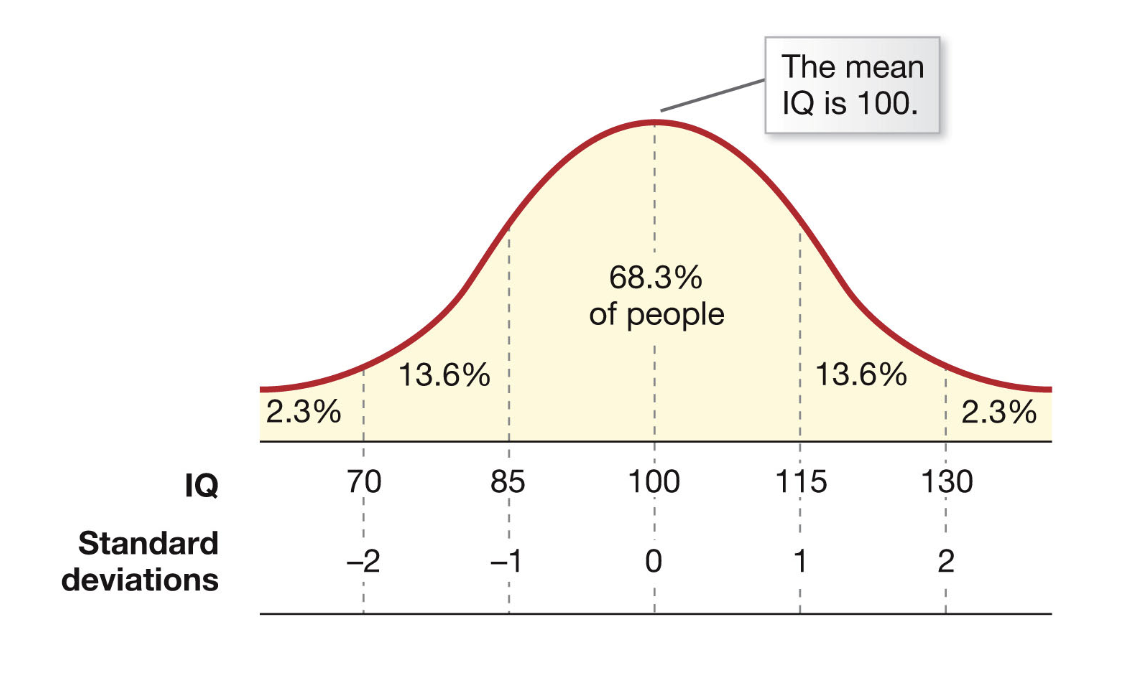
Deviation IQ
Measured against the avarage adult using a normal distribution (bell curve). the mean is 100, and the standard deviation (SD) is 15.
68.3% of people score between 85 and 115
95% of people score between 70 and 130
Intelligence tests for children
Binet / Stanford-Binet
WISC (Wechsler Intelligence Scale for Children)
Intelligence tests for adults
Wechsler Adult Intelligence Scale (WAIS): individual test; featuring both verbal and performance (non-verbal) parts
Raven's Progressive Matrices test: non-verbal test
Scholastic Aptitude Test (SAT): group test
Reliability & validity of intelligence tests
High reliability = results are consistent/stable
High predictive validity = can predict outcomes such as school/work performance; prediction depends partly on job complexity
What is the psychometric approach to intelligence?
An approach that tries to understand the nature of intelligence by studying patterns of results on intelligence tests.
What did Spearman propose about intelligence?
Intelligence consists of:
General intelligence (g): a general ability that affects performance across many tasks
Specific abilities: abilities needed for particular tasks
Theories of intelligence
General intelligence (g)
Charles Spearman (key researcher)
A general intelligence factor (g) underlies performance across different mental abilities.
People also have specific abilities (s) for particular tasks.
Theories of intelligence
Fluid vs crystallised intelligence
Raymond Cattell
Fluid intelligence: ability to reason and solve new problems, without relying on previously learned knowledge.
Crystallised intelligence: knowledge and skills acquired through experience and education.
Theories of intelligence
Multiple intelligences
Howard Gardner
Intelligence consists of multiple distinct abilities, rather than one general intelligence.
People can have different strengths across these intelligences (e.g., linguistic, musical, spatial, bodily-kinesthetic).
Theories of intelligence
Triarchic Theory
Robert Sternberg
Analytical intelligence → analysing, evaluating, comparing, and solving problems.
Creative intelligence → dealing with novel situations and generating/adapting ideas.
Practical intelligence → applying knowledge to real-world situations and adapting to everyday demands.
Theories of intelligence
Emotional intelligence
Salovey & Mayer
The ability to recognise, understand, use, and manage emotions in yourself and others.
Mental processing speed
Reaction time
Intelligent (g) people have faster simple and choice reaction times
Mental processing speed
Inspection time
The amount of time needed to view a stimulus to answer a question about it. faster inspection time correlates with higher IQ
What cognitive measures correlate with g?
Reaction time → simple and choice RT
Discrimination performance → ability to quickly distinguish between stimuli
Working memory capacity → ability to hold and manipulate information
Executive control → ability to control attention and manage competing information
Working memory and intelligence (g)
Working memory is strongly related to general intelligence (g).
This may be because both depend on the ability to maintain attention.
Example: N-back tasks measure working memory.
Brain structure and intelligence
Brain size has a small positive correlation with IQ.
Gray matter volume in the frontal lobes is related to fluid intelligence.
Savant syndrome
Savants have minimal intellectual capacity in most domains but show exceptional ability in one specific area
Is the score on an intelligence test affected by genes or environment?
BOTH!
Nature vs nurture in intelligence
Genetic factors
Behavioural genetics: twin and adoption studies show that the greater the genetic relationship, the higher the IQ correlates
Heritability: estimates suggest genetics account for 40% or variation in crystallised intelligence and 51% in fluid intelligence
Social multiplier: a small genetic advantage can lead to an environment that further nurtures that skill
Nature vs nurture in intelligence
Environmental factors
Prenatal/postnatal:
Nutrition, birth weight, and breast feeding are associated with higher IQ
Nature vs nurture in intelligence
Environmental factors
Socioeconomic status (SES)
growing up in a wealthy family can increase IQ by 12-18 points
Nature vs nurture in intelligence
Environmental factors
Enriched environments
these increase synaptic connections and activate genes involved in brain function (epigenetics)
Nature vs nurture in intelligence
Environmental factors
Schooling
the longer children stay in school, the higher their IQ
The Flynn effect
James Flynn notes that IQ scores have risen dramatically over the last century. Since genes cannot change this quickly, the rise must be due to environmental factors:
better nutrition and healthcare
increased requirements for education and complex cognitive processing in daily life
exposure to technology

Within-group vs. between-group differences in intelligence
Within-group differences: differences in intelligence among individuals within the same group.
Between-group differences: differences in average intelligence between groups.
Key point: The factors explaining differences within a group do not necessarily explain differences between groups.
Example: Plants may differ in height within the same soil, but the average height difference between two groups may be caused by soil quality (environment).