Lesson 97: Essential Macronutrients and Micronutrients
 Call Kai
 Learn
 Practice Test
 Spaced Repetition
 Match
 Flashcards
 Knowt Play
1/35

There's no tags or description
Looks like no tags are added yet.
36 Terms
Macronutrients: carbs
A primary energy source (e.g., sugars, starches)
Macronutrients: protein
Essential for building and repairing tissues (e.g., amino acids)
Macronutrients: water
Crucial for hydration, nutrient transport, and regulating body temperature
Macronutrients: fats
Concentrated energy sources and important for hormone production (e.g., fatty acids)
Function of carbs
Provide energy, heat when metabolized
storage of energy via fat or glycogen
Building blocks for other nutrients
Carbohydrates – Fiber (cellulose / hemicellulose)
Edible part of a plant that cannot be digested or absorbed in small intestine
Function of fiber: cellulose/hemicellulose
Helps maintain a healthy colon
Regulates and promotes healthy bowel function
Provides energy for gut microbes
Protein
Made up of Amino Acids: Lysine, Methionine, Taurine, Tryptophan
Essential vs non-essential
Important for growth and maintenance
Crude Protein =
amount of nitrogen in the feed
Essential Amino acids
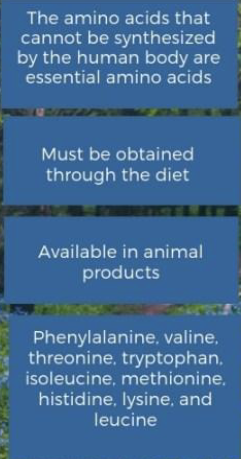
Non-essential amino acids
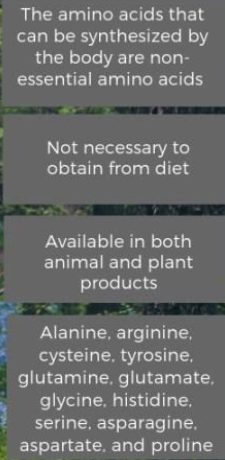
Function of proteins
"Back bone" of all cell walls
Required for all tissue growth, replenishment, and repair
Broken down into energy
Fats
Triglycerides or Fatty Acids
Most efficient source of energy
Fat is added to feed to boost energy levels when intake may be limited due to poor animal health, less palatable feed or environmental stress
Essential Fatty Acids:
Omega 3 and 6
Guide to essential and non-essential fatty acids

Function of fats
Most energy dense → Long term source of energy
Lipase dependent
Help absorb fat-soluble vitamins (A, D, E, K)
Insulation and protection
Benefits of Omega 3 fatty acids

Function of water
Solvent: dissolves nutrients in the body
Digestion and Absorption: breaks down food and absorbs nutrients from GI tract
Nutrient transport: carries nutrients via blood and lymph system
Waste removal: eliminates waste products from the body
Vitamins

Vitamin A (retinol)
Maintain vision, skin, myelin, immune, and growth
Vitamin D
Calcium and Phosphorus absorption, maintain calcium and phosphorus level in serum (bone health)
Vitamin E
Antioxidant, muscular metabolism, immune support, reproductive health
Vitamin K
Formation of blood clotting factors, synthesis of prothrombin, bone metabolism
Vitamin B Complex(1,2, 3, 5 ,6,7, 9,12)
Components of enzymes to utilize nutrients, nerve function, energy metabolism
Vitamin C(ascorbic acid)
Iron absorption, antioxidant, supports immune health
Sources of different vitamins

Minerals: Inorganic substances required for various bodily functions.
Classified as macro minerals, required in larger quantities(> 100mg or more daily), and trace/micro minerals, needed in smaller amounts (<100 mg daily).
Coenzymes, regulators of metabolism
Not stored extensively
Excess can be toxic, may cause adverse effects.
Calcium (Ca) and Phosphorus (P)
Essential for bone/teeth and milk formation, muscle contraction, energy metabolism, cell signaling & nerve transmission
Potassium (K), Sodium(Na), Chloride (C)
Helps maintain fluid balance, nerve function, and muscle contractions.
Magnesium (Mg)
Important for energy production, muscle function, and bone health, enzyme activity
Iron (Fe)
Necessary for oxygen transport in blood (hemoglobin), energy metabolism
Zinc (Zn)
Supports immune function, wound healing/skin health, growth
Copper (Cu)
Important for iron metabolism, connective tissue formation, pigmentation of skin and hair and antioxidant function
Iodine (I)
Essential for thyroid hormone production and regulation of metabolism, growth and brain development
Selenium(Se)
Acts as an antioxidant, supports thyroid function, and immune system health, reproduction
Sources of microminerals
