OCHEM Chapter 18: Aromatic Substitution Reactions
 Call Kai
 Learn
 Practice Test
 Spaced Repetition
 Match
 Flashcards
1/27

There's no tags or description
Looks like no tags are added yet.
28 Terms
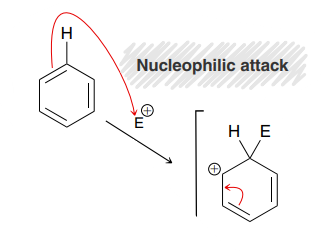
general mechanism for electrophilic aromatic substitution:
step 1: nucleophilic attack (double bond attacks electrophile, forming a ringed carbocation. electrophile attaches to the same carbon atom as the H.)
step 2: proton transfer restores aromaticity to the ring (double bond reforms as H bond collapses into the ring)

bromination reagents
Br2, FeBr3

bromination of benzene step 1 (double bond attacks Br—Br+—Fe-Br3, bromine attached in the sigma complex)
bromination of benzene step 2 (Br—Fe-Br3 bond reaches out in proton transfer, bond collapses into the ring)

chlorination reagents
Cl2, AlCl3
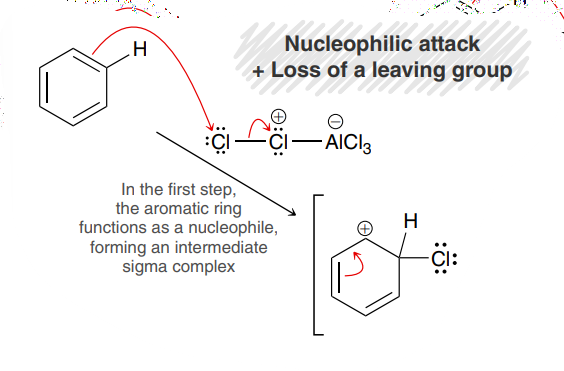
chlorination of benzene step 1 double bond attacks Cl—Cl+—Al-Cl3, chlorine attached in the sigma complex
chlorination of benzene step 2 (Cl—Al-Br3 bond reaches out in proton transfer, bond collapses into the ring)

sulfonation reagents
fuming H2SO4, treat with dilute H2SO4 to attach hydrogen back on


sulfonation of benzene step 1 (double bond attacks SO3)
sulfonation of benzene step 2 (sigma complex reacts with H2O)

sulfonation of benzene step 3
SO3 (electronegative O) attacks the resulting H3O+ ion proton and attaches the H to the SO3.

nitration reagents
HNO3, H2SO4

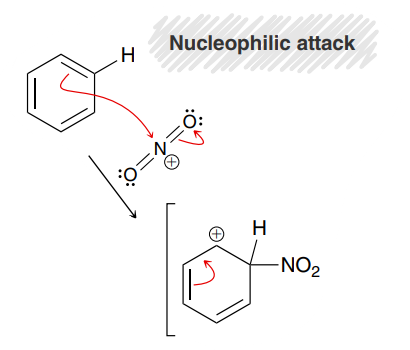
nitration of benzene step 1 (benzene reacts with nitronium ion)
nitration of benzene step 2 (sigma complex reacts with H2O)

amination of benzene (once nitrated —NO2)
treat with 2) Fe or Zn, HCl 3) NaOH to afford the —NH2 amine group

friedel-crafts alkylation reagents
alkyl halide + AlCl3 react to form a carbocation


alkylation of benzene step 1 (benzene attacks the alkyl halide’s carbocation: positive charge on the carbocation should appear above where leaving group’s bond (of alkyl halide) once was)
alkylation of benzene step 2 (Cl—Al-Cl3 bond reaches out and deprotonates, causing the collapse of the bond into the ring. alykl group is now attached)

alkylation exceptions
most primary alkyl halides cannot be used since they readily undergo carbocation rearrangement when reacting with AlCl3
installation of alkyl groups (usually using 2° or 3° alkyl halides) activate the ring toward further alkylation
nitro groups (on a starting benzene ring) are incompatible with friedel-crafts

friedel-crafts acylation reagents
acyl group attached to halide + AlCl3
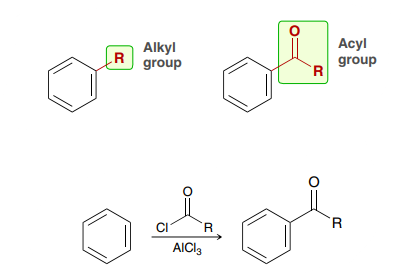

acylation of benzene step 1 (reaction with acylium ion R—C===O+. double bond reaches out and attacks carbon, triple bond goes to O)
acylation of benzene step 2 (reaction with Cl—Al-Cl3 bond reaches out and deprotonates, causing the collapse of the bond into the ring. acyl group is now attached)

reagents for reduction of an acylated benzene
Zn(Hg), HCl, Heat to afford an alkylated product

activators direct substituents in what positions on the ring?
activators are ortho-para directors (ortho 1,2) + (para 1,4). halogens (weak deactivators) are ortho para since since meta attack results in less resonance structures (less possibilities for installation around the ring)

de-activators direct substituents in what positions on the ring?
de
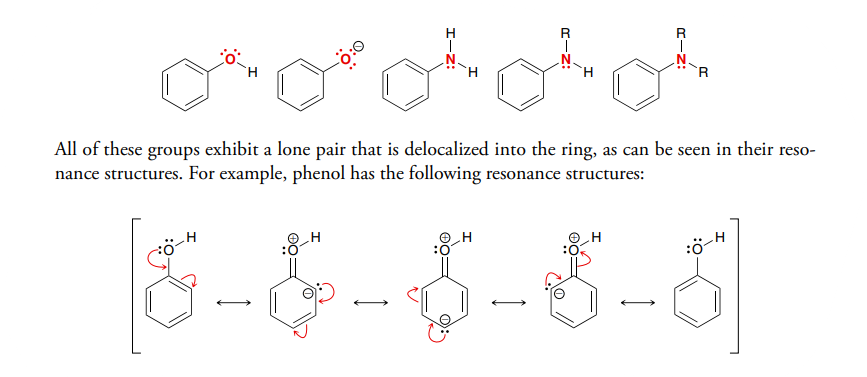
strong activators are characterized by
lone pairs immediately adjacent to the aromatic ring (contribute electron density to the ring, thereby activating it for e-sub reactions)
para favored (1,4) over ortho (1,2)
moderate activators are characterized by
a lone pair that is already delocalized outside of the ring (it also participates in resonance outside of the ring, diminishing electron density to the ring)
para favored (1,4) over ortho (1,2)

weak activators are characterized by
minimal donation of electron density to the ring (hyperconjugation effects are weak)
ortho favored (1,4) over para (1,2)

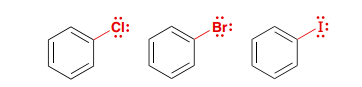
weak de-activators are characterized by
halogens withdraw electron density via induction and their lone pairs do not significantly contribute to resonance
ortho-para favored *EXCEPTION FOR DEACTIVATORS!
moderate de-activators are characterized by
pi bonds connected to an electronegative atom that withdraw electron density from the ring
meta (1,3) favored

strong de-activators are characterized by
strong electron withdrawing groups (resonance and induction)
attack at meta (1,3) favored

monosubstituted rings favor addition at what position?
para generally dominanted over ortho due to steric considerations
ortho is favored during addition to toluene (EXCEPTION)

1,4-disubstituted rings favor addition at what position?
substitution is more likely to occur at a site that is less sterically hindered (determine ortho or para depending how other substituents look)
isopropyl is a weak activating group like the methyl group, yet installation is preferred at the orth position of methyl group since it is less sterically hindered

1,4-disubstituted rings favor addition at what position?
it is extremely unlikely that substitution will occur at the position between the two substituents