Unit 3 Learning Aim B - Health Psychology
 Call Kai
 Learn
 Practice Test
 Spaced Repetition
 Match
 Flashcards
 Knowt Play
1/85

There's no tags or description
Looks like no tags are added yet.
86 Terms
Stress
physical - noise, temp, crowding , sharing a room
psychological - arguments, deadlines, coping
stress responses
physiological (sick sweaty heart rate increase)
physiological (emotions)
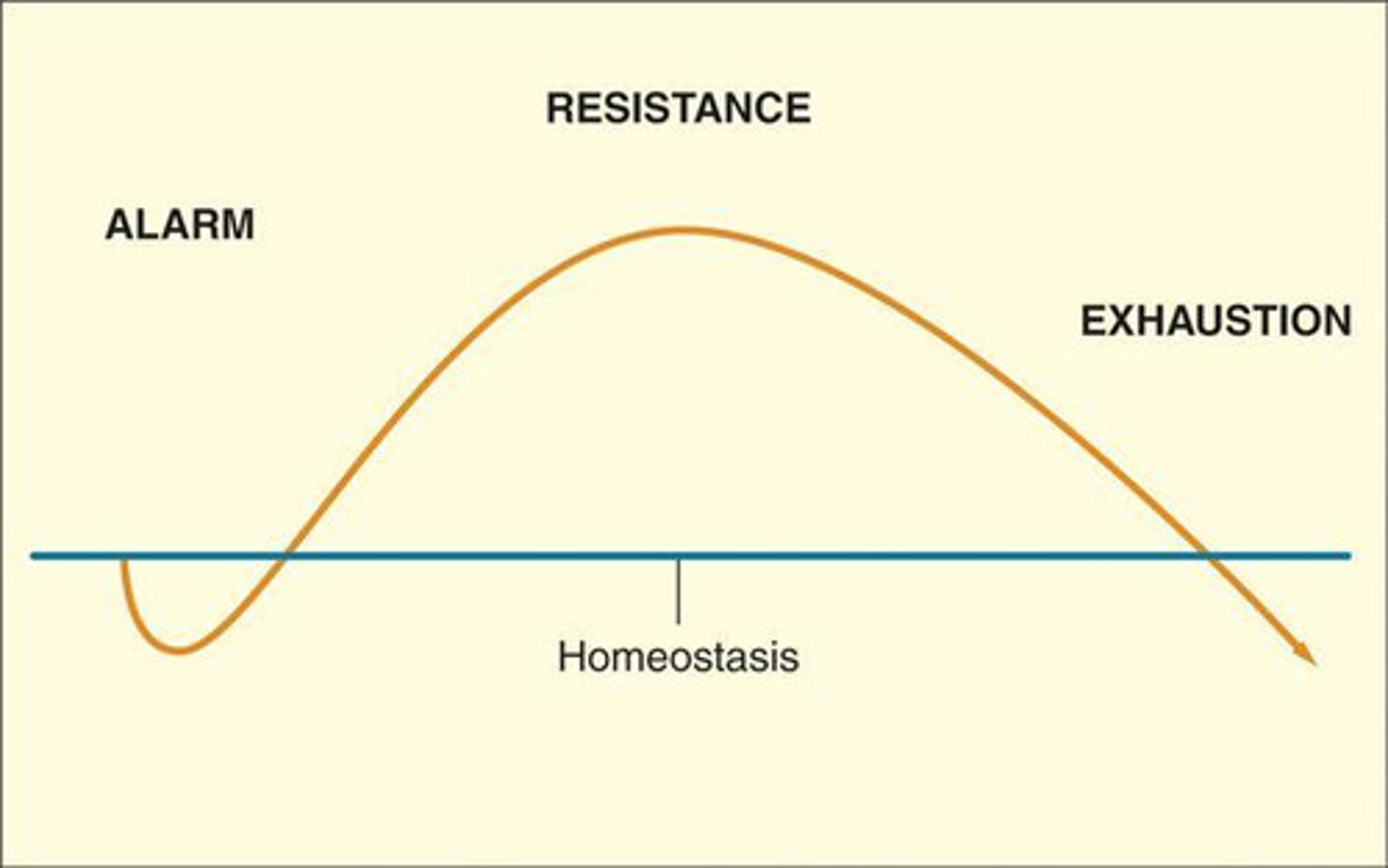
what are the three stages of the General adaptation syndrome (GAS) model (Hans Selye 1936)
1. Alarm - body first reacts to a stressor by producing adrenaline, which prepares you for a "fight or flight" response.
2. Resistance - If the stress continues, your body tries to cope and adapt. Although you may seem okay, your internal resources are being depleted, leading to irritability, poor concentration, and a weaker immune system.
3. Exhaustion - At this final stage, your body has used up all its resources. The physical "fight or flight" symptoms return, your immune system is compromised, and you may experience fatigue, burnout, or depression.
Acute stress: Sympathomedullary System (SAM system)
1. The hypothalamus is part of the brain which is in charge of the stress response, when it is triggered it sends signals to sympathetic branch of ANS
2. ANS is connected to the internal organs. When activated it automatically affects the functioning of the lungs, heart and digestive system creating fight or flight response. Additionally it is connected to the adrenal medulla.
3. The adrenal medulla releases adrenaline this hormone stimulates ANS even more, keeping activity at a high level.
4. During our fight or flight response it increases oxygen intake, increases heart rate and blood pressure and digestion slows down.
Once the threat is gone, the parasympathetic nervous system returns the body to its default state.
Hypothalamic Pituitary-Adrenal system (HPA) - Chronic Stress
1. Hypothalamus is stimulated when brain notices a stressor
2. Signal is sent to the pituitary gland in the brain which releases hormone ACTH (adrenocorticotropic hormone)
3. ACTH travels through the bloodstream to the adrenal cortex which releases corticosteroids, such as cortisol, into the bloodstream.
4. Corticosteroids main two functions:
Releases glucose from the liver to be used by the muscles as energy
They suppress the immune system to redirect energies to other areas of the body, this process is called immunosuppression
what is immunosuppression
immune system ability to fight of antigens is reduced, and are more likely to get infected/get ill.
pituitary-adrenal system cortisol is released in response to chronic stress and helps to conserve energy by suppressing the immune system. However, this immunosuppression makes us vulnerable to illness.
stress and cardiovascular disease CVD
Stress also has an impact on your heart. Stress hormones (cortisol and adrenaline) can cause atherosclerosis - narrowing of the arteries. This can lead to Cardiovascular disease.
what are the strenths of stress responses ?
- Research support
P -The General Adaptation Syndrome model is that there is research to support its assumptions.
E - Selye (1936) experimented with rats, subjecting them to various stressors. He found that typical collections of responses occurred regardless of the stressor
E - Such findings provide evidence of the three stages of GAS, the research shows that the body's general response to a stressor is as physiological reality (at least in rats).
- Beneficial for some people
These situations cause GAS to be beneficial. The alarm reaction gives people a burst of energy and concentration.
For most people however, the physical responses their body goes through when they are under stress is not helpful
what are the weaknesses of the stress responses?
- Gender Differences:
Conducted on male animals, assumed female hormones fluctuate more and would confound the results
Taylor et al (2006) suggest females evolved tend and befriend response to stress, befriending other females for social support
Females release oxytocin during stress which increases relaxation and decreases stress response.
- More than 2 responses
Animals such as rabbits faced with a predator become paralysed. Humans report to be disassociated and become rooted to the spot, this is an adaptive response as some predators could lose interest in non-responsive prey.
This suggests that fight or flight is just a part of a complex response to a stressor.
- Fight or flight is maladaptive
reaction nowadays may not apply due to the absence of similar situations.
fight-or-flight response more regularly which can have physical implications for our body in terms of using up energy and putting continual strain on vital organs like the nervous system.
This means that the fight-or-flight response may not be healthy for humans in modern society.
- Role of perception
Richard Lazarus (1991) we cognitively assess a stressor by working out if it is a threat and if we have resources to deal/cope with it
Non-human animals do not do this. This suggests that our response to stress can only be fully understood by considering cognitive factors alongside physiology.
what are life events?
These tend to be events that would not occur frequently some of them only once maybe in a person's life. The bigger the event the more we have to adjust or change so the more stressful it is thought to be. This counts for positive events as well as negative events
The SRRS
Richard Rahe (1967) and Thomas Holmes discovered a link between the number of life events and the likelihood of getting ill in the near future. They developed SRRS (social readjustment rating scale) which measures the number of significant life events a person has had over the previous 12 months.
what are the strengths of SRRS?
Researchers followed 17000 healthy people over a two year period. They measured the number of Life events the Ps experienced/
After 2 years 192 had developed asthma (none had it in the beginning)
They looked at the life events scores of those people and found they had higher LCU scores the more likely they were to develop asthma.
what are the weaknesses of the SRRS?
Is it a good questionnaire?
Assumes all life changes are bad events and bring stress.
it assumes that the life events are leading to or causing the illnesses but there is no way of knowing if the link is direct. It maybe that the life event leads to habits that affect health
what are daily hassles?
irritating incidents that will cause us stress if we perceive we cannot cope with them.
what are uplifts?
small daily boosts called "Uplifts" might counteract the effect of hassles but there is little evidence for this
what is accumulation?
accumulation of minor daily stressors creates persistent irritations, frustrations and overloads which then result in more serious stress reactions such as anxiety and depression (Lazarus 1999)
what is Amplifications?
chronic stress due to major life changes may make people more vulnerable to daily hassles. As the person is already in a state of distress, the presence of associated minor stressors may in fact amplify the experience of stress. May also deplete a person's resources as they feel unable to cope.
what are primary appraisal
quick assessment of the meaning of a given environmental event for an individual
what is secondary appraisal
when we find ourselves in a stressful situation we try to reassess the situation to see what we can do to lessen the negative effect
- how are we going to solve the problem
Daily Hassles scale
Alan Kanner (1981) developed the hassles scale which has 117 items in different categories. Every day you select the hassles you have experienced that day BUT unlike the life events questionnaire you would indicate on a scale of 1-3 how severe the incident is in terms of the stress it brought and/or how much of an uplift it was.
Retrospective data
negatively affects study reliability primarily through increased risks of research biases and compromised data quality, such as missing information, inconsistencies, and errors. Participants' memories are fallible, leading to biases like recall bias, and data collected for clinical purposes may not meet research standards, resulting in inaccuracies and difficulty in establishing causality.
Timing of Data Collection
Data collected years ago may be less accurate than current data due to memory lapses or shifts in participants' perceptions of events.
Purpose of the Data
Data originally collected for clinical purposes is not inherently designed for research, and its quality and completeness can be insufficient for research purposes.
Cognitive Burden:
Answering detailed questions about the past can place a significant cognitive burden on respondents, potentially affecting the accuracy of their responses.
strengths of daily hassles scale
Research in the 1980s has found that high scores on hassles were a predictor of poor health, doing badly at work and absence from work.
weaknesses of daily hassle scale
Increased Risk of Bias
-Recall Bias: Participants may not accurately remember past events, leading to distorted information.
-Selection Bias: When data is not collected with the study's specific goals in mind, there's a higher chance of selecting data points that are not representative of the population, skewing results.
-Information Bias: Data collected for one purpose (e.g., clinical care) may lack specific variables or details needed for the research, or the methods of data collection might differ from intended research standards, affecting the accuracy of the information gathered.
Compromised Data Quality
-Missing Information: Charts and records reviewed in retrospective studies were not originally designed for research, often resulting in missing information critical for analysis.
-Inconsistencies and Errors: Data may contain inconsistencies, gaps, or outright errors because the data was collected in the past and may not have followed a systematic, planned approach.
-Difficulty in Establishing Causality: The lack of control over data collection timing and methods makes it challenging to determine if an exposure truly caused an outcome, limiting the study's internal validity.
cause of stress: work environment
heating, lighting, temperature, noise and physical arrangements.
cause of stress: organisational
lack of opportunities for promotion, decision making, relationships.
cause of stress: role conflict
Lack of work/life balance
Being given too much to do by different bosses
Competing deadlines
2 types intra and inter conflict
what is intra role conflict
too many demands in the individuals inside the workplace, e.g. meeting deadlines for politics and history at the same time.
inter conflict
- a person is torn between two roles they have in life one being outside the workplace. E.g. worker and parent
cause of stress; level of control
Having control of a situation makes us feel like we are in charge of our lives. The workplace becomes stressful when we feel we have no choices or control. Not managing your own workload and pattern of work, e.g. shifts are decided by other people, when big projects are due.
strengths for cause of stress
Research support for control
Hons Bosma et al (1997) found workload was lesser stressor than lack of control
Employees with lack of control were more likely to have heart disease 5 years later.
weaknesses for cause of stress
Validity may be an issue
Usually conducted as questionnaire
Hard to pinpoint what exactly stressful about some jobs
May not test what we want them to.
Cultural differences
Individualistic cultures (UK/US)
Collectivist control (Japan/China)
Changing nature of work
Working practises change rapidly
New technology means more people working from home
Research into stress may be out of date
what is a type A personality ?
Constant time pressure, doing several jobs at once, being intensely competitive at work and social situations and frustrated at the efforts of others. Anger and hostility.
Build up of plaque in arteries + blood pressure = heart attack
More risks to stress because:
Negative affectivity
Transactional hostility
Reduced social support
Stress management to help
what is type B personality
Laid back, relaxed, tolerant of others, opposite of type A. less prone to hostility.
what was the aim of identifying personalities
Meyer friedman + ray rosenman - study personality link risk of heart disease
Assessed personality using provocative interviews to try indicate type A behaviour and check any signs of CHD.
what is the Hardy personality?
Some people have high levels of stress, but they don't suffer medically as a consequence.
These people are rarely ill and have certain personality characteristics.
Commitment
Sense of purpose in life,
committed to their work, and tackle tasks head on
Challenge
See problems as challenges rather than difficulties
Devote time and energy into solving them in order to succeed
Control
Believe they are in charge of their life and they have the power to change it.
If they don't have the skills to do something, they will go out of their way and get them.
Suzanne kobasa 1979
Control over their life, commitment involved with the world around them, challenge situations in life are opportunities rather than threats
Used SRRS questionnaire to determine stress scores, check illness records and make them completely a hardy questionnaire.
Parents of autistic children were given personality tests
They chose these parents because autistic children tend to cause more stress on the parents in early years
They found that parents that had the 'hardy' personality trait had the least amount of stress related symptoms
evaluation of hardy personality
May not be consistent over time, people can change
Ard to generalise and give something that trait. It requires subjective evaluation
Some people may only have some of the C's
Shows the theory behind hardiness is correct
Hardiness training is shown to lower stress levels better than mediation in an office community
what are the strengths of personalities?
Type A : may make you prone to the physically negative effects of stressors came from their western collaborative group study
Over 300 men categorized into type A and B or type X
After 8 years 257 men developed CHD 70% were from type A.
Salvador Maddi (1987), studied managers at the Bell Telephone Company in the US during a stressful time as the company was reorganising.
They classified the workers into 2 groups:
1. Those who were suffering from stress and illness
2. Those who had no bad effects and reported feeling happy and stable at work.
They found that those in group 2 scored much higher on the 3C's than those in group 1 - they seemed to have personalities that enabled them to cope better with stress
what are weaknesses to personalities
- Recent research has focussed on whether particular features of the personality types are more important than the others.
Type A - seems to make us more susceptible to stress, men with worst heart disease were not able to control their anger
Hardiness it is control.
- Self-report is subjective and may not be as valid
Both types of research rely on self-report questionnaires which means that they could be at risk of the participants feeling a social desirability bias. This might mean that participants exaggerate the extent to which they have these characteristics in order to "show off" or they may underestimate the extent to which they have these characteristics in order to "cover up" traits that they feel are unattractive or less desirable
initiation
why people start
Genetic predisposition - genetic influences contribute 53% to the risk of taking up smoking. Evidence come from twin studies (Vink et al)
Dopamine receptors - ventral tegmental area (VTA) have receptors on their surface which respond to dopamine molecules. Nicotine molecules also attach to these dopamine receptors. Smoking triggers dopamine release in the nucleus accumbens (NA). Feelings of pleasure are rewarding because of the dopamine release -they become 'hooked'
maintenance and relapse
maintenance - why people keep smoking
relapse - why people go back to smoking once they have given up
Role of dopamine - smokers continue because nicotine molecules continue to attach to receptors in the VTA and dopamine is released in the NA. dopamine releases rewards the smoking behaviour.
Nicotine regulation - people continue to smoke to regulate nicotine in their bloodstream. Smokers continue to smoke to avoid withdrawal symptoms
Withdrawal symptoms - after finishing smoking, withdrawal symptoms appear (anxiety, craving) to avoid this they smoke as the earliest signs. This increases their nicotine levels.
Tolerance - constant stimulation of dopamine receptors reduces their sensitivity. Smoking more makes it restimulate and achieve the sensations they used to get. Including tolerance to mood changing effects (fewer headaches)
nicotine
Biological effects
Travels to the brain and causes a feeling of temporary relaxation/stress relief
Can elevate mood and heart rate
Nicotine produces physical and mood-altering effects in your brain that are temporary pleasing
This makes you want to use tobacco and create dependance, at the same time stopping can cause withdrawal symptoms including irritability and anxiety.
Biological effects
Nicoten acts as a stimulant and a depressant to the central nervous system, nicotine first causes the release of hormone epinephrine, which further stimulates the nervous system.
Nicotine receptors received by ventral tegamentalis are, and dopamine released in nucleus accumbus and prefrontal cortex.
Vink et al. 2005 Heritability of smoking initiation and nicotine dependence
Aim: wanted to see if genetic risk factors contribute separately to smoking initiation and dependence
Procedure: gathered smoking related data from the Netherlands twin register on five occasions between 1991 and 2000. The data came from 868 monozygotic (MZ) twin pairs and 704 dizygotic (DZ) twin pairs. In the final survey smokers and ex smokers complete fogerstrom tests for nicotine dependence (FTND).
Findings: smoking initiation - 44% of the variation between individuals was explained by genetics (56% environment).
Nicotine dependence - 75% of the variation between individuals explained by genetic factors (25% environmental)
Initiation in terms of behaviourists approach in smoking
- Social learning theory; where individuals may observe adults and role models smoking make positive associations and imitate them; they seek the same result as the person they observe.
- Operant conditioning: peers might encourage smoking so the person experiences positive reinforcement by the reward of acceptance along with stress relief.
- Classical conditioning: association is made between smoking and increased mood, creating conditioned response behaviour.
maintenance in terms of behaviourists approach in smoking
Negative reinforcement - smoking is reinforced by the removal of unpleasant experience
Classical conditioning - before smoking, people get no pleasure from sensory information such as holding a cigarette or smelling the smoke. Gives pleasure automatically without learning.
relapse in terms of behaviourists approach in smoking
- Conditioned cues - smoker associates places, people and things with pleasure through classical conditioning, example, pub, friends, alcohol.
When an ex smoker encounter conditioned cues, they get the pleasure associated with nicotine, witch trigger the cravings again
- Self efficacy - people with low self efficacy will not have confidence in their ability to stop smoking and start again at the first sight of cravings.
A pleasurable effect is called a primary reinforcer. Smoking is accompanied by lots of other things that are called secondary reinforcers or conditioned cues as they become associated with the primary reinforcements. Explains why smokers who have quit often relapse into their addiction
what is the self medication model?
views addiction as a way of relieving current feelings of distress caused by past experiences of trauma. How we perceive or think about the trauma and distress is a cognitive process
initiation in terms of alcohol in cognitive approach
Self-medication model of alcohol addiction - Edward Khantzian
- Mitigation for current state: Someone who has experienced trauma in childhood (abuse, neglect, loss of a parent) may develop a mental disorder (depression, anxiety)
Someone may turn to drugs such as alcohol to relieve their symptoms.
This self medication has a soothing function
- Specific effects:
Self medication is used to manage negative emotional states, the choice of a drug is not random. There is a link between the specific state and the drug used to relieve it = Khantzian called this Specificity
maintenance in terms of alcohol in cognitive approach
- 'Self regulation disorder':
Lack of skills to cope with stress or in a social situation
Self regulation disorders
Use t o overcome problems
Short term ability to relieve lack of self care, low self esteem and poor relationships
- Stress relief:
The persona cannot soothe themselves because of trauma. They can not judge their true value or worth
relapse in terms of alcohol in cognitive approach
- Counterproductive: and self-defeating by creating a rebound effect, symptoms worsen and provoke relapse
- Increase of stress levels: person who is dependant on alcohol who reduces or ceases their use will experience withdrawal symptoms which increases stress
- Solving problems causes relapse: solution of stress is to drink again or use other drugs to manage symptoms.
strengths of alcohol cognitive approach
- trauma and distress
One strength is the self medication model is overwhelming evidence for supporting the role of early trauma. A study by Vincent et al. found that a strong relationship between ACE scores and later addiction and other risk behaviours. This shows that childhood trauma is linked to addiction in adulthood, as predicted by the model .
- self medication and addiction
conforming link between self-medication and risk of addiction. Samuel lazareck et al. studied the drug use more than 34,000 American adults over 3 year period, these self-medicating participants were up to seven times more likely to develop an addiction to the drug over the three years. show that the model is correct in predicting self medication is a substantial risk factor and development for alcohol.
weaknesses of alcohol cognitive approach
- cause and effect
A weakness is that the evidence is showing that underlying mental disorder does not cause addiction. A case assessed depression and alcohol dependence, they found that depression did not cause alcohol abuse, instead alcohol caused a greater risk of depression. This means that alcohol addiction can be the result of self medication for symptoms of a disorder.
- role of specificity
lack of evidence for the role of specificity in the model. anna lembke points out that in most cases, people who are dependant on one drug also use at least on other equally often. many young people with mental disorders prefer drugs that are used by their peers. emotional distress is not main motivator. model may be wrong in claiming that people self medicate with a drug that best addresses their symptoms.
initiation in terms of alcohol in behaviourist approach
- Positive reinforcement:
Can be direct or indirect. Alcohol activates the brain's dopamine reward system relatively quickly, alcohol molecules attach to dopamine receptors on neurons in the ventral tegmental are (VTA), dopamine is released in a nearby are called the nucleus accumbens and in frontal areas of the brian, which creates a sense of pleasure.
This results in the drinking experience positive reinforcement, they may be in an environment where they receive rewards for drinking, friends praising for engaging in drinking games. Pleasurable sensation reinforces their behaviour. Which is likely to be repeated.
Indirect effects are related to parental and peer role models, as discussed in relation to smoking addiction. A young person observing other alcohol enjoyers. They experience these rewarding effects second had - vicarious reinforcement-
- Negative reinforcement:
Some people experience alcohol as a way of escaping stressful lives. People learn this from watching films where the character has a drink to unwind or to avoid pain.
maintenance in terms of alcohol in behaviourist approach
- Positive reinforcement:
Drinking provides ongoing rewards which make drinking likely to be repeated. A related feature of maintenance is motivational toxicity, the rewards from drinking exceed those from previously rewarding activities because drinking becomes central to the person's life, even only as a source of reward.
- Negative reinforcement:
Drinking maintained overtime to avoid or reduce withdrawal symptoms. When someone dependent on alcohol stops drinking, they experience unpleasant and sometimes disturbing withdrawals. These symptoms can be avoided again by drinking, relief from withdrawal symptoms, it strengthens the behaviour. In some cases the fear of withdrawal symptoms can be enough to trigger drinking before symptoms occur.
relapse in terms of alcohol in behaviourist approach
- Negative reinforcement:
The learning process that initiates and maintains drinking can also cause relapse. At any point in the process of abstaining the relief gained from drinking again can be strong enough to provoke a relapse. Even when withdrawal is over and relief is no longer a motivator alcohol may still be an attractive escape from reality.
strengths of alcohol in terms of behaviourist approach
Evidence to support negative reinforcement as an explanation of relapse
George Koob (2009) drinking again to relieve the symptoms of withdrawal may be controlled by a brain structure called the amygdala. This becomes hyperactive during withdrawal, activating hypothalamic-pituarity-adrenal system. And making an ex drinker vulnerable to stressors, making relapse likely.
Practical applications - opened up several possibilities for treating alcoholism
Drinkers often use alcohol to avoid unpleasant consequences. Cue exposure with response prevention treatment, forces drinkers to confront these consequences.
weaknesses of alcohol in terms of behaviourist approach
Mixed evidence for dopamine - suggests dopamine is not critical to the effects of alcohol
Destroying the nucleus accumbus of a rat eliminates dopamine release but the rat will press a lever at a high rate to receive alcohol. Jennifer Mitchell et al. showed that drinking in humans is associated with the release of chemicals called endorphins, dopamine may not be the key biochemical factor at all stages of alcohol addiction.
Narrow explanation - operant conditioning cannot explain the transition from use to abuse of alcohol.
Most people try alcohol at some point and many will enjoy alcoholic drinks on a regular basis, but a few of them become dependant. this suggest that other non-conditioning factors are crucial in alcohol addiction, the most obvious and probably most influential of these being genes.
what is the difference between addiction and compulsion?
Addiction:
Trying something, becoming emotional and physically dependent and being addicted to it.
Compulsion:
A never ending thought that urges you to do (shop) something.
what is the initiation when it comes to shopping?- behaviourists approach
- Role models and vicarious reinforcement:
Someone who observes role models enjoying shopping and its outcomes will experience vicarious reinforcement. This could trigger a desire for the same reward in someone who hasn't been shopping to that extent before.
- Celebrities and advertisements: Goods are presented as bringing pleasure to the buyer. Adverts suggest buying can give you pleasure and gain success or status.
We look up to celebrities more than our friends because we want what the celebrities have, role, status, money ect.
Companies instead could limit use of celebrities and instead of professionals with being honest and using facts, the pros and cons.
what is the maintenance when it come to shopping - behaviourists approach
- Positive reinforcement:
Becomes compulsive because of its rewarding effects.
Friends may shop together and discuss purchase, gaining status and praise
Features of shopping environment are also positively reinforcing - sound, colours, smells -
- Adrenaline rush and rewards:
Possible link to dopamine reward system. Behavioural addictions are to trigger the same biochemical process that is involved in drug addiction.
- Negative reinforcement:
Aftermath of a binge shopping is often the feeling of emptiness, they continue to shop to block the negative feelings, motivating them to shop again.
what is the relapse when it comes to shopping? - behaviourists approach
- Cues associated with shopping:
Even after they have gained some control over their shopping they are susceptible to shopping related cues which are hard to avoid as they are everywhere (shops, TV adverts, social media). Triggers the arousal the shopper associates with their compulsion - cue reactivity.
- Relief from withdrawal symptoms:
Negative emotions such as anxiety, depression, emptiness are experienced and are relieved by shopping again. This is only temporary so compulsive shopping becomes a cycle of destructive behaviour, recovery and relapse
strengths to behaviourists approach explaining shopping addiction
- Gender differences:
Most researchers indicate that male and female compulsive shoppers buy different categories of product (Dittmar 2005). Women compulsively shop for clothes, purses, shoes, perfumes, make up and jewellery. Men shop for electronics, suits, watches and cars. These items match stereotypical gender roles and buying them attracts positive reinforcement from others, this supports the view that operant conditioning plays a key role in shopping addiction
- Role of shopping
supports advertising as a cue to shopping. The study reviewed 46 studies into the effects of celebrities in adverts. Shoppers attitudes were significantly more positive towards products when they were endorsed by celebrities than they were not. Some of the reviewed studies concluded that participants often perceived a celebrity as someone they like. This shows that identification plays an important role in how adverts featuring celebrities influence attitudes towards products.
weaknesses to the behaviourists approach to shopping
- Self report
Participants indicate the extent of their shopping compulsion by completing questionnaires = high degree of social desirability bias. Depending on participants' subjective interpretations, research findings may underestimate the extent of shopping addiction.
- Cognitive factors
Hard to explain several features of shopping addiction on the basis of reinforcement alone for example. Patrick trotzke et al. 2015, they found that positive r, of excitement was not enough to explain compulsive shopping. The most satisfactory explanation of shopping addiction could be one that combines cognitive and behavioural factors.
what is the Madame Bovary Syndrome?
someone who is compulsive to buy something just to fill a gap of boredom in their life.
what does the self-medicating model suggest about addiction?
Use substances or other effects of other addictive behaviours, they do not seek euphoria, but to relieve dysphoria or change an uncomfortable emotional state.
what is the initiation when it comes to shopping - cognitive approach
- Excitement and relief from boredom: might find shopping exciting and an easy-accessed activity to relieve boredom. No cost in buying things as virtually everything can be returned. Can develop into a habit
- Psychological problems, distress and lack of self esteem: relief from emotional distress and low self esteem that may be associated with mental disorders
Edward Khantizan 1985 - claimed issues such as emotional distress originate in childhood trauma. The trauma may have been buried but is brought back to the surface by the stress of a major life event.
what is the maintenance of shopping - cognitive approach
- Reduction of anxiety: compulsive shopping means spending money which leads many people into serious financial problems, debts cannot be repaid. Experiences anxiety when they consider the true consequences of their addictions. They may face a cue that triggers anxiety - bank statements -
The behaviours can be relieved by behaviours that disguise the shopper's reality (e.g. hiding bank statements, avoiding friends). But the simplest method is to continue shopping.
Compulsive shoppers often get into serious debt because they spend huge amounts of money. This adds to the stress, which in turn creates anxiety.
- Continuation of boredom/anxiety relief: Compulsive shoppers often report that they think of nothing else when they are shopping. Their attention is very narrowly focussed on what they are doing. Shopping relieves their anxiety, provides excitement and allows them to forget their everyday lives. Richard Elliott (1994) called this the 'mood repair' function of shopping
what is the relapse of shopping - cognitive approach
- effects of withdrawal: shoppers who decide to stop are vulnerable to the feelings of distress. Boredom and loneliness they are trying to relieve, and face anxiety to financial consequences.
- Breakdown of coping strategies: Khabtizan 1985 believed the addiction cycle could be overcome by treating the underlying emotional distress.
A compulsive shopper needs to find other ways to deal with underlying problems. E.g. increasing self esteem emotionally stabilizes the person. Therapy may help, making friends, work or hobbies.
what are the strengths for shopping cognitive approach?
- Support for early trauma
Gilles valence et al. 1988 compared the family histories of compulsive shoppers and non-compulsive control participants, compulsive shoppers reported significantly more experiences of family dysfunction in their childhoods. Wayne DeSarbo and Elizabeth Edwards 1996 linked childhood abuse and neglect with later emotional distress. Behaviour that self medicates distress arising out of early trauma and neglect.
- Link to mental disorders
Donald Black 2007 compulsive shopping is co-morbid with several disorders. 41% and 80% of compulsive shoppers also have an anxiety disorder, the model is correct in claiming current emotional distress arises out of mental disorders
what are the weaknesses for shopping cognitive approach?
- Non - cognitive factors important
Ignores or minimises the role of non cognitive factors
Parents with mental disorders create dysfunctional home environments which cause trauma in children, mental disorders have significant genetic components, why children grow up develop depression/anxiety as well as shopping addiction.
- Cause and effect
Unclear
Under researched
Mental disorders should occur before compulsive shopping develops, but very little evidence to conform.
what is the initiation of gimbling - cognitive approach
- Cost benefit analysis - depends on the persons expectations of the future costs and benefits of their behaviour
Potential cost = financial losses and anxiety
Potential benefits = enjoyment, financial gain and feeling control
If the benefits outweigh the costs they are more likely to gamble.
what is the maintenance of gambling? - cognitive approach
- Irrational thoughts - how probability, chance and luck operate. E.g gamblers fallacy is the mistaken belief that if something happens more frequently than normal in a given period. It will happen less frequently in the future vice versa
- Cognitive biases - thinking is biased toward perceived favourable outcomes. E.g near miss bias.
- Illusions of control and exaggerated ability - addicted gamblers may believe they can influence a gambling outcome. They might consider some superstitious behaviour to alter the odds in their favour. Others believe they have special knowledge that makes them experts.
what is the relapse of gambling? - cognitive approach
Recall bias and overestimation of success - their memory is self-serving. The recall wins and success and overtime the benefits of gambling. They forget losses and make gambling seem more attractive again.
what are the strengths to explain gambling - cognitive approach
- Practical applications
Supported by cognitive therapies that address the cognitive biases and irrational thoughts and replace them with more rational ways of thinking about gambling. This supports the view that distortions underline addictive gambling behaviour because tackling theme reduces.
what are the weaknesses to explain gambling - cognitive approach
Problems explaining initiation and maintenance
Cannot fully explain the link between cognitions and gambling
People with irrational thoughts and disordered cognitions about gambling but very few people start gambling in the first place. This suggests that cognitive factors are not enough to explain why people start and continue to
what is the initiation to gambling? - behaviourist approach
- Social learning - many people begin gambling by observing models and experience vicarious reinforcement. Observation can be direct and indirect, through social media reports and presentations of lottery winners, the glamour of horse racing etc. this can trigger a desire for the same reinforcement for someone who hasn't gambled before.
- Classical conditioning - first time gamblers enjoy the intense external - flashing lights, noise etc - and internal - excitement, tension - sensations they experience. These become associated with gambling activity - conditioned stimuli -
what is maintenance when it come to gambling? - behaviourist approach
- Positive reinforcement - provides opportunities to win money as we have an exciting 'buzz'. Both reward a gamble and make it likely to be repeated.
Big wins usually happen not long after a gambler has started, which reinforces them to keep gambling
Near misses are also reinforcing the behaviour. Near misses provide a short-lived burst of excitement and tension.
- Negative reinforcement - used as an escape of reality for some people. The temporary relief from everyday anxiety is negatively reinforcing and again strengthens gambling addiction.
- Partial reinforcement - occurs when only some instances of behaviour are rewarded, B.F. Skinner 1948 showed that this schedule causes the learned behaviour to persist for a longer time than continuous.
- Variable reinforcement - only a certain proportion of gambles are rewarded. E.g. A fruit machine might pay out after an average of 10 spins but not every 10th spin. Very highly unpredictable pattern of reinforcement. Gamble cannot be sure when the reward will appear if they continue to feed a fruit machine or place bets.
what is relapse when it comes to gambling - behaviourist approach
- Cue reactivity - explains how gambling can be reinstated after the gambler has quit. Experienced gamblers encounter many conditioned cues. These are stimuli that become reinforcing because they are associated with psychological and emotional arousal. They include adverts for gambling, the colourful look of lottery scratch cards, and the noisy flashy environment of a casino. They cue the arousal that the ex gambler will likely crave it again.
what are the strengths to explain gambling - behaviourists approach
- Evidence that support learning approach
Mark Dickerson 1979 observed gamblers in two betting offices in Birmingham. High-frequency gamblers consistently placed their bets in the last two minutes before the start of the race. If low frequency gamblers had not placed their bets by this point they were more likely to bet on the next race instead. They delay their bets to prolong the excitement.
- Role of partial reinforcement
Rachel Horsley et al 2012, compared high frequency gamblers and lower frequency gamblers in their sensitivity to partial reinforcement on a computer game. Some participants received reinforcement every time they successfully solved a puzzle. HFG continued to play longer even though reinforcement stopped. Show how partial reinforcement influence addicted gamblers to continue even if their losing.
what are the weaknesses to explain gambling - behaviourists approach
- Role of individual differences
Mark Griffiths and Paul Delfabbro 2001 that responses to identical stimuli differ from person to person, as do motivation. Some people gamble to relax others to experience arousal. Some people quit even though they experience cues. These findings are difficult for learning theory to explain without including cognitive features of gambling.
- Lacks explanatory power
Some gambling outcomes are due entirely of chance or luck so the gamblers have no opportunity to influence them. Other gamblers benefit from the skill of the gambler.This is hard for the learning theory to explain addiction to gambles requiring skill in which there is a delay between bet and outcome.
Illusion of control
Mistaken belief of having a special ability to influence the operation of chance outcomes.
Irrational thoughts
ideas and beliefs that do not have logical bias in reality
Recall bias
Self-serving memory that exaggerates the benefits of a behaviour and minimises the costs.