Intro to innate and adaptive immunity
 Call Kai
 Learn
 Practice Test
 Spaced Repetition
 Match
 Flashcards
 Knowt Play
1/99

There's no tags or description
Looks like no tags are added yet.
100 Terms
Myeloid
innate responses (erythroid, granulocytes, agranulocytes)
Lymphoid
generally adaptive responses (lymphocytes, natural killer (NK) cells)
Erythroid
RBCs, anucleate when mature, platelets=magekaryocytes
granulocytes
neutrophils, eosinophils, basophils
neutrophils
phagocytic, most abundant (ex: PMNs)
Eosinophils
parasitic worms and allergies
basophils
inflammatory, allergies
monocyte/macrophage
phagocytic, antigen presenting cells (APC)
Dendritic cells
phagocytic, APC
Mast cells
inflammatory, allergies
lymphocytes
B,T- antigen specific
natural killer (NK) cells
NON antigen specific, recognize altered-host cells
most and least abundant WBC types
most: neutrophil (40-75%)
least: basophil: <1%
Neutrophils (PMNs)
typically first to arrive at infection, associated with bacterial infections
Basophils and eosinophils
-release pro-inflammatory factors
-relatively low % in blood
-associated with allergies (eosinophils=worm infections)
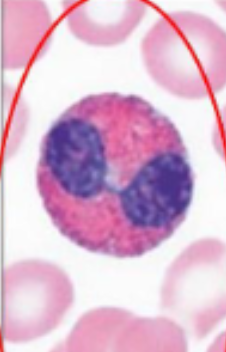
dumbell shape= eosinophil

purple-black granules= basophil
Monocytes
-phagocytic
-LARGEST wbc
-in tissue develop into macrophages
-bridge adaptove and innate resposnes

kidney shape= monocyte
Lymphocyte
-T or B lymphocyte
-adaptive responses that are antigen specific

left= resting lymphocyte (big circle inside)
right= reactive lymphocytes
where do blood cells originate
bone marrow, specifically hematopoietic stem cells expressing CD34 protein
where do RBCs and some WBCs originate from
myeloid lineage
where do lymphocytes originate from
lymphoid lineage
myeloid cells
granulocytes and agranulocytes, for innate defenses
Lymphoid cells
-the adaptive defense, forms lymphocytes and includes B and T lymphocytes
-NK cells are from here, but not part of adaptive responses
Innate immunity
-born with
-fast acting
-barriers, cells, and seurm proteins
Acquired (adaptive) immunity
-improves with exposure
-primarily mediated by lymphocytes (T and B cells)
Cells of innate immunity
NK cells, macrophages, dendritic cells, granulocytes
Cells of acquired immunity
T and B lymphocytes
Innate immunity soluble mediators
cytokines, chemokines, defensins, pentraxins, complement
Acquired immunity soluble products
Cytokines, chemokines, antibodies
Innate immunity: first lines of defense (6)
-saliva (antibacterial enzymes)
-tears (antibacterial enzymes)
-skin (prevents injury)
-stomach acid (low pH kills harmful microbes)
-mucus lining (traps dirt and microbes)
-’good’ gut bacteria out compete the bad
phagocytes
destroy infected/damaged cells via phagocytosis
NK cells
Lytic (related to destruction of cell membrane)
cytokines and chemokines
pro-inflammatory and chemotactic (moves cells)
Lysozyme
antimicrobial molecules
Complement cascade
Cell lysis, inflammation, and opsonization
Inflammation
isolate, recognize, and destroy microbes
4 Phagocytosis steps
chemotaxis
recognition
ingestion
digestion
General phagocytosis process
neutrophils and monocytes/macrophages engulf microbes and cell debris of injured tissues
Pus formation
PMNs die after digesting debris and release a liquid to liquify bacteria, this forms pus
Complement cascade
-involves 30 different proteins
-cascade of events results in cell lysis, opsonization, and/or inflammation
-mostly made by liver cells
-MOST effective against bacterial infections
3 complement casdade pathways
-classical
-MB-lectin pathway
-alternative pathway
Classical pathway
-antigen=antobody complexes
-C1q, C1, C1s, C4, C2
MB-lectin pathway
-mannose-binding lectin binds mannose on pathogen surfaces
-MBL, MASP-1, MASP-2, C4, C2
Alternative pathway
-pathogen surfaces
-C3, factor B, factor D
C’ activation responses
-cell lysis (MAC, membrane attack complex)
-opsonization of Ag (tagged substance removed by C3b)
-mediated inflammation (products bind to mast cells, basophils and neutrophils, releasing histamine), involves C3a and C5a
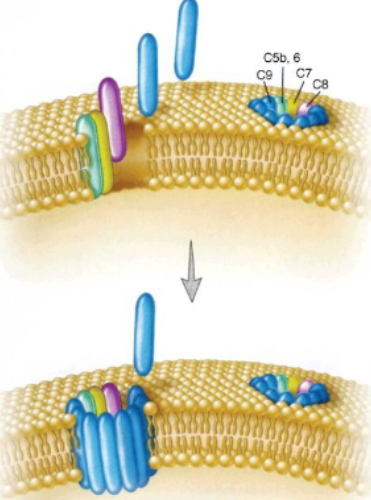
MAC (membrane attack complex) of complement cascade
Interferons (3 types)
IFN-alpha, IFN-beta, IFN-gamma
IFN-alpha and IFN-beta
-have direct anti-viral effects
-made by mostly virally infected cells
IFN-gamma
-made by immune cells (T and NK cells)
-key in immune system activation
-NK cells=innate defense, kill altered self cells
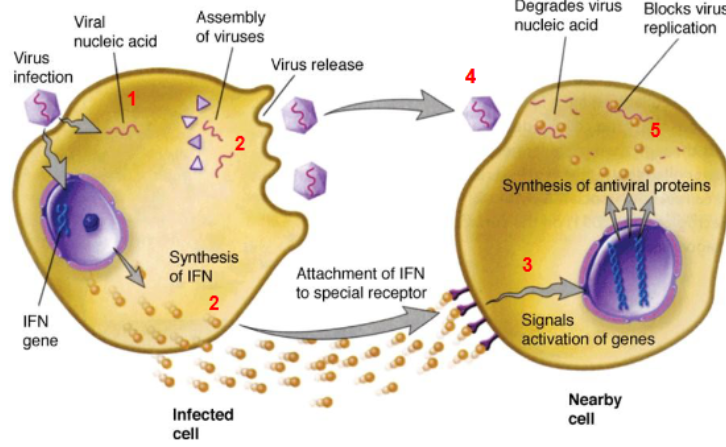
IFN-alpha,beta (with IFN attachment to special receptor)
Lysozyme
-made by cells of the mucous membrane (tears, saliva, mom’s milk)
-hydrolyzes the beta-1,4 linkage of bacterial peptidoglycan

Arrow shows the beta-1,4 linkage that lysozymes hydrolyze
Cardinal signs of inflammation
-heat (calor)
-redness (rubor)
-pain (dolar)
-loss of function (functio laesa)
Histamine
along with other chemicals stimulates increased blood flow
3 pro-inflammatory cytokines
-Interleukin 1 (IL-1)
-interleukin 6 (IL-6)
-tumor necrosis factor alpha (TNF-alpha)
Heat
-increased blood flow to area
-localized increase in pressure
-inc chem rxns, inc cell activity
Redness
-increased blood flow to area
-more RBC and WBC to area
Swelling
-smooth muscle dilation
-fluid accumulation
Pain
-release of chemicals to stimulate nerves
--bradykinin and prostaglandin E2 (PGE2)
Loss of function
combination of factor
Inflamed periodontitis
inflammation along with T cells (cytokines) and antibodies cause tissue damage
immune response barriers
skin and mucous membranes
immune response cells
phagocytic and NK cells
immune response chemicals
complement cascade and interferons (IFNs), lysozymes, inflammatory cytokines
adaptive defenses are primarily from
Action of B and T lymphocytes
C3 Convertase of complement cascade
-C3a and C5a—>inflammation
-C3b—>binds to phagocytes—>pathogen opsonization
-C3B—>terminal complement components(C5-C9)—>lysis of certain pathogens and cells
1st line of host defense
(non-specific) skin, mucous membranes, chemicals
2nd line of host defense
(nonspecific) phagocytosis, complement, interferon, inflammation, fever
3rd line of host defense
(specific) lymphocytes, antibodies
2 types of major immune organs
primary and secondary lymphoid organs
primary lymphoid organs
-central
-site of immune cell development
-bone marrow and thymus
secondary lymphoid organs
-peripheral
-where immune response is generated (rec Ag)
-lymph node, spleen, blood, and MALT
-germinal center=site in LN of activated B cells
when are self-reactive cells destroyed
should be destroyed early in development of B and T cells, those NOT silenced undergo antigenic tolerance (are silenced)
B cells mature in:
mature in the bone marrow
T cells mature in:
mature in bone marrow and Thymus
B and T cell receptors
-antigen receptors determine specificity
-B cell receptor: BCR-Ab, Ig on B cell
-T cell receptor: TCR on T cells

Fab region=variable region= where antigen binds on B cell

Variable region = where antigen binds on T cells
antigens can be:
protein, carbohydrate, lipid, or nucleic acid
antigen can be found from:
bacteria, virus, protozoan, worm, and kidney (extracellular or intracellular microbes)
B cells recognize:
Soluble Ag (antigen) in conformation configuration
B cell Ag can be:
-protein or carb (most common)
-nucleic acid or lipid (rare)

Denaturation often prevents Ab binding
T cells recognize:
processed Ag that’s presented with MHC (major justocompatibility complex)
MHC/HLA proteins
-proteins on surface of our cells
-Class I MHC=on all nucleated cells
Class II MHC= on professional Antigen presenting cells (ex: B cells)
T cells are usually:
protein or peptides

T lymphocyte epitope
Antigen presenting cells (APCs)
present protein Ags to T cells
Professional APCs
Macrophages, dendritic cells (DCs), and B cells
Target cells
present antigenic peptides via MHC class I molecules

Target cell (an infected cell)

Antigen-presenting cell, a macrophage
Activated immune cells produce:
effector cells and memory cells
memory cells
-quicker and better response (to rec ag)
-secondary immune response=a few days
-subsequent exposure to same Ag=1-3day response, better
-rationale for vaccine
Vaccination (2 types)
-passive= immune system products from another (mom’s milks, gamma globulin)
-active= stimulate individual’s immune system to produce memory cells
the effector cells:
Th1 and Th2
adaptive/acquired immune response 4 properties
self versus non-self recognition
specificity
heterogeneity
memory