Phylum Platyhelminthes: The Flatworms
 Call Kai
 Learn
 Practice Test
 Spaced Repetition
 Match
 Flashcards
 Knowt Play
1/40

There's no tags or description
Looks like no tags are added yet.
41 Terms
Turbellaria (no longer recognized taxon)
free living flatworms
Monogenea
ectoparasites, monoxenous
Trematoda
endoparasites, heteroxenous, (one host always
a mollusc). Flukes
Cestoda
Tapeworms, heteroxenous, lack digestive system
Traditional Phylum
Turbellaria, Monogenea, Trematoda, Cestoda
Currently accepted classification
Taxon Neodermata, Class Trematoda, Subclass Aspidobothrea, Subclass Digenea, Class Monogenoidea, Class Cestoidea
Taxon Neodermata
Includes all parasitic Platyhelminthes
Monophyletic taxon
Syncytial adult epidermis (Synapomorphy)
ectolecithal eggs,
larvae loose ciliated epithelium
Class Trematoda
flukes,
adhesive organ (sucker),
pharynx near oral sucker
Subclass Aspidobothrea
Posterior sucker divided into compartments
Subclass Digenea
’Digenetic Trematodes’
Miracidium larva,
sporocyst/redia,
cercaria stage
Class Monogenoidea
‘Monogenes’ mostly gill parasites of fish
Class Cestoidea
tapeworms, no digestive tract
General Characteristics
Dorsoventrally flat,
Bilateral Symmetry and Cephalization,
Acoelomates-
Most flatworms are parasitic
Soft body covered by Tegument
Free-living Flatworms
Ciliated epithelium
Duo-gland system
Rhabdites

Flukes
no cilia (except larval stages)
Syncytial
Cytons

Tapeworms
Microtriches

Digestive System
Incomplete
“Mouth only” in few spp.
Anenterotrema spp bat parasiteMouth/Pharynx present in most spp.
Gut varies—Simple sac to highly branched ceca
No digestive system in Cestodes (Tapeworms)
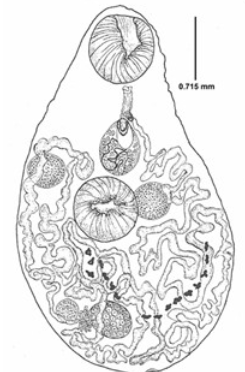
Excretory System
Functional unit
Flame Cell or Protonephridium
Excretory System Function
Osmoregulation
Nitrogenous waste removal
Reproductive System
Most Monoecious, Some Dioecious
Hermaphrodites can self fertilize
Cross fertilization common
Most Oviparous
Ectolecithal eggs

Class Trematoda: Subclass Aspidobothrea
~80 spp typically parasitic in molluscs, but some in fish and turtle
Simple 1 or 2 host life cycle. NOT very host specificity
1st host mollusc
2nd hosts include chondrichthyes fishes (sharks, rays and chimaeras/450 myo)
reach maturity in mollusc or vertebrate host
Can survive several days to weeks outside of host
No Polyembriony
Not highly specialized for parasitism
Sister group to Digenetic Trematodes

Aspidobothrea Synapomorphies with trematodes
Laurer's canal,
posterior sucker
Life cycles involving molluscs and vertebrates

Digenetic Trematodes
Parasites of ALL vertebrates, great economic and medical importance
Found in most organs
Complex heteroxenous life-cycle
typically 3 hosts
Digenetic Trematodes Morphological Stages
Miracidium –free swimming larva
Sporocyst –sac like
Redia –more differentiated (pharynx and gut)
Cercariae –free swimming emerge from snail
Metacercariae –additional stage in some
Adult --sexual reproduction
Digenetic Trematodes Adult BODY FORM
Body size varies greatly
Most dorsoventrally flat
Mouth surrounded by Oral Sucker
Acetabulum or ventral sucker
(holdfast organ)
Echinostome
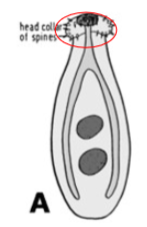
Schistosome

Monostome

Strigeoid

Amphistome

Distome
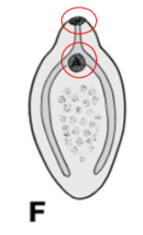
Trematode REPRODUCTIVE SYSTEM
Most are Hermaphrodites

Trematode REPRODUCTIVE SYSTEM Male Anatomy

Trematode REPRODUCTIVE SYSTEM Female anatomy
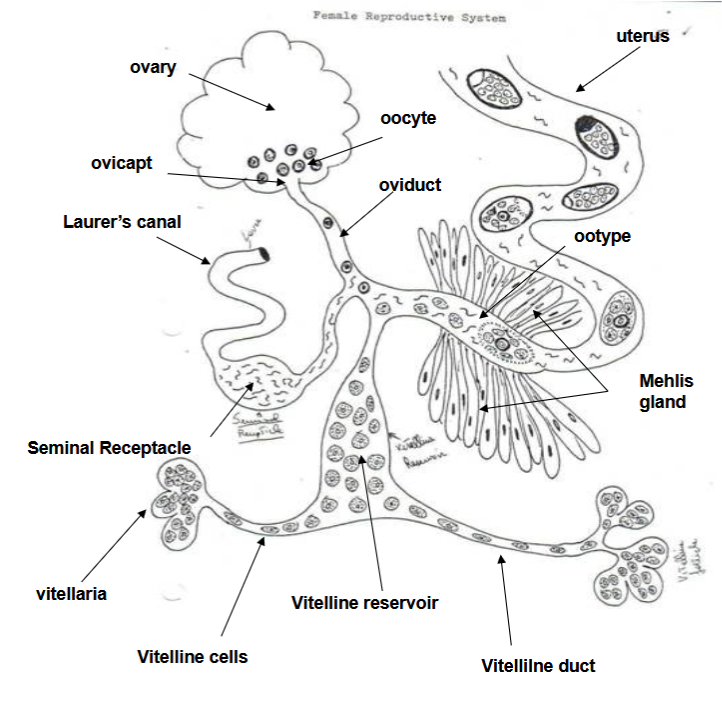
Trematode Development: Polyembryony
Zygote
1st cleavage results in a
Somatic cell
Propagatory Cell (Pc) or germinal cellIn miracidium, sporocyst and redia
Each Pc will become an embryoin Cercaria
Pc give rise to Gonad PrimordiaEgg (shelled Embryo)
really not an ovum
developing embryo surrounded by shell
Operculum

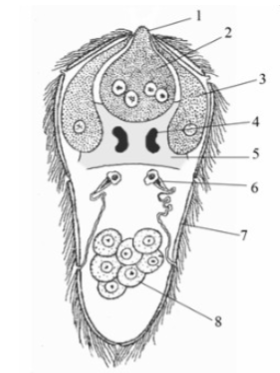
Development: Miracidium
Ciliated Larva, develops inside egg
Miracidium penetrates mollusc host
Apical Papilla/Gland - histolytic enzymes
Penetration Glands
Propagatory cells
Development: Sporocyst
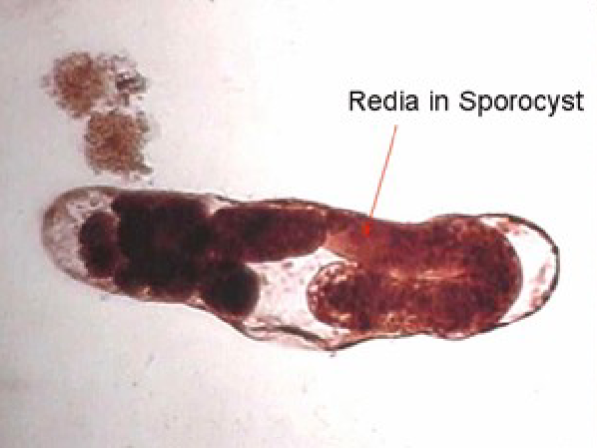
Miracidium sheds ciliated epithelium and metamorphose into Sporocyst
no mouth or pharynx
germ ball (Pc Cells) may give rise to
Daughter sporocysts
Redia
Cercariae
Development: Redia
Exit sporocysts through
birth pore
rupture of sporocystRudimentary digestive tract with
mouth
pharynx
Short unbranched gutFEED ON HOST TISSUE
can also feed on sporocystsPc cells in redia develop into
Daughter redia
Cercaria

Development: Cercariae
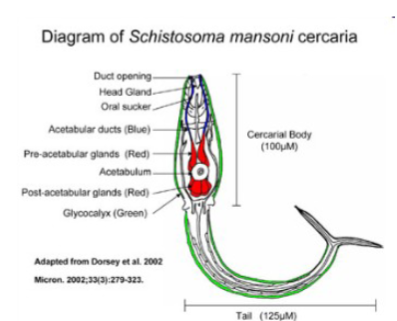
Juvenile stage typically leaves snail to find next host
lots of different forms (Taxonomy)
Penetration glandslots of other glands
Escape glands –help leave snail hostPre and Post Acetabular glands –
Mucus production for adhesion
Enzymes help in getting through host skin
Development: Meso- and Metacercaria

LIFE-CYCLE OF DIGENETIC TREMATODE
