ADME of Cancer
 Call Kai
 Learn
 Practice Test
 Spaced Repetition
 Match
 Flashcards
 Knowt Play
1/48

There's no tags or description
Looks like no tags are added yet.
49 Terms
Pharmacodynamic properties (potency, selectivity and target activity) and pharmacokinetic properties (absorption, distribution, metabolism and excretion).
A drug must bind its target effectively and reach it at a sufficient concentration.
Clinical benefit, safety, efficacy, patient tolerability, regulatory acceptability, commercial viability and affordability to healthcare services such as the NHS.
Pharmacodynamics is what the drug does to the body, including target binding and therapeutic effects.
Pharmacokinetics is what the body does to the drug, including absorption, distribution, metabolism and excretion.
Potency describes how much drug is required to produce an effect.
Selectivity describes how preferentially a drug acts at its intended target compared with other targets.
It may have poor aqueous solubility, inadequate absorption or bioavailability, rapid metabolism, inappropriate distribution or poor metabolic stability, preventing sufficient active drug from reaching the target.
A simplified model with a central compartment representing blood/plasma and a peripheral compartment representing tissues.
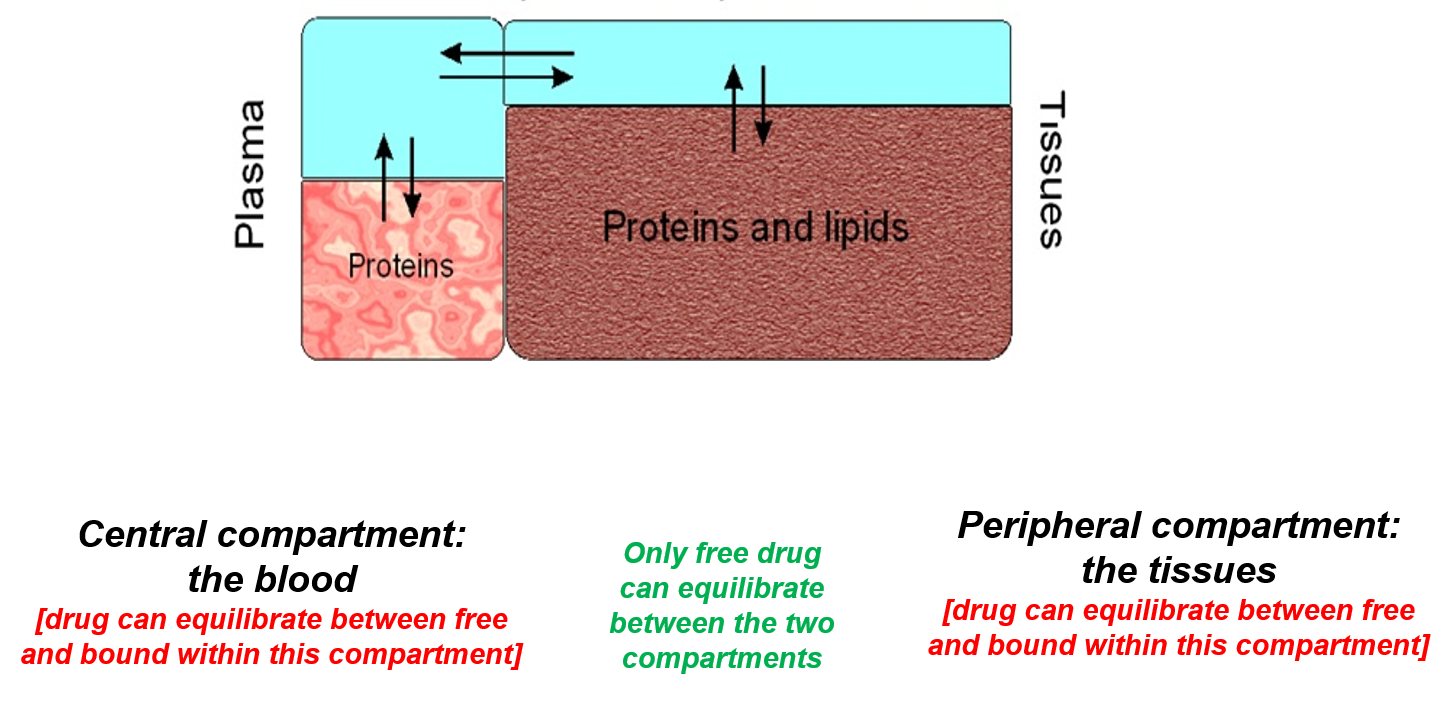
Only unbound drug can directly distribute into tissues. Protein-bound drug acts as a reservoir that can release free drug as equilibrium changes.
What is volume of distribution (Vd)?
What does a larger Vd indicate?
The apparent volume relating the total amount of drug in the body to its plasma concentration.
A larger Vd generally indicates more extensive distribution outside plasma
Oral drugs require gastrointestinal dissolution and absorption and may undergo first-pass metabolism.
IV drugs enter systemic circulation directly, avoiding the absorption step and initial first-pass metabolism.
The fraction of an administered dose reaching systemic circulation unchanged
The relationship between a molecule's chemical structure and its biological activity. Structural modifications are tested to optimise potency, target binding and selectivity.
The relationship between chemical structure and physicochemical or pharmacokinetic properties
Aqueous solubility, membrane permeability, lipophilicity, pKa, chemical/metabolic stability, metabolite formation, CYP450 inhibition, plasma protein binding and volume of distribution.
Ionic interactions between oppositely charged groups (long-range);
H-bonds between suitable donors and acceptors (intermediate-range);
van der Waals interactions between closely positioned atoms (short-range).

What N functional groups are not normal Hydrogen bond acceptors?
Amide nitrogen and protonated amines are not normally acceptors.
It competes with ATP at a kinase binding site and forms specific interactions, including hydrogen bonds, that inhibit kinase activity.

Modification of a hydrophobic region helped reduce metabolic susceptibility,
modification of a solvent-exposed region improved solubility without substantially disrupting essential kinase-binding interactions.

They occupy the kinase ATP-binding site, interfering with ATP-dependent phosphorylation of substrates, reducing downstream signalling that promotes cell proliferation or survival.
Bcr-Abl is an oncogenic protein kinase that promotes abnormal growth signalling.
Imatinib inhibits its kinase activity by binding in the ATP-binding region, preventing normal phosphorylation signalling.
Related kinases have similar ATP-binding sites, so inhibitors may act on multiple enzymes.

What are the mechanisms and targets of paclitaxel and methotrexate?
Paclitaxel is a spindle poison that binds tubulin and disrupts mitosis.
Methotrexate is an antimetabolite that inhibits dihydrofolate reductase (DHFR).
No more than 5 hydrogen-bond donors
No more than 10 hydrogen-bond acceptors
MW below 500 Da
LogP below 5
Primary, secondary or tertiary amines can be protonated using an acid such as HCl, producing a charged ammonium salt that may improve aqueous solubility.
Acidic groups such as carboxylic acids, suitable sulfonamides and tetrazoles can be deprotonated using an appropriate base, forming ionic salts such as sodium salts.
First, the drug must dissolve in aqueous gastrointestinal fluid, generally favoured by ionisation.
Second, it must cross the lipid gastrointestinal membrane, generally favoured for passive diffusion by the non-ionised lipophilic form.
How can poorly soluble drugs be formulated for intravenous administration?
What is an example
They must be suitably solubilised, potentially through salt formation, co-solvents or solubilising agents.
Paclitaxel is an example requiring solubilising agents or co-solvents for IV admin
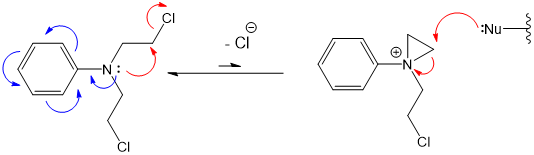
Chlormethine is a highly reactive nitrogen mustard that reacts readily with nucleophiles, creating toxicity concerns when administered orally.

The nitrogen lone pair attacks an adjacent chloroethyl carbon intramolecularly, displacing chloride and forming a reactive aziridinium ion.
A nucleophile such as DNA guanine N7 attacks the aziridinium ring, opening it and forming a covalent bond.
The second chloroethyl group can react similarly, producing further alkylation and possible DNA cross-linking.

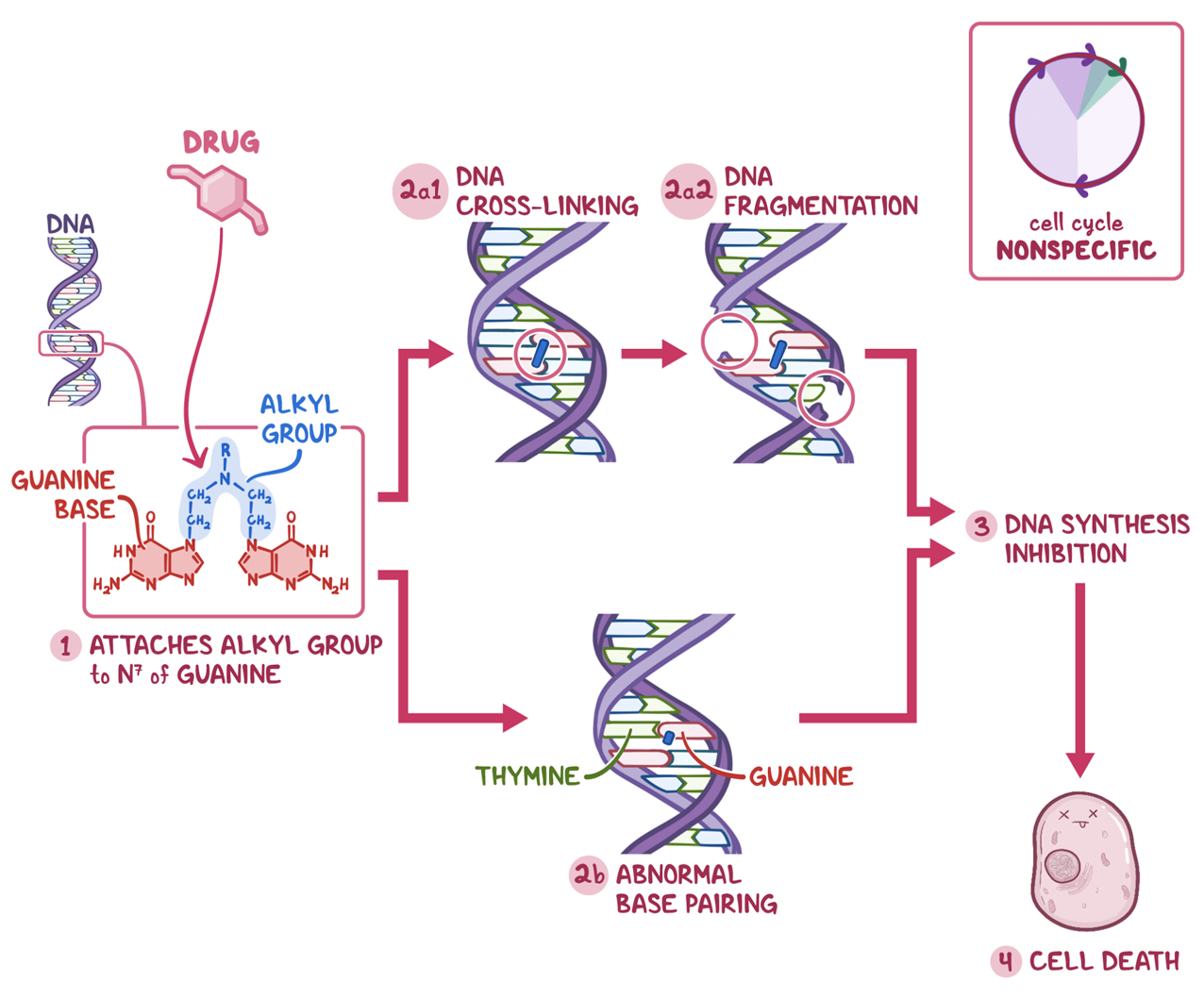
They alkylate DNA, commonly at guanine N7, causing abnormal base pairing, cross-linking and DNA damage.
This interferes with DNA synthesis and can trigger cell death. Their action is described as cell-cycle non-specific.
How does attaching a nitrogen mustard to an aromatic ring reduce reactivity?
But what does adding an aromatic ring do?
How can we fix this?
The nitrogen lone pair becomes less available because it can delocalise into the aromatic ring.
This reduces aziridinium ion formation and lowers chemical reactivity.
reduces aqueous solubility
introduce polarity/salt forming groups to improve solubility

Both retain an aromatic nitrogen mustard to reduce reactivity.
Melphalan contains amino and carboxylic acid groups
Chlorambucil contains a carboxylic acid group.
These provide polarity and opportunities for ionisation or salt formation.

Oestradiol stimulates oestrogen receptors on susceptible tumour cells, promoting proliferation.
Tamoxifen competes for the receptor-binding site, reducing oestrogen-driven signalling, proliferation and tumour growth.
Tamoxifen undergoes CYP-mediated metabolism, with CYP2D6 and CYP3A4 highlighted, producing active hydroxylated metabolites including 4-hydroxytamoxifen.
What is name of active metabolite of tamoxifen?
4-hydroxytamoxifen
occupy similar positions within the oestrogen receptor pocket, allowing favourable interactions despite having a different chemical structure
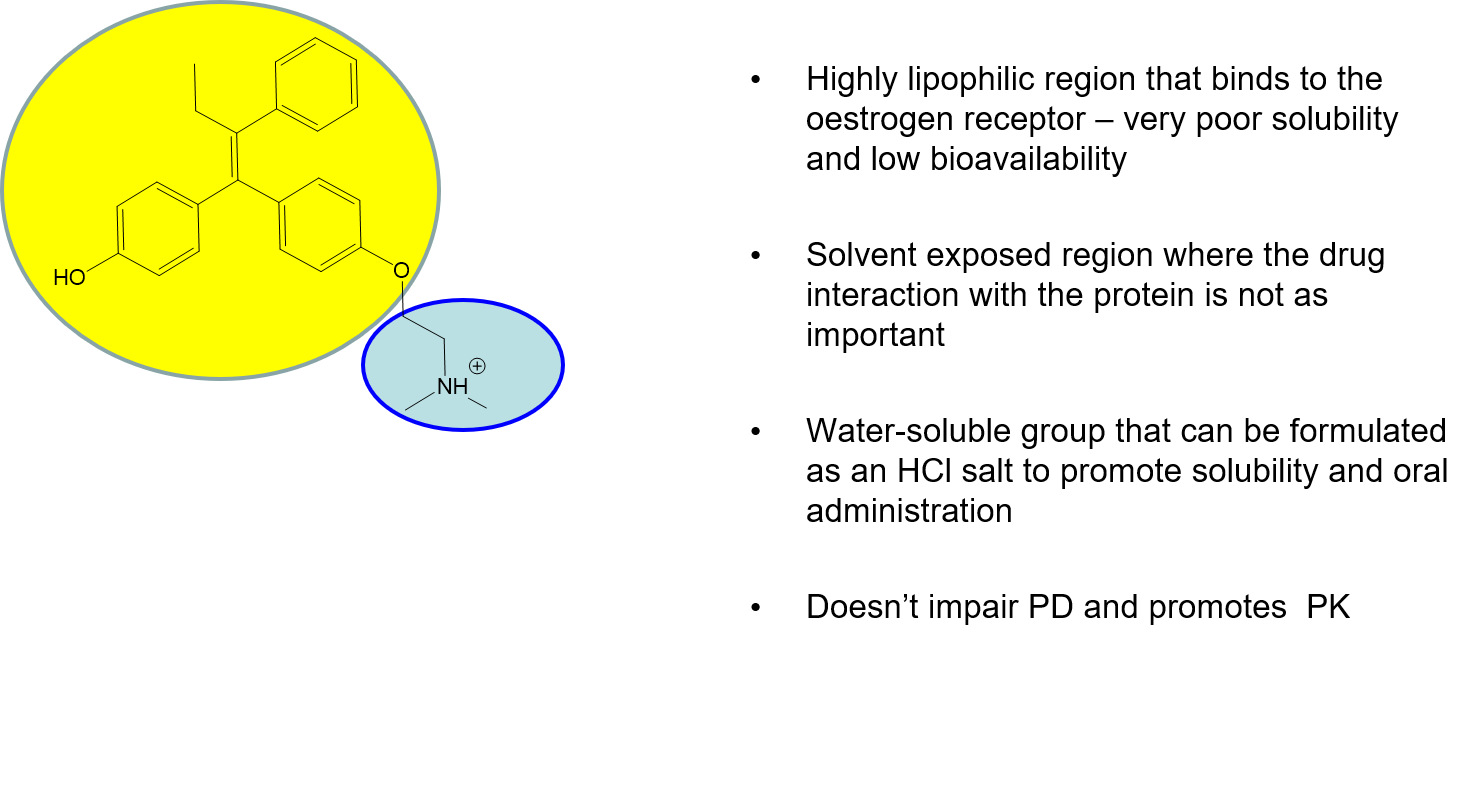
Preserve the lipophilic region needed for receptor interactions and introduce a basic, salt-forming group in a solvent-exposed region.
Hydrochloride salt formation improves aqueous solubility while maintaining pharmacodynamic activity.
Camptothecin inhibits topoisomerase I, interfering with the enzyme's role in controlling DNA topology during replication and transcription.
It has no convenient salt-forming groups, and its planar aromatic structure promotes stacking in the solid state, making it difficult for solvent molecules to penetrate and dissolve the compound.

intact lactone ring is essential for interaction with the topoisomerase I–DNA complex. Ring opening therefore destroyed pharmacodynamic activity.
How does topotecan overcome camptothecin's solubility problem (lactone ring)?
How can topotecan be administered?
Topotecan contains a solvent-exposed tertiary aliphatic amine that can form a water-soluble hydrochloride salt, while retaining the intact lactone ring needed for topoisomerase I inhibition.

It can be administered orally or intravenously.
What can topotecan be used to treat?
Why are fluorine and chlorine introduced during medicinal chemistry optimisation?
What problem with adding too many halogens?
They can block metabolically susceptible positions and reduce CYP-mediated oxidation, improving metabolic stability and potentially extending half-life.
However, they may also increase lipophilicity and affect solubility or target binding.
How does fluorine substitution improve the metabolic stability of crizotinib?
A benzene-ring position susceptible to CYP450 aromatic hydroxylation is substituted with fluorine, reducing metabolism while making a relatively small steric change.

Crizotinib is an ALK inhibitor used in non-small-cell lung cancer.
How does CF₃ substitution reduce metabolism in sorafenib?
A methyl group susceptible to CYP450-mediated aliphatic hydroxylation is replaced with a trifluoromethyl group, reducing that metabolic transformation.

Sorafenib is presented as a RAF kinase inhibitor used in advanced renal carcinoma.
A metabolically susceptible methyl ether group is modified using CF₃ substitution to reduce CYP450-mediated O-dealkylation.

Sonidegib is a Hedgehog pathway inhibitor used in basal cell carcinoma.