Lecture - Cell Cycle, Mitosis, Cancer
 Call Kai
 Learn
 Practice Test
 Spaced Repetition
 Match
 Flashcards
 Knowt Play
1/13

There's no tags or description
Looks like no tags are added yet.
14 Terms
What are checkpoint proteins? Where do they function?
Checkpoint proteins regulate certain points of the cell cycle to slow it down—don’t speed it up. They function at the end of each phase in interphase.
For example, if you have damaged DNA in G2, you aren’t going into the M-phase, so checkpoint proteins will bring in repair proteins to fix that DNA.
What protein controls the G1 checkpoint?
The retinoblastoma protein (Rb), which is considered a tumor suppressor gene. This means it can halt the cycle or prevent the entire cell cycle from progressing. Remember that after the G1-phase, the cell cycle is committedd because of that signal transduction pathway’s progression.
What happens at the point in G1 that determines the go-no go?
This point is where the Rb protein lets go of E2F.
What happens if Rb is mutated but you have one good copy and one bad copy? Why?
What about two mutated copies?
The Rb will still function because of that good copy. Remember that Rb is a tumor suppressor gene!
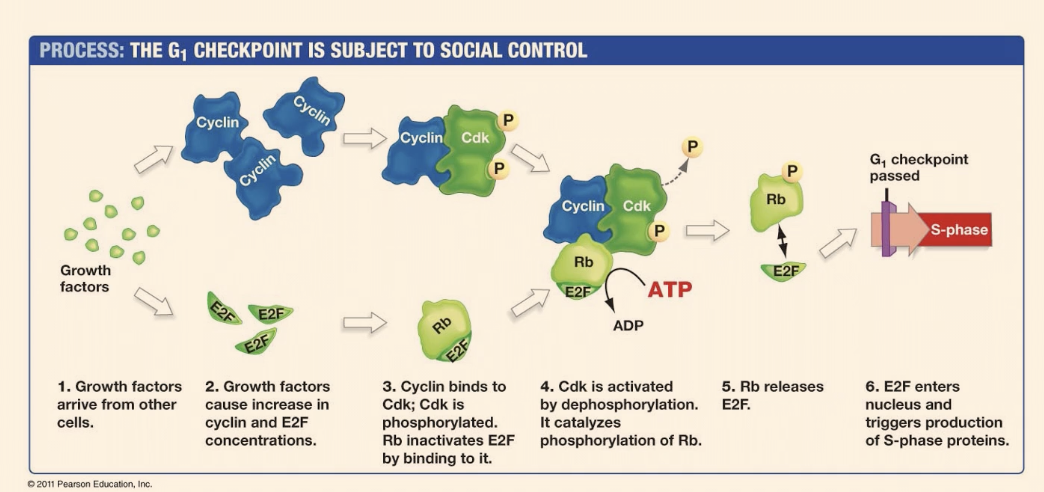
If you have two mutated copies, then the G1 checkpoint will not be able to function. Rb itself won’t be able to bind to the E2F and/or bind to the Cyclin-CDK complex. Without this, the cell cycle will progress UNCHECKED.
Look at image
In a tumor suppressor gene, it is an active/inactive molecule? Do both or just one copy need to be knocked out?
It is an inactivating molecule. Both of the alleles need to be knocked out for the gene to be totally disfunctional.
What is the difference between a Ras mutation and an Rb mutation?
The Ras protein will become hyperactivated, whereas Rb—a tumor suppressor gene—is unable to inhibit (stop). You need both copy of Rb to be this way.
If one copy of Ras is activated, then you’re already in trouble because hydractivity has already started.
What is an oncogene? Give an example
This is where the mere activation of the gene leads to hyperactivation. An example is Ras.
Only one gene here needs to be mutated for something wrong to happen.
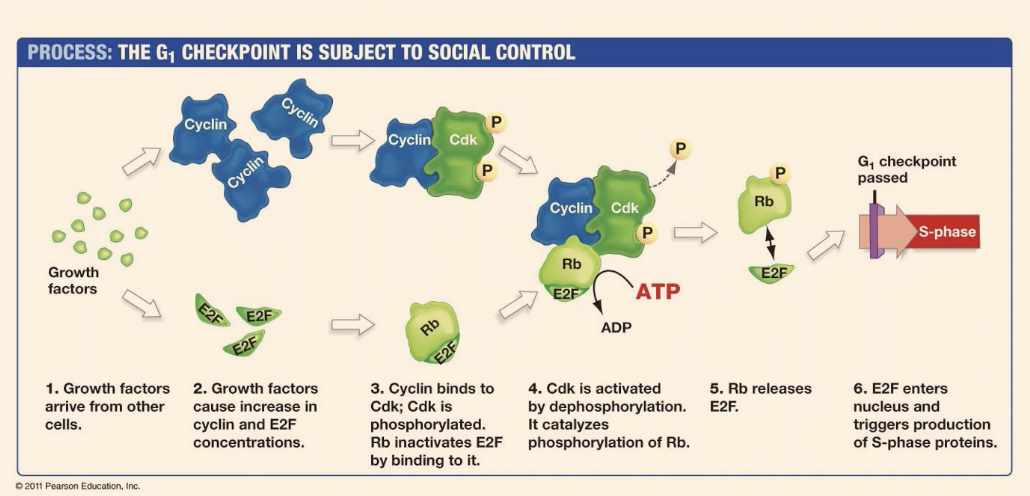
How exactly does the G1 checkpoint work? Give me the step by step…
Growth factors in the cell will end up binding to RTKs, which activate a number of proteins like Cyclin (not CDK) and transcription factors like E2F concentrations. Cyclin will then be able to bind with Cdk, and E2F will bind with Rb (inactivated)
The E2F-Rb and Cyclin-CDK complexes will come together. Then, the Cyclin-CDK complex LOSES one phosphate group and Rb-E2F becomes phosphorylated via ATP —> ADP, releasing this molecule from the Cyclin-CDK-4,-6 complex, and then releasing the E2F molecule. The E2F then goes into the nucleus and sends the cell into S-phase.
Look at image
What kind of genes are going to be turned on by E2F? Why?
Since E2F is a transcription factor, it is going to turn on other proteins like DNA polymerase or proteins FOR DNA replication.
What is the job of p53? Where in the cell cycle?
It’s job is to pause the cell cycle (in any step). It will rise in S-phase, telling replication to stop. In G2, it will tell that stage to stop.
If the cell cycle gets paused by p53, what does it do?
It will bring in DNA replair molecules or molecules to fix the cell. If the damage is so high, though, then p53 will put the cell into a pathway called apoptosis.
P53 EITHER pauses the cell cycle or initiates apoptosis.
Exam concept.
Assume that the DNA is damaged and that you have a double-stranded break. How does the cell respond?
The damaged DNA itself will attract repair molecules like kinases. These kinases will phosphorylate p53 to active it. After comformational change, p53 binds to the regulatory region in the nucleus as a transcription factor, activating p21 gene and making its concentration go up.
p21 gene will act as a tumor suppressor gene, SUPPRESSING Cyclin-CDK by binding to it (just like Rb!) to prevent continuation of the cell cycle.
What are the concentrations of p53 like at any given time?
They usually fluctuate, but are ALWAYS present because of the importance of this molecule. The cell will always expend energy creating it because of its usefulness.
Why is it important that the cell constantly expends or degrades p53 IF the levels keep going up?
If the levels keep going up, then the cell cycle will either be arrested or the cell will be programmed into apoptosis.