Lecture 3: Action Potential Conduction and Synaptic Transmission
 Call Kai
 Learn
 Practice Test
 Spaced Repetition
 Match
 Flashcards
 Knowt Play
1/48

There's no tags or description
Looks like no tags are added yet.
49 Terms
What are the three variables that determine the speed of the action potential? For a slow action potential, what are the relative values of these variables?
1) membrane resistance (low if leaky)
2) membrane capacitance (high if sticky)
3) axial resistance (high if axon is thin)
How did invertebrates evolve to combat the slowness of action potentials? What are the tradeoffs to this?
Evolved wide axons, lowering axial resistance
Can not have too many of these axons (limited space), reserved for systems like escape reflexes
How did vertebrates evolve to combat the slowness of action potentials? What does property does this allow vertebrate neurons to have compared to invertebrates?
evolved myelin, reducing leakiness (increased membrane resistance) and stickiness (lowered capacitance)
This way, vertebrates can have thin neurons
What is the transmission of a signal along a myelinated axon called?
saltatory conduction
What are nodes of Ranvier and how many ion channels do they have?
gaps in between the myelin with a high concentration of Na+ and K+ channels
1000-2000 voltage-gated Na+ channels per square micron compared to 100-200 in an unmyelinated axon
What are the two key characteristics of vertebrate axons that contribute to the conduction velocity?
myelination and diameter
What glial cell myelinates axons in the CNS?
oligodendrocyte
What glial cell myelinates axons in the PNS?
Schwann cells
How do glial cells myelinate axons?
First surround the axon, then squeeze out cytoplasm so only lipid bilayer remains. Repeat with multiple layers to form myelin
How do oligodendrocytes compare to Schwann cells in how they myelinate axons?
oligodendrocytes branch and wrap around multiple axons while Schwann cells only wrap around one
Who said "All living things are composed of cells and cell products"?
Theodor Schwann (1847)
Multiple sclerosis (description and symptoms)
antibodies attack myelin in the CNS (oligodendrocytes)
affects vision, tactile abilities, balance speech, etc around 20-40 years old
Multiple sclerosis (prevalence, suspected causes)
1/1000 people in North America
2x more prevalent in women
suspected to be an autoimmune disorder with strong genetic component (30% probability in identical twins vs 4% in fraternal), strongly associated with Epstein-Barr virus
Guillain-Barre syndrome (description and symptoms)
similar to MS but in PNS: antibodies attack myelin (Schwann cells)
symptoms: paresthesia, paralysis, loss of sensation, movement difficulty / paralysis usually begins in feet and legs, then progresses upward to arms, face - difficulty swallowing, etc. (30% of patients require ventilator)
Guillain-Barre syndrome (prevalance and prognosis)
1 in 100 000 people (rarer than MS)
rapid onset (days) with recovery after weeks or years
Who made very detailed drawings of neurons? What technique did they use to do this?
Santiago Ramón y Cajal
Golgi stain
What theories were Camillo Golgi and Santiago Ramón y Cajal proponents of?
Golgi: reticular theory (neurons are connected in a large mesh)
Cajal: neuron doctrine (there are gaps between neurons)
How large is the synaptic cleft? Why wouldn't it be obvious that there are gaps between neurons?
20-40nm
conventional light microscopy has a resolution of 200nm
Otto Loewi
proved the existence of chemical transmission in frog hearts
stimulated vagus nerve to slow heartbeat by the release of acetylcholine
transferring solution from a stimulated heart to another heart caused the other heart to slow down (with delay), proving there was some kind of chemical in the solution affecting the hearts
Bernard Katz
found evidence for quantal transmission in neurons (synaptic vesicles)
In low Ca++ solutions, he stimulated an axon connected to a muscle cell and recorded the postsynaptic membrane potential
Found that the amplitude of potentials were multiples of some number (poisson distribution)
Intracellular and extracellular Ca++ concentrations
inside: 0.0001mM
outside: 1mM
Ca++ pump
Uses ATP to bring 2 H+ in and one Ca++ out
Na+/Ca++ ion exchanger
Uses concentration gradient of sodium to bring one Na+ in for one Ca++ out
Describe the cascade of events that happens when the action potential reaches the axon terminal (5)
1. Voltage gated Ca++ channels open
2. Ca++ binds to synaptotagmin on vesicles, forming SNARE complexes with other proteins
3. SNAREs pull vesicle to cell membrane
4. Ca++ bound synaptotagmin catalyzes membrane fusion, releasing neurotransmitters into the cleft
5. neurotransmitters bind to ligand-gated ion channels on postsynaptic neuron
What are the two types of neurotransmitters and some examples of them?
1. small-molecule neurotransmitters: acetylcholine, amino acids (glutamate & GABA), purines, biogenic amines (dopamine, norepinephrine, etc)
2. peptide-neurotransmitters: methionine enkephalin, endorphins
Who discovered that peptides can also be neurotransmitters?
Lily Jan & Yuh Nung Jan
Gruber Prize in Neuroscience (2012)
What is the main difference between GABA and glycine?
Found in different areas of the body: GABA is used in cerebral cortex, glycine is used in brainstem and spinal cord
Glutamate
Most common excitatory neurotransmitter
Small molecule neurotransmitter (amino acid)
GABA
Most common inhibitory neurotransmitter in cerebral cortex
Small molecule neurotransmitter (amino acid)
Glycine
Most common inhibitory neurotransmitter in the brainstem/spinal cord
Small molecule neurotransmitter (amino acid)
On what part of the neuron can receptors be located?
Usually dendrites and cell body, sometimes axon
Glutamate Receptor channel
An ionotropic receptor that opens in response to the binding of glutamate
Equally permeable to Na+ and K+, but still results in EPSP (Na+ entering > K+ leaving)
GABA Receptor Channel
Opens in response to the binding of GABA
Only permeable to chloride, opening results in IPSP (hyperpolarization)
What is the driving force equation?

Based on the driving force equation, what would happen to the current if there is a large difference between Vm and Ex?
If there is a large difference between the membrane potential and the equiibrium potential of the ion, the magnitude of the current increases (becomes more positive or more negative)
What does positive current mean?
positive charge is moving out of the cell or negative charge is moving into the cell
i.e. outside of the cell is becoming more positive
What does negative current mean?
negative charge is moving out of the cell or positive charge is moving into the cell
i.e. outside of the cell is becoming more negative
Use the driving force equation to prove that in the glutamate receptor, the overall current is negative (more Na+ entering than K+ leaving).
I(Na) = gNa (−65 − 67)mV
= gNa (−132)mV
I(K) = gK (−65 + 84)mV
= gK (19)mV
I(total) = I(Na) + I(K)
= g(-132 + 19) = -113
Therefore the overal current is negative (positive charge moving in)
Axon hillock
AKA initial segment
A "swelling" that occurs at the connection point between the axon and cell body
T/F: There are no Na+ and K+ voltage-gated channels in the dendrites and cell body
True
What role does spatial integration play in EPSPs?
The closer the EPSP occurs to the axon hillock, the larger voltage displacement it will produce

What does lambda represent and what is the equation for it?
Represents the distance travelled by an EPSP that will cause it to decay to 1/e or ~37% its original magnitude

Explain what effect increasing Ra (axial resistance) has on the membrane space constant and why
increasing axial resistance = thin diameter = more difficult for ions to flow = slower APs
lambda will decrease in response to higher axial resistance, as the EPSP will degrade faster and thus travel a shorter distance
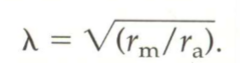
Explain what effect increasing Rm (membrane resistance) has on the membrane space constant and why
increasing membrane resistance means there is less leakiness, allowing signals to travel longer distances
i.e. increasing the membrane resistance will increase the space constant

What is the relationship (equation) between distance and voltage?
Vx = Vo e^(-x/λ)
i.e. exponential decay in voltage as a function of space (distance from synapse)
What role does temporal integration play in EPSPs?
Over time, the strength of an EPSP diminishes (ions diffuse into or out of cell, may also stick to membrane)
What does tau represent and what is the equation for it?
time constant (the amount of time it takes for an EPSP to degrade to 1/e or 37% of its original magnitude)
𝜏 = cₘrₘ
What is the relationship (equation) between time and voltage?
Vx = Vo e^(-t/τ)
i.e. exponential decay in voltage as a function of time (since EPSP reached peak amplitude)
Explain how increasing Rm will affect the membrane time constant and why
increasing membrane resistance prevents ions from leaking, allowing the EPSP to maintain the strength of its signal for longer
i.e. increasing Rm will increase the time constant