20: Nutrient Cycling
 Call Kai
 Learn
 Practice Test
 Spaced Repetition
 Match
 Flashcards
 Knowt Play
1/33

There's no tags or description
Looks like no tags are added yet.
34 Terms
What is a biogeochemical cycle?
circular flow of nutrients between living & non-living parts of ecosystems
What are the main reservoirs of nutrients in the gaseous cycle? Sedimentary Cycle?
1) atmosphere
2) water
1) soils, rocks & minerals
2 Phases of the Sedimentary Cycle?
1) Rock Phase→weathering releases minerals
2) Salt Solution Phase→minerals become available to living organisms as dissolved salts in water cycle
2 Cycles of the Water Cycle?
1) Precipitation
2) Evaporation
Does precipitation & evaporation occur mostly over oceans or land? Where is precipitation highest & lowest?
Oceans
highest→tropics & +60 degree latitude
lowest→desert/ polar latitudes & +30 degree latitude
2 major reservoirs of Oxygen Cycle? 2 cycles of Oxygen Cycle?
1) atmosphere
2) water
1) Photosynthesis
2) Respiration
When H2O becomes O2, where does the H go?
H escapes to outer space
% of Oxygen, Nitrogen, & CO2 in atmosphere?
O2→21%
N2→78%
CO2→<1%
3 ways O2 is removed from cycle?
1) O2 combines w/ Ca2+ to form Carbonates
2) O2 combines with/ minerals to form oxides
3) O2 is reduced to Ozone in stratosphere
Major reservoirs of Carbon?
1) geological (in rocks) MAJORITY OF WORLD’S CARBON
2) ocean
3) terrestrial (soil+organisms)
4) atmosphere
How does Carbon move through terrestrial ecosystems?
1) Photosynthesis→plants absorb C from air
2) Animals eat plants who have C
3) Animals exhale Carbon
4) When organisms die, C is in soil which plants take up
5) Carbon can also be released by erosion of limestone & volcanic eruptions
What are major consumers and reservoirs for Carbon?
Forests
How does Carbon move through aquatic ecosystems?
1) Air-water exchange of CO2
2) Phytoplankton absorb Carbon during photosynthesis
3) Consumers eat Phytoplankton
4) Consumers release CO2 during respiration or some use Calcium to make Calcium carbonate shells
5) Carbon in dead organisms/shells sink to bottom of ocean but are then brought to surface by upwelling
—-Carbon also stored in sediments
What element is an essential constituent of protein?
Nitrogen
Can most organisms access N2 directly from atmosphere?
NO, only certain bacteria & cyanobacteria can do it.
What are 2 ways plants can take up Nitrogen?
1) ammonium (NH4+)
2) nitrate (NO3-)
How is Nitrogen fixed? This produces _____% of Nitrogen used by organisms.
Nitrogen-fixing bacteria convert N2→ammonia(NH3)
90%
Which group of plants is most efficient at nitrogen fixation?
Leguminous plants bc they are symbiotic bacteria in their root nodules
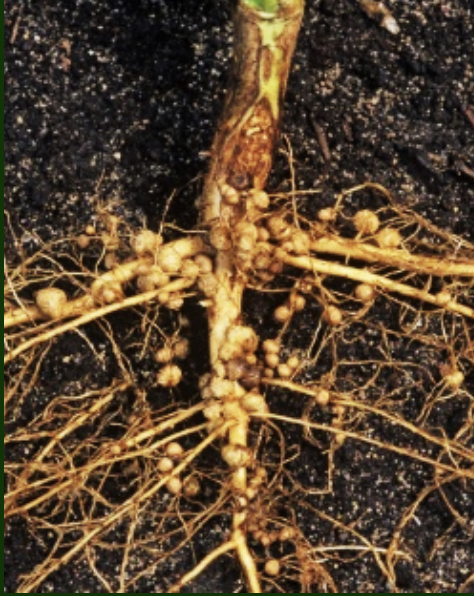
Where else can Nitrogen come from?
rain, snow, fog, lightning→small amounts only
Explain ammonification.
this is when organisms die & release NH3 ions during decompositions
→soil has excess H+ so NH3→NH4+
Explain Nitrification.
when bacteria converts NH3→NO2- →NO3-
NO3- is important bc plants can easily absorb this
Explain denitrification. Under what conditions does this occur in?
bacteria converts NO3- back into N2
-occurs in anaerobic conditions
In what environments does denitrification occur?
relatively rare in terrestrial ecosystems, but common in wetlands(mudflats) & in bottom sediments of open ocean
In anaerobic respiration, what is used as the final electron acceptor?
Nitrate (NO3) instead of O2
Main reservoirs for Phosphorous?
rock & natural phosphate deposits
Is there a lot of Phosphorus in the atmosphere? Why or why not?
NO, virtually all circulate in the sedimentary cycle.
How does Phosphorus move through terrestrial ecosystems?
1) Nearly all P comes from weathering of Calcium Phosphate ROCK
2) Plants absorb the P & moves up food chain
How does Phosphorus move through aquatic ecosystems?
Rain washes P from terrestrial ecosystem→oceans
a) producers take in P & moves up food chain
b) P stored in sediment at ocean bottom
c) upwelling brings P back to surface
Explain Sulfur moving through sedimentary phase.
1) rocks break & release sulfur
2) plants absorb sulfur
3) consumers eat plants
4) consumers die & sulfur goes back into soil
How can Sulfur enter the atomsphere?
1) volcanic eruptions
2) fossil fuels
3) exchange at ocean surface
4) gases released by decomposition
What compound form does Sulfur enter the atmosphere as?
Hydrogen Sulfide (H2S)→then it becomes SO2(Sulfur Dioxide)→goes back to earth as rainwater as dilute sulfuric acid(H2SO4)
Define the Gaia Theory.
Proposes that Earth exhibits Global Biogeochemical Homeostasis where concentrations of O2 & CO2 throughout Earth’s history have been constant.
Under the Gaia Theory, how are optimal physics and chemical environment of the Earth’s atmosphere, oceans, and soils thought to be regulated and buffered?
By activity of living organisms
Which form of nitrogen tends to stay in soil & which form is readily leached from soil into aquatic ecosystems?
NH3+ tends to remain in soil & NO3- tends to go into water