Quiz 3: Enzymes
 Call Kai
 Learn
Learn Practice Test
 Spaced Repetition
 Match
Match Flashcards
 Knowt Play
1/49

There's no tags or description
Looks like no tags are added yet.
Name | Mastery | Learn | Test | Matching | Spaced | Call with Kai | Chat |
|---|
No analytics yet
Send a link to your students to track their progress
50 Terms
Enzyme Cofactors and Coenzymes
Some enzymes use other things to help them do their job like cofactors and Coenzymes:
Cofactors: Fe, Mg, Mn, Zn
Coenzymes: Enzymes or metaloorganix molecules that act like carriers

Holoenzymes and Apoenzyme
Holoenzymes: Complete structure of protein and cofactor or coenzyme.
Apoenzyme: Protein part of the holoenzyme
Prosthetic Groups: Cofactor or Coenzyme that is covalently bonded to a protein.
Classes of Enzymes

7 of em. List them off the domepiece or you dont know it
Rate constants and orders
First Order: Depends on one compound
Second order: Depends on 2 with units M^-1s^-1

ENZYMES CAN BE STEREOSPECIFIC
Interactions between enzymes and substrates
Binding of substrate to enzyme makes binding energy which is a source of free energy to use for equation.
Covalent interactions between enzymes and substrate lower Ea
Noncovalent Interactions are introduced in the transition state

Desolvation
When substrate enters active site, it displaces water, increasing randomness

Acid-Base Catalysis

Acid Catalysis
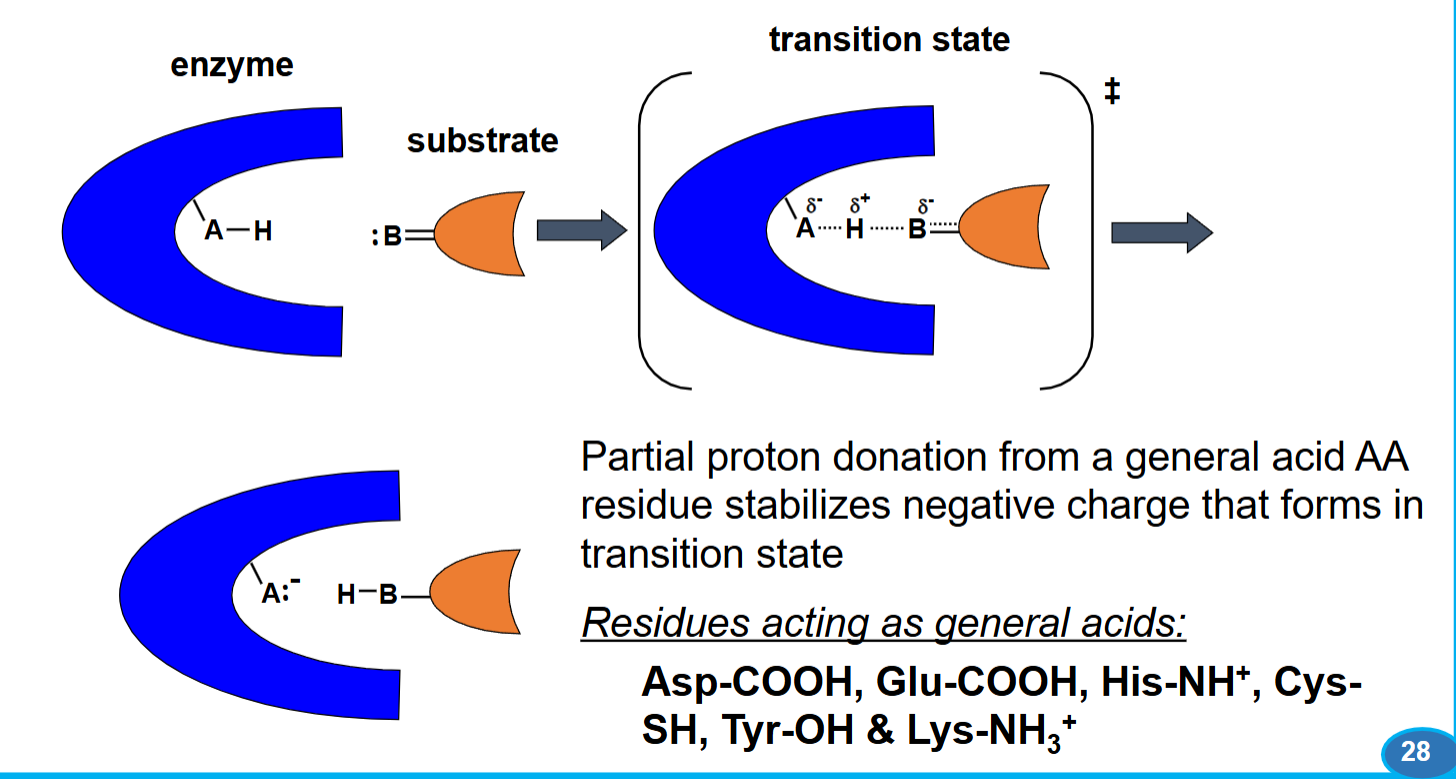
Basic Catalysis

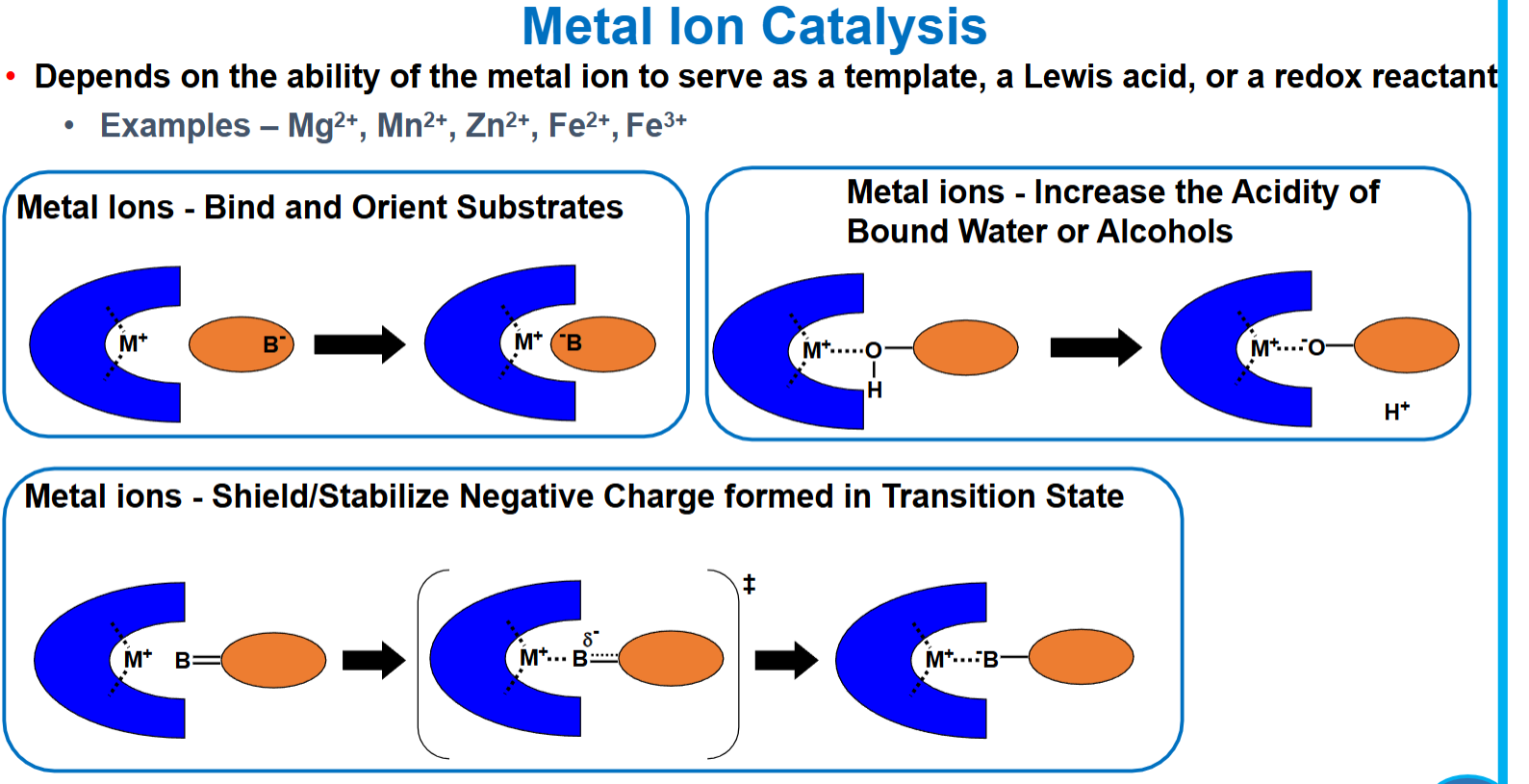
Metal Ion Catalysis
Can orient the substrate, increase acidity through resonance, or stabilize charges
nearly 1/3 of all enzymes require metal ions to work
Covalent Catalysis
A transient covalent bond is formed in active site.
Chymotripsin
Protease where it cleaves aromatic amino acid peptide bonds at the COOH side

Chymotripsin Catalyzed reaction
Broad asf, will tune in closer
Steps:
1: Side chain of amino acid adjacent to bond to be cleaves positions itself inside the hydrophobic enzyme

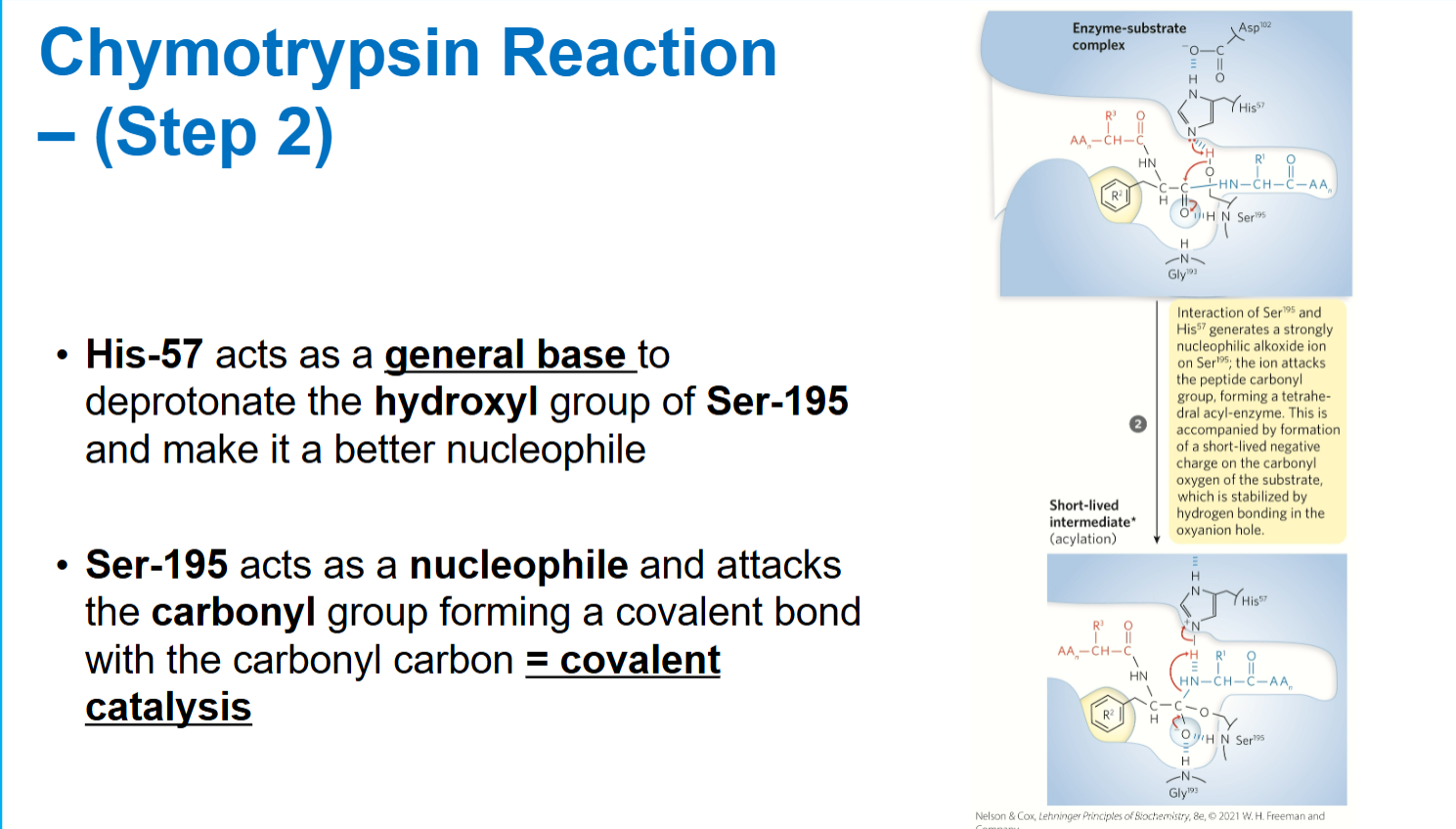
Chymotripsin reaction step 2
proton transfers allow for covalent opening and bonding to carbonyl carbon
Chymotripsin reaction step 3 and 4
Peptide bond breaks by protonating amine, releasing COOH terminal chain of polypeptide
Step 4: H2O enters the site where the product just left

Chymotripsin step 5
His acts as base to turn water to OH-. Nucleophile comes in and does a textbook nucleophilic substitution of ester
Chymotripsin reaction step 6 and 7
ser197 is protonated and made a better leaving group for the nucleophilic ester substitution
Step 7: Cleaved N terminus side dips and enzyme back to original state
HIV Protease Mechanism
Pretty simple stuff just look at it

HIV Protease Inhibitors
Form interactions with enzyme and can be seen as irreversible inhibitors

Hexokinase Induced Fit
Binding energy when ATP interacts causes conformational change so the enzyme can actually start to catalyze the
Xylose still causes this change even though its different from glucose.

Enolase
Basically just a metal ion catalysis. Replaces some bonds and allows for time in order to replace the lost hydrogen with a double bond

Enolase MEchanism

Kd in enzyme kinetics
Dissociation of enzyme substrate complex Kd=[S][E]/[ES]
K-1/k1
![<p>Dissociation of enzyme substrate complex Kd=[S][E]/[ES]</p><p>K-1/k1</p>](https://assets.knowt.com/user-attachments/b42062a5-eead-4482-bd5f-1fb4256cdf97.png)
Vo for high vs low concentrations of substrate
At low conc., it increases linearly with increased substrate concentration because there are more enzyme than substrate
At high conc., it is an exponential increase because there are more substrate than enzyme so it reaches a limit
Michaelis mentin theory of enzyme kinetics
Final step of enzymatic catalyzation is slower (Breakdown of enzyme complex to enzyme and product)

Michelis Mentin Constant Km
Kcat= k of limiting step
Et= total enzyme concentration Et= [E]+[ES]
km= (k-1 + k2)/k1
The concentration of substrate that gives half max velocity is Km
![<p>Kcat= k of limiting step</p><p>Et= total enzyme concentration Et= [E]+[ES]</p><p>km= (k-1 + k2)/k1</p><p>The concentration of substrate that gives half max velocity is Km</p>](https://assets.knowt.com/user-attachments/559799b2-5206-42b3-bf95-5d025417269e.png)
Vo both equations and why IMPORTANT
Vm= kcat*Et
allows for different ways of finding initial velocity

Kcat significance
The larger the Kcat, the better because it can do more per time
kcat/km gives a value of the enzymes catalytic efficiency (higher the better)
Double reciprocal or lineweaver plots, what is it and how is it
Used to determine if it is michaelis mentin enzyme. Some weird reciprocal of eqn just look

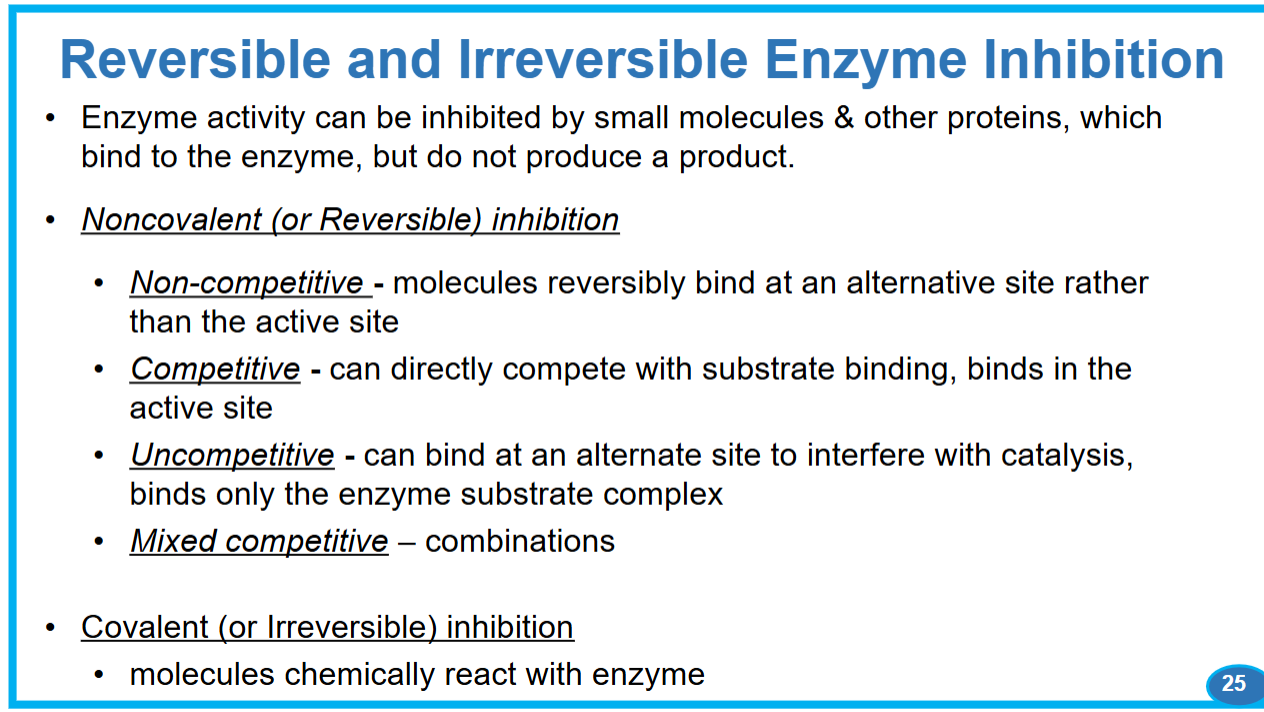
Types of enzyme inhibition
four reversible, one irreversible
Competitive inhibition (graph as well)
More inhibitor, the steeper the line slope gets, y intercept is always the same

Uncompetitive inhibition graph n stuff
Binds to enzyme substrate complex, stopping release of product
Line steepness stays the same but more inhibitor raises it, changing y and x intercept

Mixed Inhibition
Similar to uncompetitive; binds to enzyme or complex ig stopping it from reacting or slowing it down. The more it increases, the lines get steeper and intercept to the left of the y axis

Competitive inhibitor designs
Can be designed as a substrate analog, meaning its like the substrate and enzyme thinks it is
Can be transition state analog because enzymes want to bind to transition state more

Irriversible inhibition

Suicide Inactivation
Does a few steps of the enzyme catalyst until it reaches a point where it can’;t be disconnected
Regulatory enzymes
Control and regulate metabolism and enzyme activity

Roles of regulatory enzymes and mechanics read in depth
Read in Depth
Think as an analog for hormone secretions and stuff. Feedback loops and stuff
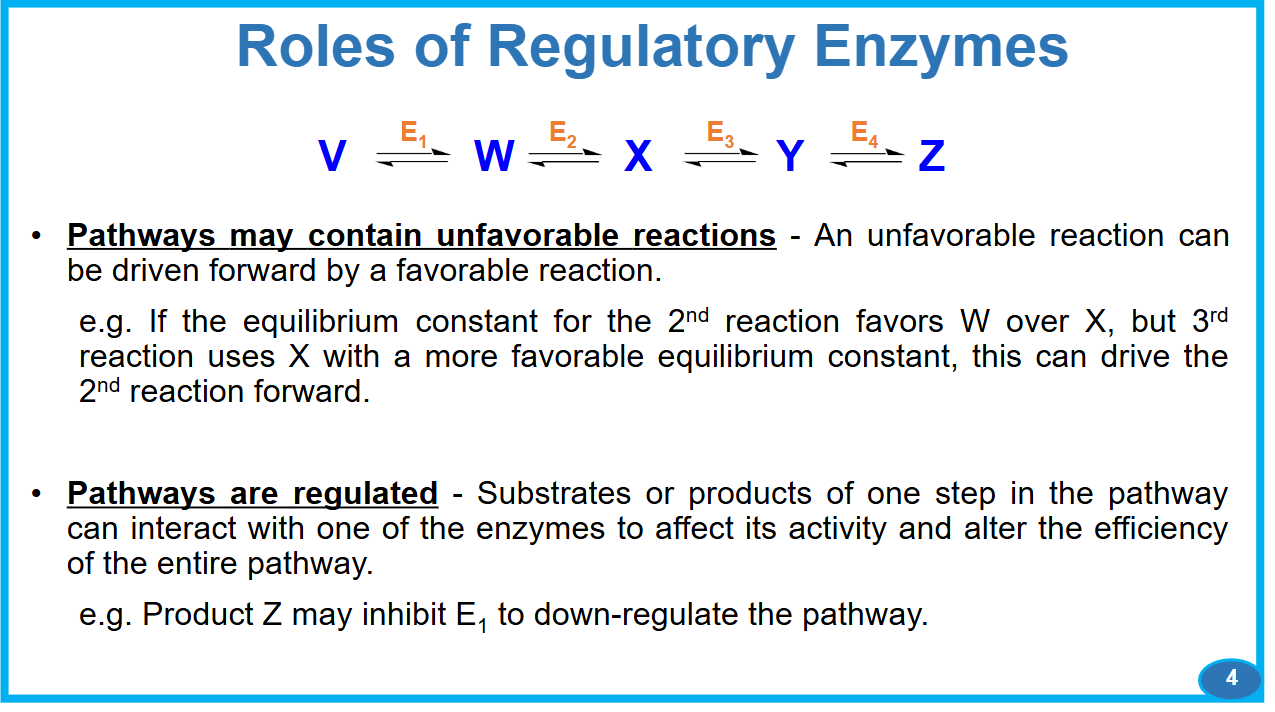
Michelis mentin kinetics with regulatory enzymes?
Regulatory enzymes usually dont follow them, the rest in the pathway might though
Allosteric regulation of enzymes
Allosteric enzymes are enzymes that function through other things modulating them, binding to them noncovalently (allosteric modulators or allosteric effectors)
Allosteric modulators are often cofactors or small metabolites

Aspartate Transcarbamoylase (ATCase) what is it and structure
Catalyzes formation of carbamoyl aspartate

kinetic properties of allosteric enzymes (graph and stuff)
Makes a sigmoid curve which is different from michelis mentin graphs and uses K0.5 which is [s] at half maximal velocity instead of Km
![<p>Makes a sigmoid curve which is different from michelis mentin graphs and uses K0.5 which is [s] at half maximal velocity instead of Km</p>](https://assets.knowt.com/user-attachments/7b1205c3-aa13-4428-ae5c-9498a9ebb6c6.png)
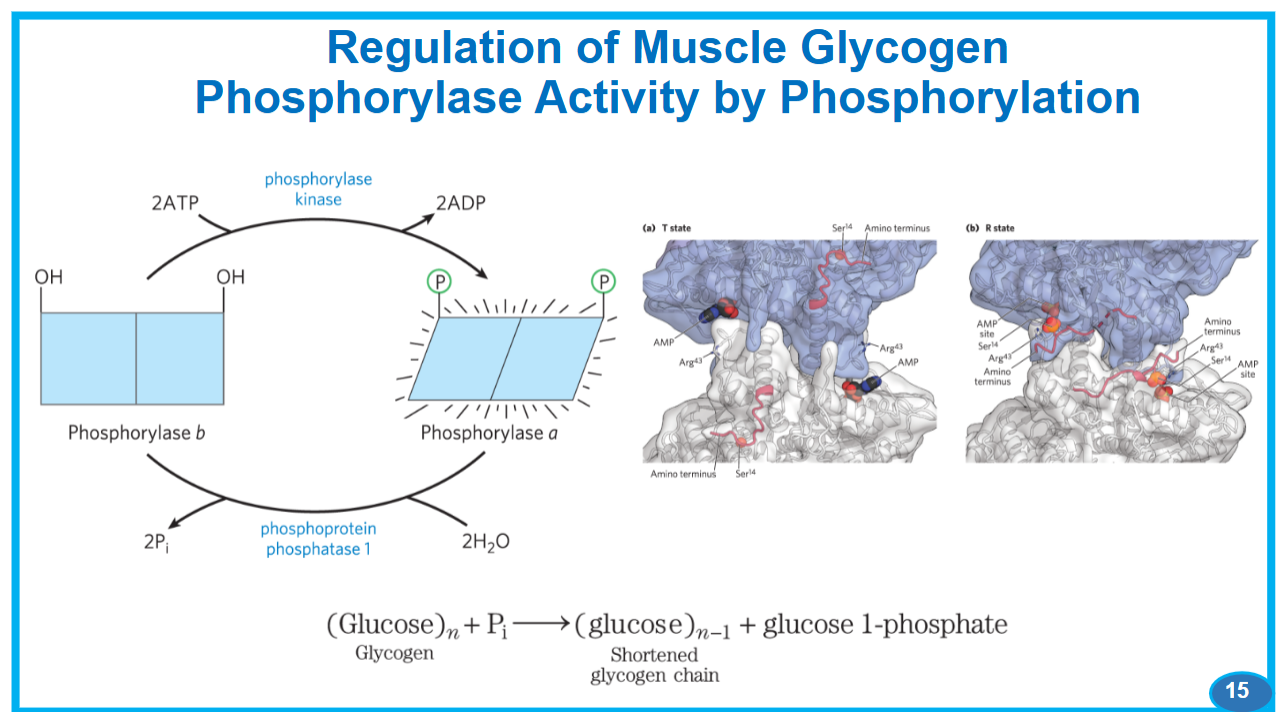
Reversible covalent Modulation

Regulation of muscle glycogen phosphorylase activity by phosphorylation of
Enzyme Precursor cleavage
Zymogen is inactive that is cleaves to form an active PROTEASE enzyme

Blood Coagulation Cascade
Regulatory cascade = a mechanism that allows a
very sensitive response to ‘and amplification of’ a
molecular signal
– example = formation of a blood clot

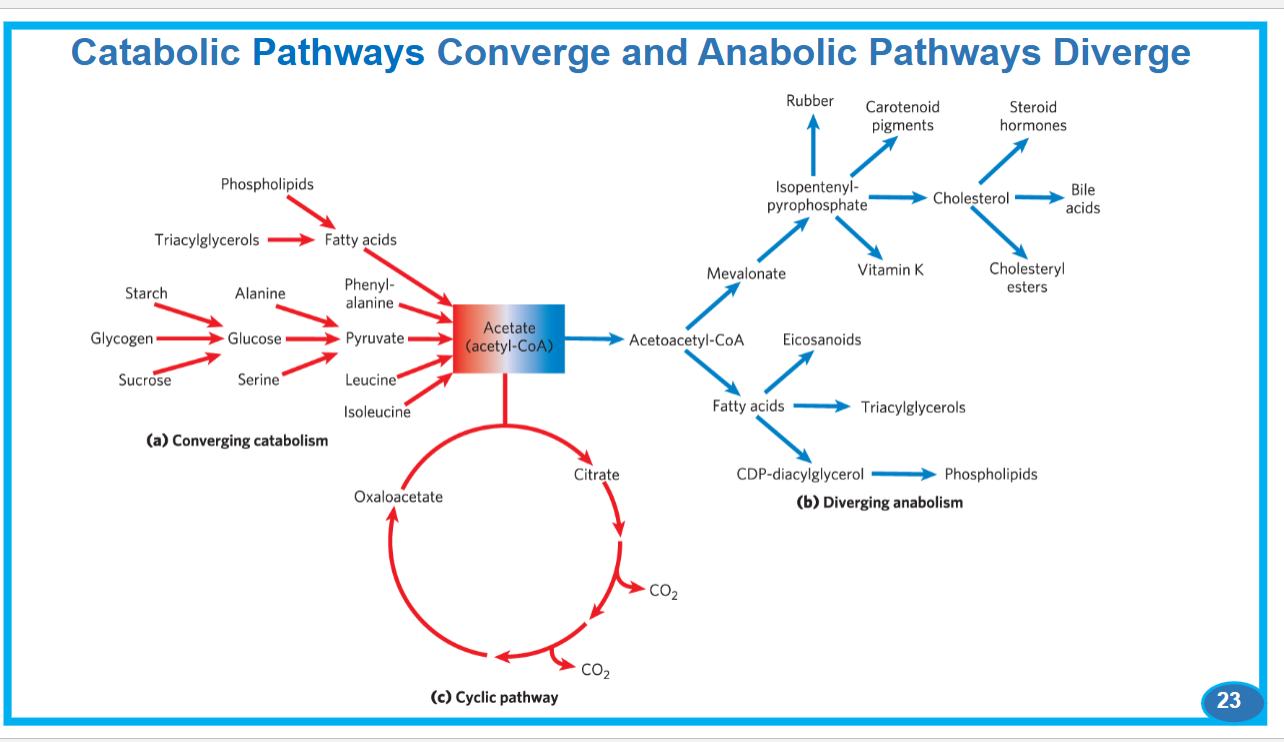
Catabolic vs anabolic pathways
Group transfer ATP I
This is what drives the effect of atp in endergonic reactions.
A group goes to ATP and releases a phosphorous which is favorable

Group Transfer ATP II
