Infection, Inflammation, and Immunity
 Call Kai
 Learn
 Practice Test
 Spaced Repetition
 Match
 Flashcards
 Knowt Play
1/63

There's no tags or description
Looks like no tags are added yet.
64 Terms
How are platelets activated?
By tissue destruction. This activates thromboxane (TXA-2), which causes potent vasoconstriction.
Platelets produce & activate thromboxane (TXA-2). How does this affect blood vessels?
TXA is a potent vasoconstrictor.
T/F: Endothelial cells, a single cell-thick epithelial lining of blood vessels, have a selective, permeable barrier.
T
T/F: Endothelial cells, a single cell-thick epithelial lining of blood vessels, do not have a selective, permeable barrier.
F, they do
What do endothelial cells produce?
Antiplatelet and antithrombic agents
Vasodilators and vasoconstrictor agents
Who is the 1st and 2nd responder of the immune system?
Neutrophils & Monocytes (eventually turning to macrophages)
Which white blood cell is higher in bacterial infections?
Neutrophils
Monocytes are released from the bone marrow and become
macrophages
What do basophils respond to and what immunoglobulin do they bind?
Similar to mast cells in the way they both bind IgE. Basophils respond to allergies/hypersensitivity.
An increased number of band neutrophils means what? What is this process called?
Band neutrophils are immature neutrophils. Mature ones are segmented. An increased number of band neutrophils results in left shift, meaning your blood has a high number of immature white blood cells. This means your bone marrow is working very fast to send emergency cells into your blood.
What are inflammatory mediators?
Chemicals that induce the signs and symptoms of inflammation.
Chemicals that induce the signs and symptoms of inflammation are known as
inflammatory meditaors
How are inflammatory mediators categorized and classified?
Plasma-derived (liver) and Cell-derived (intracellular granules). Classified by function.

Where is histamine stored?
Pre-formed, stored in cells
T/F: Histamine causes vasodilation and increased vascular permeability.
T
T/F: Histamine causes vasoconstriction and decreased vascular permeability.
F, opposite. Histamine causes vasodilation and increased vascular permeability.
_____ is one of the first mediators in acute inflammatory reactions and widely distributed.
Histamine
What are the three arachidonic acid metabolites?
TXA2, Prostaglandins, and Leukotrienes
The release of arachidonic acid is done by
phospholipases

Know this table to remember your MOA’s for drugs.
Okay!
What are cytokines and chemokines?
Signaling proteins involved in acute & chronic inflammation.
What is a major source of cytokines and chemokines?
Macrophages
T/F: Cytokines and chemokines are pro-inflammatory.
F, cytokines & chemokines can both be anti- or pro-inflammatory.
TNF-alpha and IL-1 stand for
Tumor Necrosis Factor and Interleukin-1. These are cytokines.
What are the 3 plasma protein systems?
Clotting system, complement system, kinin system.
Describe the plasma protein clotting system. How is it triggered? What does it produce?
The sequence of proteins activated to form a clot. It is triggered by collagen exposure, enzymes, and bacterial toxins. It produces chemokines, endothelial adhesion, prostaglandins, and platelet-activating factor (PAF).
Describe the plasma protein complement system. What does it produce?
The plasma protein clotting system (coagulation cascade) is a rapid chain reaction of specialized proteins in the blood that stops bleeding by turning liquid blood into a solid gel plug.
Antibodies, pathogens, and bacteria cause the activation of:
Opsonins
“Flag” invaders
Chemotaxis
Leukocytes migrate
Anaphylatoxins
Degranulate mast cells
Lysis of invader
In the complement system, Antibodies, pathogens, and bacteria cause the activation of:
Opsonins
Chemotaxis
Anaphylatoxins
What do each of these do?
Opsonins
“Flag” invaders
Chemotaxis
Leukocytes migrate
Anaphylatoxins
Degranulate mast cells
Describe the plasma protein kinin system. What does it produce or activate?
The kinin system works closely with the clotting cascade; it activates bradykinin, which causes vasoDILATION and with prostaglandin, it increases the vascular permeability & causes further pain sesnation.
What is bradykinin inactivated by?
ACE (Angiotensin Converting Enzyme).
T/F: Bradykinin causes vasoconstriction.
F, it actually causes vasodilation.
Nitric oxide is a unique gas molecule that acts as a beneficial signaling molecule and a free radical at the same time. What does nitric oxide do?
Nitric Oxide is a mediator against infection and causes smooth muscle relaxation, leading to vasodilation. It is the antagonist against platelet adhesion, aggregation, and degranulation, and recruits leukocytes.
Where are free radicals released from?
Leukocytes. They combine with NO to increase inflammation
Barriers, secretions, and our microbiome are (innate/adaptive) immunity.
Innate Immunity.
What are the 5 cardinal signs of inflammation?
Redness
Swelling
Heat
Pain
Loss of Function
Acute inflammation is critical for restoring tissue homeostasis. What are the 3 phases of acute inflammation?
Vascular Phase
Cellular Phase
Leukocyte Activation & Phagocytosis
Describe the vascular phase associated with acute inflammation.
Brief Vasoconstriction
Rapid Vasodilation: Increased Blood Flow
Increased vascular permeability — exudate —> extravascular tissue
Fluid moving out of vessels —> stagnation & clotting of blood
What does serous wound drainage look like?
pale yellow, thin/watery. blood plasma low in proteins.
What does sanguineous wound drainage look like?
bright red, watery and thin initially then darkens and thickens, coppery smell. mainly blood.
What does purulent wound drainage look like?
Thick, pus-like, brown gray, yellow, or green in color. Bacteria, dead tissue, fluid, and WBC’s. Always abnormal, indicates infection.
Describe the cellular phase of acute inflammation.
The increase in blood flow and increased permeability allows for WBC’s to get to the site of injury and expedites the delivery of PMNs (polymorphonuclear leukocytes (also called polymorphonuclear neutrophils), which are a type of white blood cell).
Involves leukocyte.
Margination & Adhesion to endothelium
Transmigration across endothelium
Chemotaxis
__ are derived from cells or plasma to increase the inflammatory response.
Mediators
Describe leukocyte activation and phagocytosis in acute inflammation.
Leukocyte activation is the process where white blood cells are stimulated by signs of infection or injury to move toward, swallow, and destroy harmful germs and dead cells through a process called Leukocyte Activation. They tag pathogens thanks to opsonization.
T/F: Acute inflammation is self-perpetuating.
F, this is chronic inflammation
Chronic inflammation is from the infiltration of what cells?
macorphages and lymphocytes
What are the different types of chronic inflammation?
Non-specific, granulomatous
What type of immunity develops after exposure?
Adaptive immunity. Requires antigen to start; more like a detective.
T/F: T-cells are apart of innate immunity.
F, they are apart of adaptive immunity.
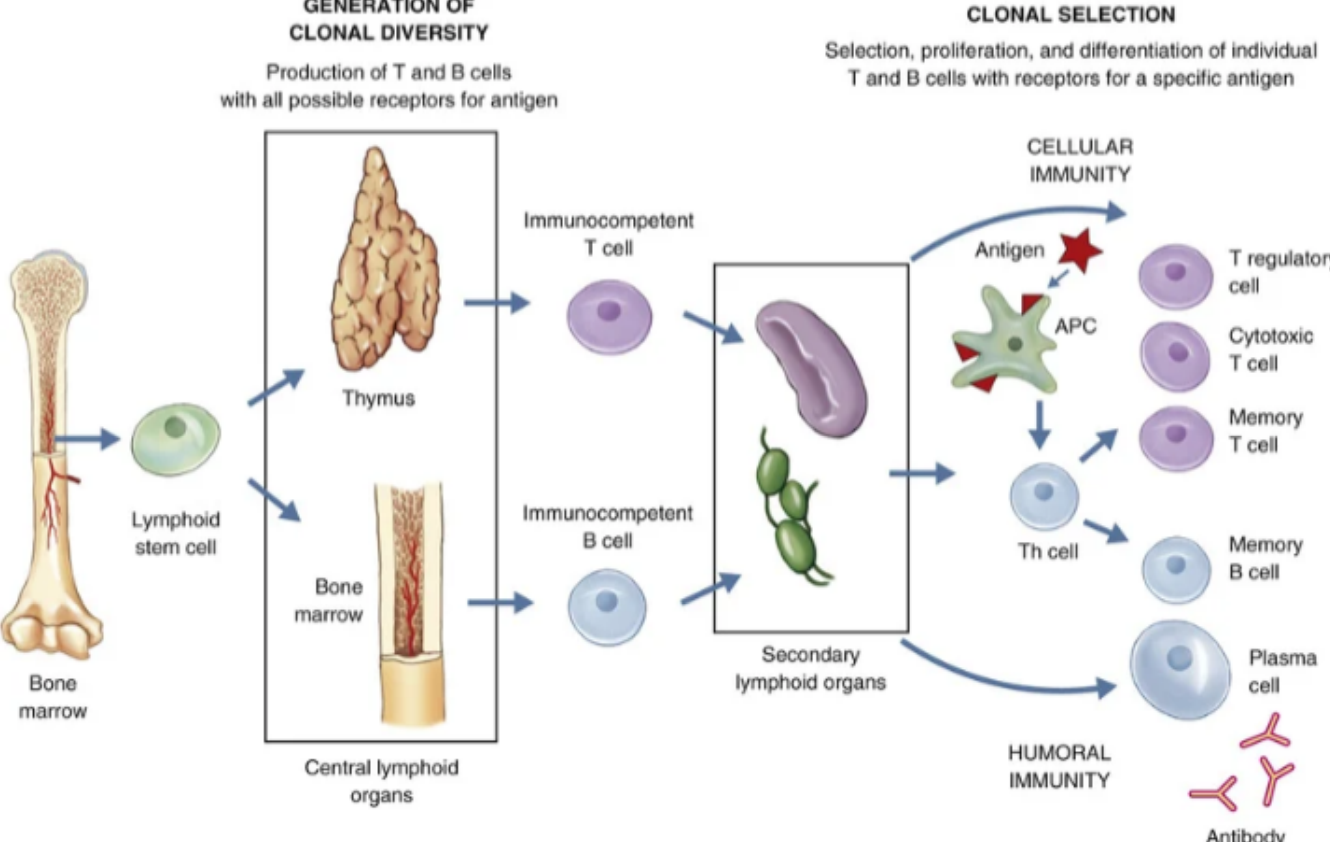
Where do B cells originate?
Bone marrow
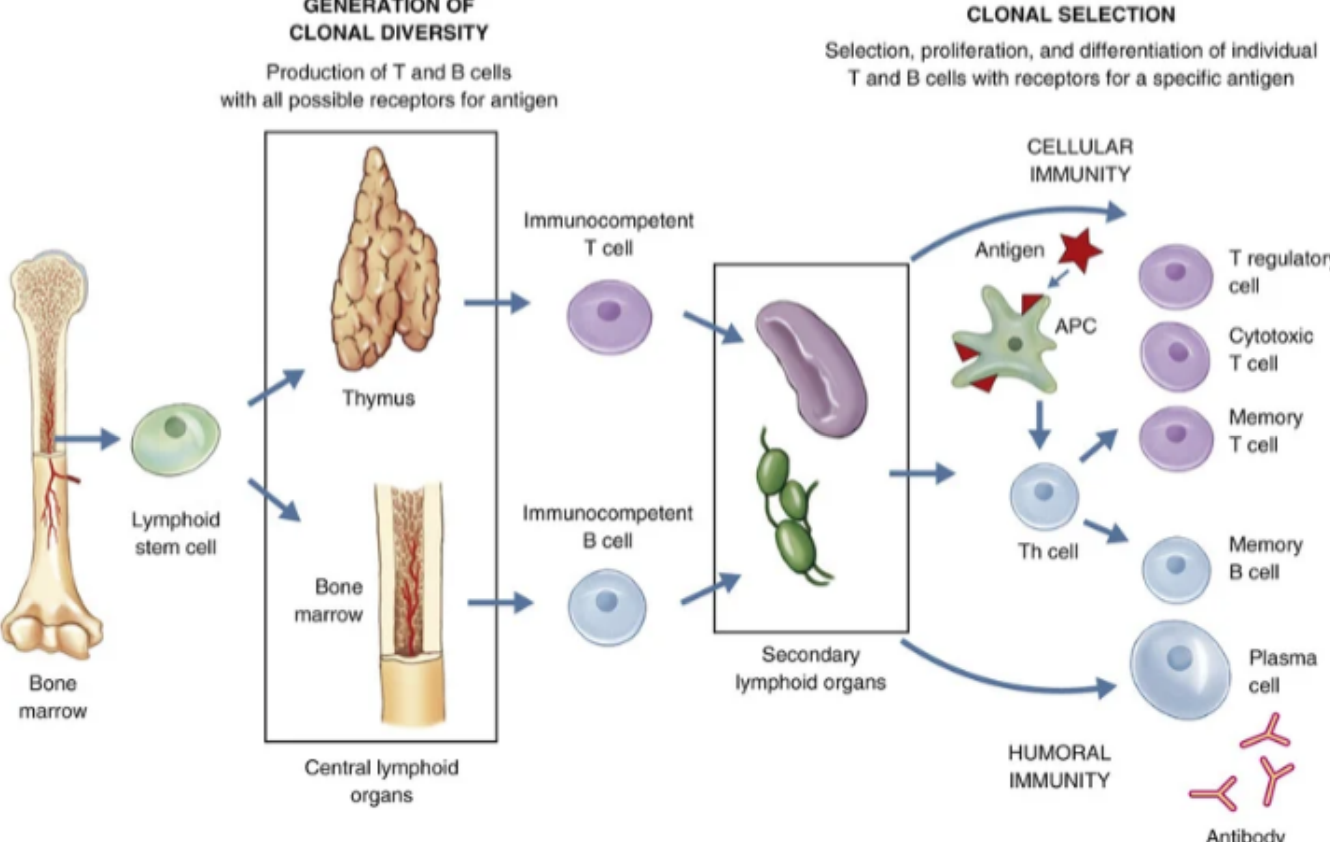
Where do T cells originate?
They are born in the bone marrow, BUT mature in the Thymus
B cells and T cells defend against different microbes. What are they?
B Cells — defend against extracellular microbes
T Cells — defend against intracellular microbes
What do B cells differentiate into?
Antibody-secreting plasma cells
Antibody-secreting plasma cells are differentiated from
B cells
T/F: B Cells defend against viruses.
F, this is mainly the job of T-Cells.
T/F: T-Cells are cytotoxic.
T
T/F: B-Cells are cytotoxic.
F, this is true for T-Cells.
How do vaccines work?
A naive B-cell recognizes that there is someone that is not like them, becoming activated then producing the needed memory cells so that the second time it happens it gets to the area faster (secondary response).
Describe the immunoglobulin, IgG.
Goes across placenta.
Anti-viral, bacterial, toxin properties
Present in all body fluids.
Describe the immunoglobulin, IgA.
AT entrances. Usually associated with mucosal and glandular secretions.
Saliva, tears, colostrum, bronchi, GI, prostate, vagina
Prevents attachment to epithelial cells.
Describe the immunoglobulin, IgM.
Made first
Agglutinating antibody (helps clumps organisms to be eliminated.
Lysis & Elimination
1st fetal antibody
What antibody appears only in primary immune response?
IgM
Describe the immunoglobulin, IgD.
On the membrane of B-Cells.
Receptor for antigen (functions as an antigen receptor)
A mysterious little guy
Describe the immunoglobulin, IgE.
“epipen”
Tightly bound to basophils and mast cells
Inflammation and allergic
Parasite fighters
T/F: Older people have significantly lower immune responsiveness.
T. They have a small thymus gland, resulting in less T-cells, less lymphocytes and altered functon, decreased cytokine synthesis, less B-cells.