Vasculature and Blood Pressure
 Call Kai
 Learn
 Practice Test
 Spaced Repetition
 Match
 Flashcards
 Knowt Play
1/17

There's no tags or description
Looks like no tags are added yet.
18 Terms
arteries
vessels that carry blood away from the heart
high pressure system, pulsatile
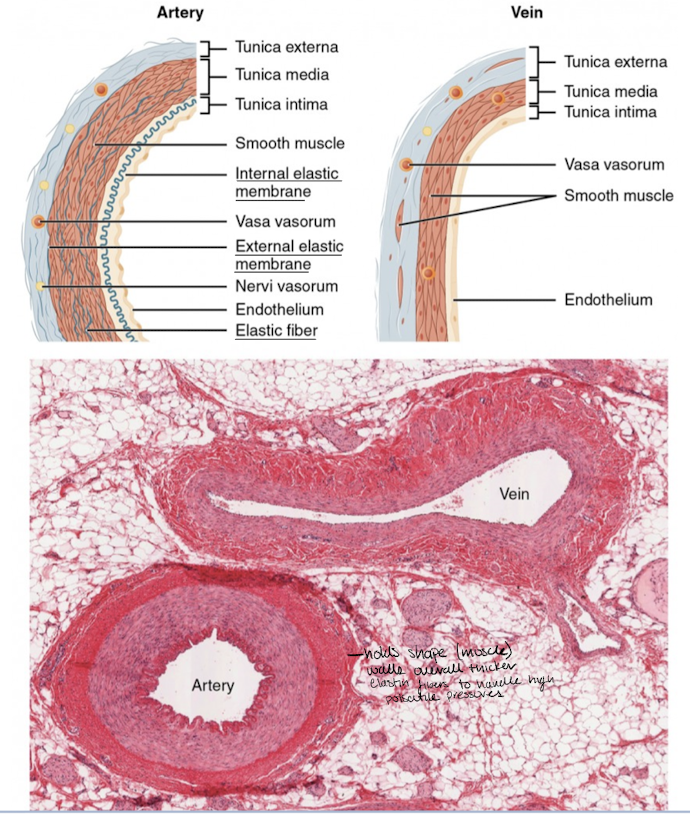
3 tunics (intima, media, externa)
small lumen and thick walls
more muscle and elastin fibers
no valves
capillaries
vessels that exchange nutrients, gases, water and solutes between blood and tissues or alveoli
very tiny lumen
thin walls with 1 tunic (intima) - endothelium
large cross sectional area as a group
no elastin, muscle fibers, or valves
veins
vessels that carry blood toward the heart
low pressure system, non-pulsatile
3 tunics (intima, media, externa)
large lumen and thin walls
fewer muscle and elastin fibers
valves - prevent back flow
artery vs vein
histologic structure reflects the different function and pressure environment
compliance
ability to stretch
capacitance
ability to hold a large volume under low pressure
compliance and capacitance
veins have higher compliance and capacitance compared to arteries
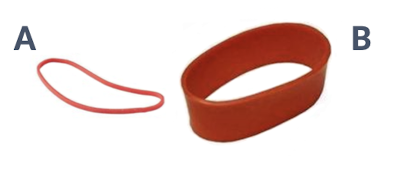
which is more difficult to stretch?
because it has more/less elastic fibers?
high/low capacitance and compliance?
represents an artery or vein?
B
more
low
low
artery
septic shock
severe infection resulting in dilation of the vessels (vasodilation)
initially have to stabilize BP before further treatments
how does severe systemic vasodilation effect venous return to the heart?
decreases, blood pools in dilated vessels
what types of treatments could be used to improve BP in systemic vasodilation?
vasoconstrictor: norepinephrine, vasopressin
IV fluids would be temporary fix because it doesn’t fix the underlying problem
elastic artery
large vessels (aorta, pulmonary artery)
thick walls with a lot of elastin tissue, smooth muscle, and CT
walls allow absorption of high pressure and blood flow as blood is pumped from the ventricles
muscular artery
medium sized vessels
moderately thick walls with moderate amount of elastin tissue, smooth muscle, and CT
arteriole
smallest branches of arteries
site of highest resistance to blood flow
smooth muscle constrict or dilate in response to sympathetic NS activity
a1 → vasoconstriction
B2 → vasodilation
continuous capillaries
least permeable
in skin, muscle, brain
passage of lipid soluble molecules (O2, CO2) via diffusion across the lipid membrane
passage of v. small water soluble molecules via intracellular clefts
fenestrated capillaries
middle permeability
in small intestine and kidneys
fenestrations allow passage of small molecules
sinusoidal capillaries
least permeable
in liver, bone, marrow, spleen
large fenestrations and incomplete basement membrane allow for exchange of large molecules (whole cells)
the high elastic ocntent of the large arteries results in which of the following properties?
high compliance and high capacitance
low compliance and low capacitance
high compliance and low capacitance
low compliance and high capacitance
low compliance and low capacitance