chemical chirality safety + practice questions
 Call Kai
 Learn
 Practice Test
 Spaced Repetition
 Match
 Flashcards
 Knowt Play
1/57

There's no tags or description
Looks like no tags are added yet.
58 Terms
When in the middle of an experiment in lab, it is okay to leave on your gloves to go to the restroom so you don't have to waste another pair
False
Methylene chloride should be disposed of in what proper waste container?
The waste container under the fume hood
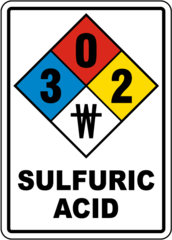
The following symbol in the NFPA diamond means the chemical will react when exposed to water:
True
When working in a fume hood:
At middle-level stop
Before beginning a distillation or reaction:
Never distill dryness, always leave a small amount of liquid left to distill
Click on the location of the emergency shower.
(with eyewash station, by main door)
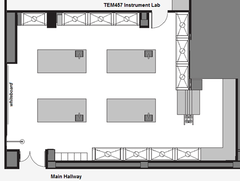
Click on the location of the broken glass receptacle.
(front of the room, otherside of whiteboard)

Click on the location of the secondary exit you could use in case a fire blocked the main exit.
(backside of the lab room, headed toward the instrument lab)
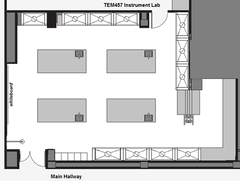
Click on the location of "sharps" collection area.
In the 1st fume hood by the door

Click on the location of the pull-down eyewash.
(front of the room by the whiteboard)

Click on the location of the fire extinguisher.
(by main entrance, right by the door)
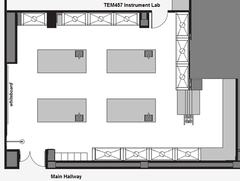
Click on the arrow that best represents the height of the hood sash for routine work.
(middle)
Click on the location of the waste collection area
(by main hallway, 1st fume hood)

In the NFPA symbol shown here, which of the following would indicate the greatest flammability risk?
Red

In the NFPA symbol shown here, which sections indicate the health and reactivity risk ratings?
Blue

You have spilled several milliliters of a solution on the lab bench. You should:
Inform your instructor, who will handle the clean up
If you do get a chemical in your eye, your first actions should be to:
Immediately call for help, then rinse out with water
During the lab period, what should you do with used / excess solutions?
Put in a designated beaker and then pour into a waste container under the fume hood
A student working next to you has splashed some flammable liquid on her / his clothes and the liquid has caught fire. You should:
Use the stop, drop and roll technique
You drop a flask on the floor and it shatters. You should:
Sweep is up and deposit in the special broken glass container
Your lab partner drops a beaker of acid and some of it splashes onto your hand. You should:
Wash your hands in the sink thoroughly
If a significant fire starts in the laboratory, you should:
Alert everyone and then get out of the area
"MSDS" stands for:
Material Safety Data Sheet
For this lab class, eye protection must:
Cover the eyes fully and provide indirect ventilation.
This GHS pictogram indicates that the substance is:
Acutely Toxic

What is red on the MSDS?
Flammability
What is blue on the MSDS?
Health
What is white on the MSDS?
Special
What is yellow on the MSDS?
Reactivity
On the MSDS, the higher the number in the quadrants, the more?
Hazardous
On the white quadrant of the MSDS, what does W with a line through it mean?
Dangerous reaction with water
On the white quadrant of the MSDS, what does OX mean?
Strong oxidizer
What would be the effects of soluble and insoluble impurities on a melting point determination?
a.
Soluble impurities have no effect on the melting point of a solid compound but insoluble impurities decrease the melting point of a compound.
b.
Soluble and insoluble impurities both decrease the melting point of a compound.
c.
Both soluble and insoluble impurities increase the melting point of a solid compound.
d.
Soluble impurities decrease the melting point of a solid compound but insoluble impurities have no effect on the melting point of a compound.
d.
Soluble impurities decrease the melting point of a solid compound but insoluble impurities have no effect on the melting point of a compound.
During a melting point determination, why is it important to use a finely powdered sample?
a.
It heats faster
b.
Ease of getting it into a capillary tube
c.
It helps distinguish the impurities from the sample
d.
The sample should be finely powdered to aid heat transfer throughout the sample
d.
The sample should be finely powdered to aid heat transfer throughout the sample
You have an unknown with an observed melting point of 90 to 93 C. Is your unknown compound A with a reported melting point of 95.5-96 C or compound B with a reported melting point of 90.5-91 C?
a.
None of the above
b.
The unknown is compound B
c.
The unknown is compound A
d.
Hard to say. It can be either compound A or B
c.
The unknown is compound A
A pure compound melts at 50-51 °C. If a trace amount of an impure compound, whose melting point is 70-72 °C, is mixed in with the first compound, what happens to the melting point?
a. The second compound would lower the melting point of the first one.
b. The second compound would raise the melting point of the first one.
c. It is impossible to determine without knowing the identity of the two compounds.
d. The second compound would have no effect on the melting point
a. The second compound would lower the melting point of the first one.
In the pre-laboratory information on solubility, you were told to carry out what part(s) of the experiment?
a.
Parts A, B, and D
b.
Parts A-E
c.
Part E
d.
Parts A, B, and C
e.
Part A only
a.
Parts A, B, and D
Which of the following is the most dense?
a.
1-octanol
b.
hydrochloric acid
c.
diethyl ether
d.
hexane
e.
malonic acid
e.
malonic acid
Which of the following terms does not apply to mixing a solid with a liquid?
a.
immiscible
b.
soluble
c.
partially soluble
d.
solute
e.
insoluble
a.
immiscible
If the procedure requires 250 mg of biphenyl, how many grams of biphenyl should be measured?
a.
25.0
b.
250
c.
0.250
d.
0.00250
e.
2.50
c.
0.250
Ethyl 4-aminobenzoate is soluble in what solvent and why?
a.
It is soluble in water because it reacts with water to form a water soluble salt.
b.
It is soluble in HCl because it forms a salt with the acid. The salt being ionic it is soluble in aqueous solution.
c.
It is soluble in NaOH solution because it react with the base and form a water soluble salt.
d.
It is soluble in water because it forms hydrogen bonding with water
b.
It is soluble in HCl because it forms a salt with the acid. The salt being ionic it is soluble in aqueous solution.
Benzoic acid is soluble in what solvent and why?
a.
It is soluble in water because it reacts with water to form a water soluble salt.
b.
It is soluble in HCl because it forms a salt with the acid. The salt being ionic it is soluble in aqueous solution.
c.
It is soluble in NaOH solution because it react with the base and form a water soluble salt.
d.
It is soluble in water because it forms hydrogen bonding with water
c.
It is soluble in NaOH solution because it react with the base and form a water soluble salt.
What is the name of the property that you are instructed to calculate that is equal to:
weight of substance isolated/weight of original material x100
a.
recovery
b.
percent recovery
c.
weight percent
d.
yield
e.
percent yield
b.
percent recovery
A student starts with 1.034 g of impure sulfanilamide. After purification, the student isolates 0.724 g. of pure sulfanilamide. What is the student's percent recovery?
a.
29.98
b.
73.74
c.
142.8
d.
70.02
e.
42.82
d.
70.02
What makes for an ideal solvent for recrystallization?
a.
high solubility at low and high temperatures
b.
low solubility at low and high temperatures
c.
equal solubility at low and high temperatures
d.
high solubility at low temperatures and low solubility at high temperatures
e.
low solubility at low temperatures and high solubility at high temperatures
e.
low solubility at low temperatures and high solubility at high temperatures
The general procedure for a recrystallization is:
dissolve solid
remove insoluble impurities
crystallize
collect and dry crystals
True or False?
True
The solubility of compound A in ethanol is 0.3 g per 100 mL at 0 ºC and 5 g per 100 mL at 78 ºC. What is the minimum amount of solvent needed to recrystallize 7.0 g of compound A? How much would be lost in the recrystallization?
a.
200 mL needed to recrystallize the sample and 0.6 g is lost.
b.
140 mL needed to recrystallize the sample and 3 g is lost.
c.
120 mL needed to recrystallize the sample and 0.3 g is lost.
d.
140 mL needed to recrystallize the sample and 0.42 g is lost.
d.
140 mL needed to recrystallize the sample and 0.42 g is lost.
Which of the following is a liquid at room temperature and has the highest density?
a.
water
b.
dichloromethane (or methylene chloride, CH2Cl2)
c.
caffeine
d.
sodium sulfate
e.
sodium carbonate
b.
dichloromethane (or methylene chloride, CH2Cl2)
A student starts with 753 mg of tea, follows the procedures outlined for this experiment and weighs 0.054 g of crude caffeine. What is this student's percent recovery? (provide answer to the nearest tenth of a percent)
7.2
Why should each sample be tightly packed into the capillary tube prior to heating?
tight compaction makes heat transfer more efficient
Give an example of the effect of an impurity on the melting point of a common substance.
Adding salt to ice lowers and widens the melting point range of the ice
predict the solubility of naphthalene in water and hexane
water - insoluble because naphthalene is nonpolar and water is polar
hexane - soluble because both naphthalene and hexane are nonpolar

predict the solubility of amphetamine in ethyl alcohol, water, and HCl
ethyl alcohol - soluble because both are slightly polar
water - insoluble because water is more polar than amphetamine
HCl - soluble because amphetamine is a base

predict the solubility of octanoic acid in water and NaOH
water - insoluble because octanoic is nonpolar
NaOH - soluble because octanoic acid reacts with NaOH (a base)

The solubility of benzoic acid in water is 0.34 g/100 mL at 25 degrees Celsius and 6.80 g/100 mL at 100 degrees Celsius. Calculate the maximum theoretical percent recovery from the recrystallization of 1.00g of benzoic acid from 15mL of water, assuming the solution is filtered at 25 degrees Celsius.
maximum theoretical percent recovery = 94.9%

Coffee contains a number of volatile, oily compounds that dissolve in dichloromethane. How would the dicholormethane affect the extraction of caffeine from coffee if we used the same procedure used to extract caffeine from tea?
The oils would extracted along with the caffeine and condense, contaminating the recovered caffeine.
On average, people use one teaspoon (2.5g) of instant tea to make an 8-oz glass of iced tea. The average glass contains 10 mg of caffeine per oz. What is the mass percent of caffeine for an 8-oz glass of tea?
3.2% caffeine

Suggest a way to modify the qualitative test for alkenes experiment procedure to determine the relative levels of unsaturation in various cooking oils.
Instead of adding 12 drops of PBP all at once, add PBP dropwise. The longer the oil remains clear (i.e. after the most drops of PBP), the more unsaturated the oil is.