Money and Banking 1
 Call Kai
 Learn
 Practice Test
 Spaced Repetition
 Match
 Flashcards
 Knowt Play
1/37

There's no tags or description
Looks like no tags are added yet.
38 Terms
What are financial markets?
Places where people with funds transfer money to those in need of funds
What are the most common financial markets?
Bond Markets (Interest rates)
Stock Market (Equity rates)
Foreign Exchange Markets (Foreign Exchange Rates)
What are Financial intermediaries?
Institutions that borrow funds from savers to turn into loans for borrowers
What are common financial intermediaries?
Banks
Insurance companies
Mutual funds
Pension funds
Monetary (1) vs Fiscal Policy (2)
1 - Money supply & Interest Rates
2 - Government Spending & Taxation
How do Interest rates affect bond prices?
Inverse Relationship
How does the money supply affect interest rates and inflation?
Interest rates - inverse relationship (Short run)
Inflation - positive relationship (Long run)
What does a strong (1) vs weak (2) dollar mean?
1 - Exports are more expensive for foreigners because the foreign currency is less valued (1 euro = 0.5 Dollars)
2 - Imports are more expensive because foreign currency is worth more than the dollar (1 Euro = $2)
What is money? What is it not?
Stock of assets used for transactions; it is not wealth or income.
What is direct finance?
Borrower issues securities directly to lenders (Company A (borrower) issues you (lender) a bond)
What is indirect finance?
There is a financial intermediary between the borrower and the lender (using an investment bank to buy stock)
Describe the flow of funds chart
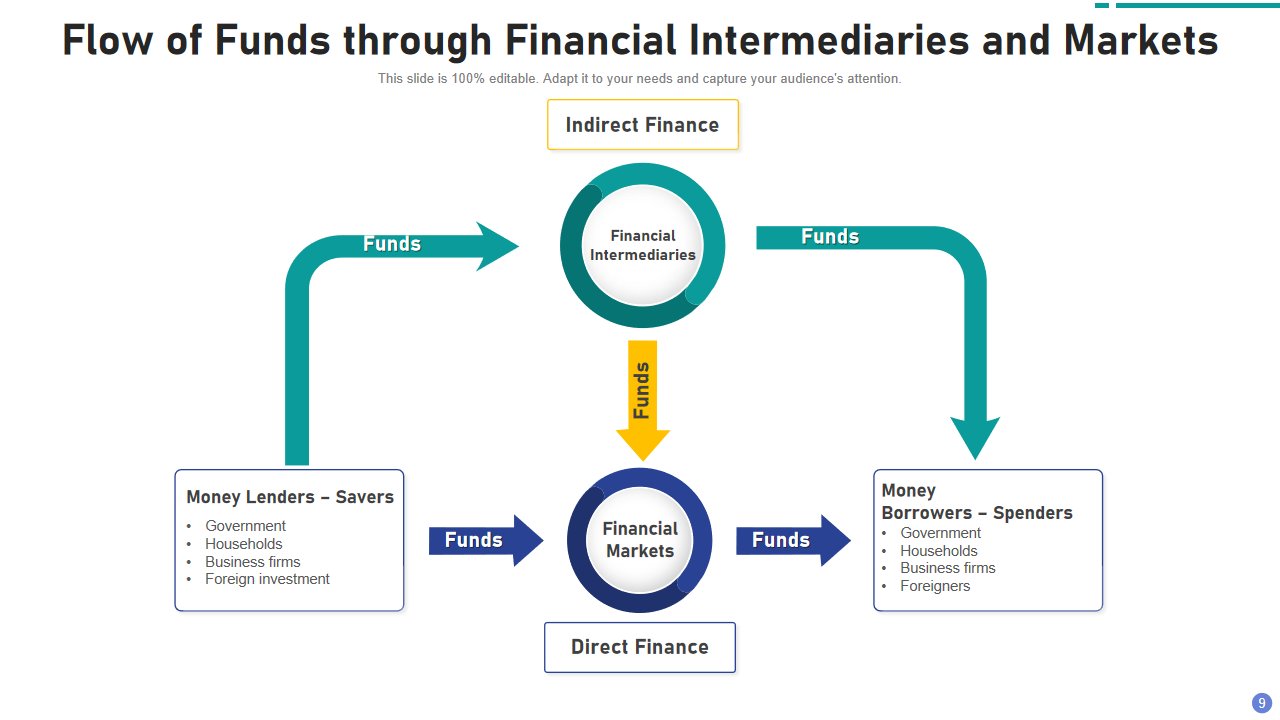
What is the function of financial markets?
To channel funds from surplus units (savers) to deficit units (Borrowers)
Debt (1) v Equity (2) markets?
1 - Fixed contractual payments (coupon bond)
2 - residual claim + no maturity (stock)
Primary (1) vs Secondary (2) markets?
1 - new securities issued + companies are paid here (IPO)
2 - Brokers & Dealers + most liquid + where most of trading occurs
Money (1) vs (2) Capital Market?
1 - Less than 1 year maturity
2 - Equal to or more than 1 year maturity
What do financial intermediaries reduce?
Lower transaction costs (Economies of scale, liquidity services, economies of scope)
Reduce exposure to risk (risk sharing & diversification)
Asymmetric information (Adverse selection - Before transaction ; Moral Hazard - After transaction)
Exchange (1) vs OTC (2) Markets?
1 - New York Stock Exchange + Chicago board of trade
2 - Foreign Exchange + Federal Funds
What are the 3 functions of money?
Medium of exchange (eliminates bartering / trans costs)
Unit of Account (measure of value in economy)
Store of Value (will still work in 20 years)
What must a medium of exchange be?
easily standardized
Widley accepted
Divisible
Easy to carry
Not deteriorating quickly
What is M1?
Currency in circulation + demand deposits + other checkable deposits + savings deposits (past 2020)
What is M2?
M1 + small denomination time deposits + MMMF shares + other near monies
Commodity(1) vs Fiat (2) Money?
1 - Valuable, easily standardized & divisble commodities (precious metals, cigarettes)
2 - Paper money decreed as legal tender by the government
What is PV?
The value today of a future cash flow
= Cash flow / (1+rate)^n
What is YTM?
the interest rate that equates PV of all CF to current bond price
What is a fixed payment loan?
Equal periodic payments covering both principal and interest (mortgage, coupon bond)
= Summation(cost/1+i) + (face value/1+i^n)
n = years to maturity
What is a discount bond?
no coupon, sold at a discount, repays FV at maturity
What is current yield?
= (Annual coupon / current price)
Approximation for YTM when bond nears par
What is rate of return?
For bonds held less than maturity it is both coupon income & capital gain/loss
= (Coupon pmt/Pt) + (Pt+1 - Pt)/Pt
What is real interest rate
= nominal rate (no adjustments) - expected inflation rate
What is bond price and Interest rate (yield) relationship?
Inverse (always)
YTM > coupon rate = bond discount
YTM < coupon rate = bond premium
YTM = coupon rate = par
What is different about long term bonds?
Greater price sensitivity to rate changes
What happens if you sell your bond early?
The ytm needs to include the gain/loss
What is the loanable funds framework? What are the determinants for demand and for supply?
Bond Market
Demand:
Wealth (positive)
Expected returns (positive)
Expected inflation (inverse)
Risk (inverse)
Liquidity (positive)
Supply
Profitability (Positive)
Opportunity cost (positive)
Expected inflation (positive)
Government deficit (more budget) (Positive)
What is the liquidity preference framework? What are the determinants of supply and demand?
Money Market
Demand
interest rate (inverse)
income level (positive)
price level (Positive)
Supply
Set by the fed
Vertical straight line
Perfectly inelastic
Short run vs Long run of money supply?
Short - MS Increase = interest rates Decrease (Liquidity effect)
Long - MS Increase = inflation AND interest rates increase (fisher equation)
What happens during business cycle expansion?
Bond Demand and Supply Rise
More borrowing to fund investments
More wealth to use
What happens during a recession?
Bond Supply and Demand fall
Prices rise and interest rates fall