KINS 158 - Motor Learning
 Call Kai
 Learn
 Practice Test
 Spaced Repetition
 Match
 Flashcards
 Knowt Play
1/10

There's no tags or description
Looks like no tags are added yet.
11 Terms
What is motor learning?
What factors affect performance and not learning?
What is the difference between performance and learning?
A relatively permanent change in a person’s capability to perform a skill, inferred from improved performance due to practice or experience
Arousal, Anxiety or stress, Unfamiliar setting, Fatigue

General Performance Characteristics of Skill Learning
What 6 performance characteristics can be observed as skill learning occurs?

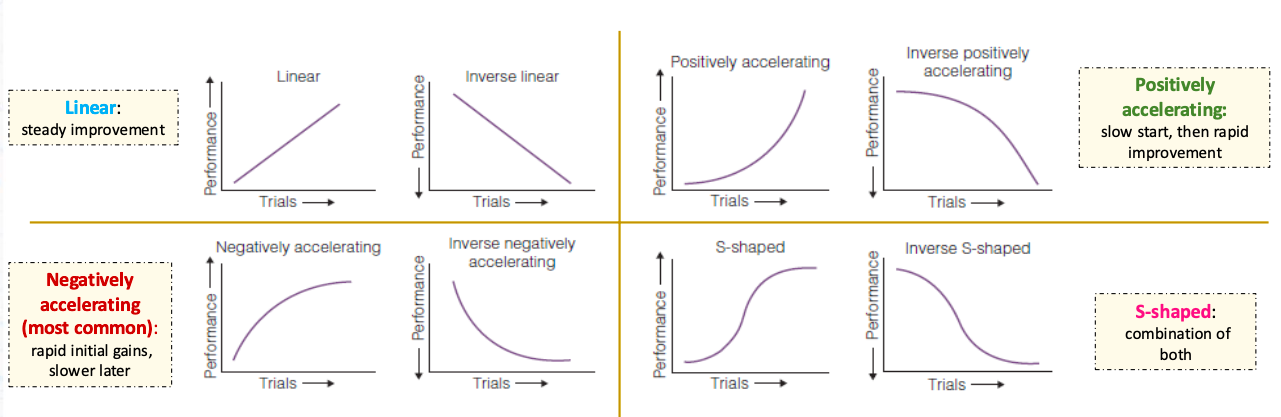
Performance Curves for Outcome Measures
What is the purpose of graphs showing how performance changes with practice over time?
What does a linear graph represent?
What does a positively accelerating graph represent?
What does a negatively accelerating graph represent?
What does an s-shaped graph represent?
Reveals rate and pattern of skill acquisition
Steady improvement
Slow start, then rapid improvement
Rapid initial gains, slower later
Combination of both
Retention Tests
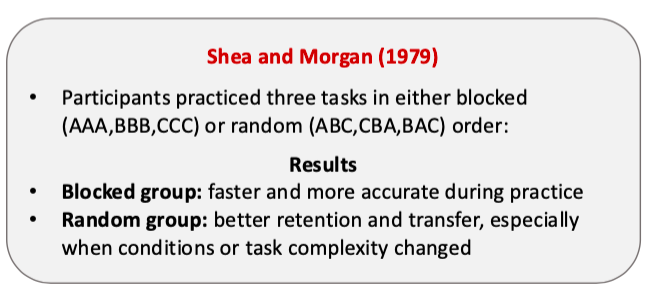
What do retention tests measure?
Explain the Shea and Morgan (1979) blocked vs random experiment
Measures persistence of learning after a period without practice
Transfer Tests
What do transfer tests evaluate?
What do transfer tests show when performance is consistent?
What are New Contexts as a transfer test?
What are three examples of New Contexts as a transfer test?
What are Novel Skill Variations as a transfer test?
What are three examples of Novel Skill Variations as a transfer test?
Evaluates adaptability — how well a learned skill applies to new contexts or variations
Transfer tests show true learning when performance remains
stable across changing situations
Intra-task trasferì: same skill, new conditions
Change augmented feedback availability, change environment, change personal factors
Inter-task transfer: related but different skill
Assess ability to adjust movements for new forms of a skill (e.g.,
walking at different speeds, drinking from various cups).
Demonstrates capacity to generalize learning to unpracticed
conditions.
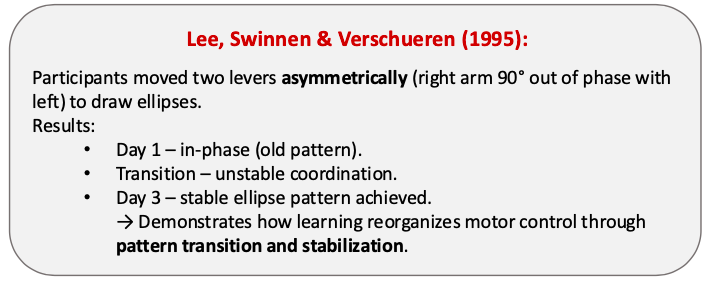
Coordination Dynamics
What does coordination dynamics examine and what does it reveal?
Explain the Lee, Swinnen & Verschueren (1995) experiment. What does it demonstrate?
Examines movement pattern transitions during learning → Reveals how learners reorganize motor control for efficiency.
Fitts & Posner’s Three Stages of Motor Learning
What is the Cognitive Stage?
What is the Associative Stage?
What is the Autonomous Stage?

Gentile’s Two-stage Model
What is the Initial Stage
What is the Later Stage

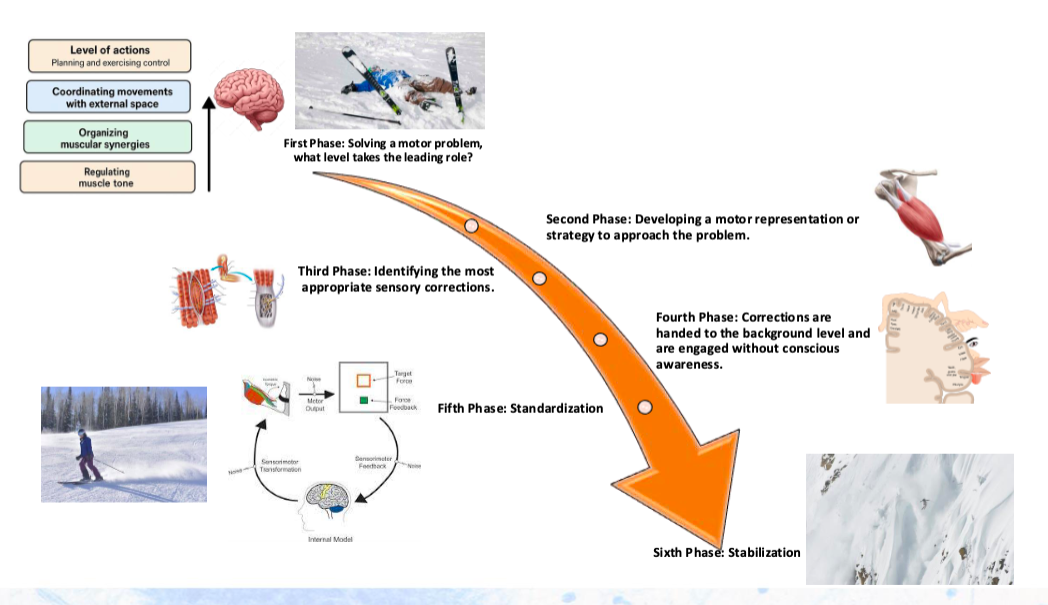
Bernstein’s description of the learning process
What are the 6 phases of Bernstein’s description of the learning process?
Performer and Performance Changes Across Stages of Learning
Changes in Rate of Improvement
Rapid improvement early —> ___ gains later
What is the Power law of Practice?
Are refinements easier at the start of a task or later on?
Smaller
Large early gains, smaller later ones
Early practice corrects large errors; later, refinements take longer
Performer and Performance Changes Across Stages of Learning
Degrees of Freedom
What are degrees of freedom?
1. The number of independent components in which a system can independently vary
Muscles + Joints + Motor Units + other forces acting on body