Non lethal skeletal anomalies
 Call Kai
 Learn
 Practice Test
 Spaced Repetition
 Match
 Flashcards
 Knowt Play
1/28

There's no tags or description
Looks like no tags are added yet.
29 Terms
Most common non-lethal skeletal dysplasia
Heterozygous achondroplasia
Heterozygous achondroplasia
Autosomal dominant disorder
Macrocrania
Flattened nasal bridge with frontal bossing
Trident hand
May be missed on routine second tri exam if performed at 20 weeks or earlier
Rhizomelia identified between week 21-27
Spinal lordosis
Ellis van Creveld syndrome
Chondroectodermal dysplasia
Autosomal recessive disorder
MOST COMMON IN AMISH communities
Mild-moderate mesomelia
Short ribs, narrow thorax
Polydactyly
Cardiac defects - ASD, single atrium
Abnormal upper lip
Severe cases can be fatal
Remember these 4 things for Ellis van Creveld syndrome
Short ribs, narrow thorax
Cardiac septal defects
Mesomeila
Polydactyly
Osteogenesis imperfecta
Type 1, 3 and 4 are milder forms than type 2
Type 1 - MOST COMMON, associated with deafness
Type 3- Thick, irregular bones and micromelia
Type 4- Hypomineralization, mild micromelia, mild bowing of long bones, shortening of long bones, bell-shaped thorax
Dysostosis
Any condition with abnormal bony ossification
Cleidocranial - Widening of the cranial fontanelles w/increased cranial width
Craniofacial - Midface hypoplasia
Associated with syndactyly
Cleidocranial Dysplasia
Autosomal dominant condition
Most common characteristic is clavicular aplasia or hypoplasia
Also seen with brachycephaly and midface hypoplasia
Short straight clavicle
Asphyxiating thoracic dysplasia
Jeune dystrophy
Pear-shaped thorax
Micomelia
Polydactyly
Associated with pelvic/renal anomalies
Disease is usually severe, but not always fatal
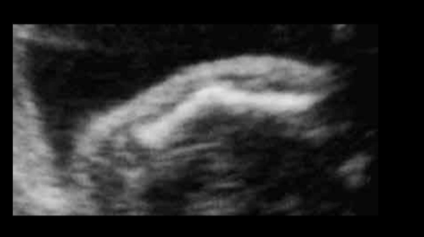
Osteogenesis imperfecta
Radial ray anomalies
Abnormal radial development; hypoplasia or aplasia
Type 1: radius is slightly shortened and hand curves sideways at wrist
Type 2: Radius is very short and the ulna curves sideways
Type 3: Absence of portion of radius
Type 4: Complete absence of radius
Associated with Trisomy 18, Holt-Oram syndrome, amniotic band syndrome
Arthrogryposis
Contraction and loss of movement in multiple joints
Increases in severity as you move distally from trunk
Affects upper and lower extremities
Suspected with significant lack of fetal movement and flexion deformities
Genu recurvatum - hyperextension of the knee, it bends backwards
Nuchal edema
Polyhydramnios
Arthrogryposis us associated with
Micrognathia, bilateral talipes, deformed elbows, wrists, ankles, knees and hips
Remember these 2 things for arthrogryposis
Contracted and fixated joints
Genu recurvatum (hyperextension of knee)
Sandal gap toes
Gap between 1st and 2nd toe bones
Can be normal variant
Associated with trisomy 21
Club foot
Congenital talipes equinovarus
Affected foot appears rotated internally at the ankle with an eccentric junction between the calcaneus and tarsal bones
Best evaluated by identifying a sagittal view of lower leg
See deformity in multiple views
50% of cases are bilateral
Mostly isolated
Associated with spina bifida
Club foot can be caused by…
Oligohydramnios, amniotic band syndrome and extrinsic compression
Club foot occurs more in ______ than females by a ratio of 2:1
Males
Radial clubhand
Associated with absent thumb, thumb hypoplasia, thin first metacarpal, and absent radius
MOST COMMON type of clubhand
Associated with congenital scoliosis
Usually associated with a syndrome
Ulnar clubhand
Mild deformities of the ulnar side of the hand, partial or complete absence of the ulna
Usually an isolated anomaly
Rocker bottom foot
Congenital vertical talus
Best evaluated by a sagittal view of lower leg
Normally the foot is seen in profile when the long bones are visible
Rocker bottom foot demonstrates prominent calcaneus and a convex rounded bottom to the foot
Associated with Trisomy 9, Trisomy 13, and 18
CHILD syndrome
Congenital Hemidysplasia with Ichthyosiform Erythroderma and Limb Defects
Characterized by abnormalities on one side of the body
Unilateral long bones deformities, unilateral hydro, unilateral agenesis of kidney, adrenal gland, ovary, thyroid
Associated with congenital heart defects
MOST COMMONLY SEEN IN FEMALES
Holt Oram Syndrome
Heart and Hand syndrome
Defects are seen in cardiac anatomy and upper extremity
Defects are more severe on left side
Strawberry skull and radial ray anomalies are common in a Trisomy __
21
Ellis van Creveld syndrome is an ___________ disorder that is commonly seen in _________
Autosomal recessive; Amish communities
What cardiac defect is common in Ellis van Creveld syndrome
ASD
All the following are commonly associated with Radial ray anomalies except:
Trisomy 18
Turner syndrome
Holt oram syndrome
Amniotic band syndrome
Turner syndrome
Genu Recurvatum is a finding seen with:
Arthrogyroposis
How does club foot appear on US
The bottom of the foot in the same plane as the long bones
Which of the following is typically an isolated finding?
Osteogenesis imperfecta
Rocker bottom foot
Ulnar club hand
All of the above
Ulnar club hand