Lecture 17 - Protein Engineering
 Call Kai
 Learn
 Practice Test
 Spaced Repetition
 Match
 Flashcards
 Knowt Play
1/97

There's no tags or description
Looks like no tags are added yet.
98 Terms
Protein engineering
The modification of protein structure with recombinant DNA technology or chemical/physical treatment to get a desirable function
use in medicine, industry and agriculture
Two rationales for protein engineering
Enhancing existing protein properties (activity, stability, solubility, substrate range)
Creating novel protein functions (fusion proteins, tagging)
Three expectations from protein engineering
Create a superior enzyme to catalyze production of specific high-value chemicals
produce enzymes in large quantities with high productivity
produce non-natural biological compounds superior to natural ones

Lipases
Enzymes that break down fats and oils
used in detergents to enhance stain removal
grease and oil stains

Why engineer lipases for enhanced stability
Detergent formulations contain harsh chemicals and cleaning conditions can be extreme (e.g. high temperatures)
lipases must remain active and stable

Why engineer lipases for improved activity
Higher activity means they break down more oil and grease, giving better stain removal

Why engineer lipases for detergent compatibility
Lipases must be compatible with surfactants and other ingredients
so they are not inactivated and do not interfere with detergent performance
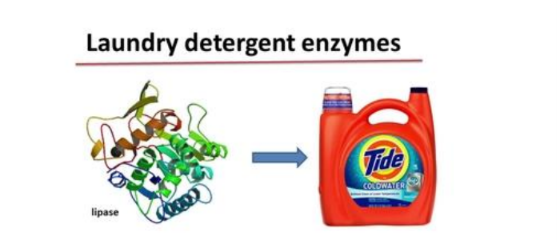
Why engineer lipases for specific stains
Some lipases are engineered to target specific types of oil and grease stains
more effective on certain stains
Reasons for performing protein engineering (stability-related)
pH/thermal stability
stability in organic solvents
resistance to proteases
reduced aggregation/misfolding
improved solubility
Reasons for performing protein engineering (catalysis-related)
Alleviate small molecule inhibition
improve kinetic properties
alter cofactor requirements
alter substrate binding specificity
change allosteric regulation
improve biological activity
improve substrate affinity
Reasons for performing protein engineering (production-related)
Better recombinant expression and better purification/separation
3 main protein engineering approaches
Site-directed mutagenesis
combinatorial protein design
directed evolution of protein catalysts

Central principle linking structure and function
The functions of proteins are determined by the structures of proteins
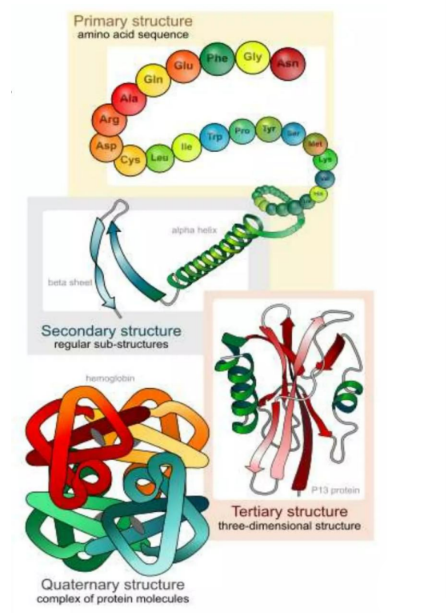
Primary structure
The sequence of amino acids present in the polypeptide chain
each component amino acid is called a "residue"

Secondary structure
The localized arrangement of adjacent amino acids formed as the polypeptide chain folds
alpha-helix, beta-sheet, beta-bends, non-repetitive structures

Tertiary structure
The three-dimensional conformation of a polypeptide
>200 residues usually fold into two or more globular clusters called domains (functional units)

Quaternary structure
arrangement of polypeptide subunits in multimeric proteins
function requires multiple polypeptide chains

Disulfide bonds (tertiary structure)
Covalent bonds formed between two sulfur (SH) atoms
cysteine
Electrostatic bonds and van der Waals forces
Non-covalent
charged side chains attract oppositely charged side chains
repel like-charged side chains

Hydrogen bonds
A non-covalent electrostatic attraction
between hydrogen atom covalently bonded to an electronegative "donor" atom and another atom bearing a lone pair of electrons
Hydrophobic interactions
Non-covalent
amino acids with water-repelling side chains are often found inside proteins and interact with one another

Stability of native protein states
Native states are only weakly stable
5–20 kcal/mol relative to unfolded states

Temperature dependence of protein stability
Proteins tend to be maximally stable around room temperature
subject to both cold and heat denaturation
inversion of sign of both the enthalpy and entropy of unfolding
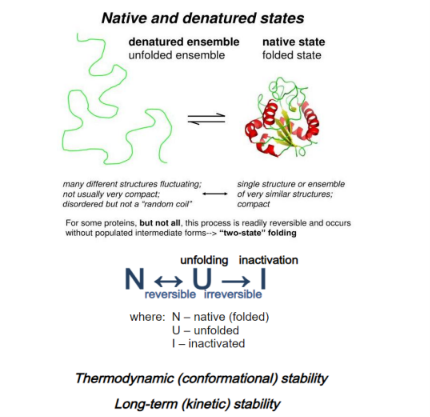
Basis of protein denaturation behavior
Much of it can be understood simply in terms of burial and solvent exposure of nonpolar and polar surface area
Denaturation
A loss of three-dimensional structure sufficient to cause loss of function
does not necessarily mean complete unfolding or random conformations

Denaturation midpoint
The temperature (Tm) or denaturant concentration (Cm) at which folded and unfolded states are equally populated at equilibrium, assuming two-state folding

How Tm is measured
Often determined using a thermal shift assay

Renaturation
The reversal of denaturation

Anfinsen's experiment
In the 1950s Christian Anfinsen denatured ribonuclease with urea and a reducing agent (mercaptoethanol)
on removal of the reagents it spontaneously refolded to an active form with disulfide cross-links correctly re-formed

Enzymes as biocatalysts
continuous controlled chemical activity in cells,
regulate metabolism by altering the rate of chemical reactions

How enzymes alter reaction rates
By decreasing the activation energy
they can also transform one form of energy to another

Enzyme selectivity
Enzymes are highly selective and may catalyze only one reaction or a specific class of reactions
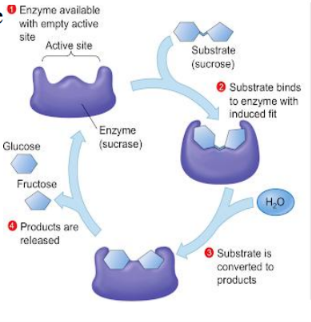
Lock and Key Theory
The shape of the enzyme's active site is complementary to that of its substrate
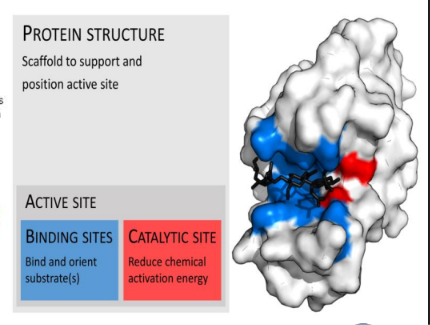
Induced Fit Theory
The active site is flexible in shape, so when an appropriate substrate contacts it, the active site changes shape to fit the substrate

π–π interactions
Interactions between aromatic residues
fundamental role in protein stabilization, protein-protein interactions and ligand binding

Cation–π interactions
Interactions involving arginine, whose delocalized charge on the guanidinium group yields dispersion energy contributions in addition to electrostatic ones

Disulfide bridges as a stability strategy
Engineering disulfide bonds gives contradictory results that depend crucially on the position where the new interaction is introduced

Salt bridges (definition and location)
A combination of hydrogen bonding and ionic bonding
preferentially located at the protein surface
often mediated by arginines that can be involved in two salt bridges or H-bonds at once

Hydrophobic effect
A main driving force of protein folding
resulting from the tendency of hydrophobic amino acids to cluster together to avoid contact with water
Ionic interactions as a design strategy
Targeting surface charges has been proposed as a valuable protein design approach
Rational design workflow
Computer-aided design → site-directed mutagenesis of an individual mutated gene → transformation → protein expression → protein purification → biochemical testing of the constructed mutant enzyme

Directed evolution workflow
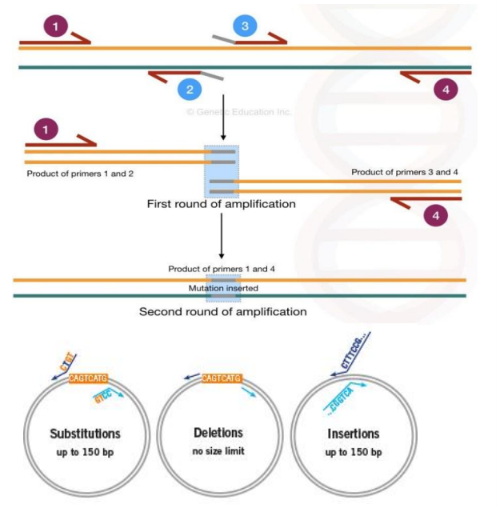
Site-directed mutagenesis (SDM)
A powerful technique that lets the experimenter assess the importance of particular amino acid side chains in a protein

Uses of SDM
Most commonly in the study of enzymes
also to identify key residues in protein–protein interactions

How SDM produces a mutant protein
By changing a single base in the gene so that the codon for the target amino acid is changed to one encoding the desired replacement amino acid
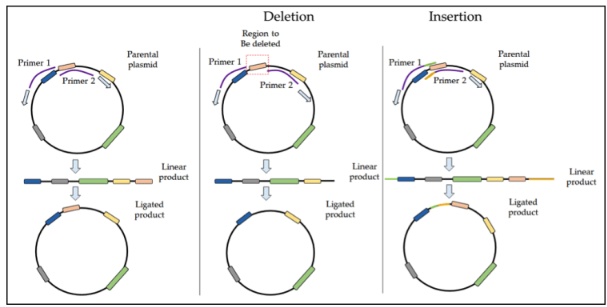
When to use inverse PCR
For deletions or insertions of >50 bp, inverse PCR is the most popular approach
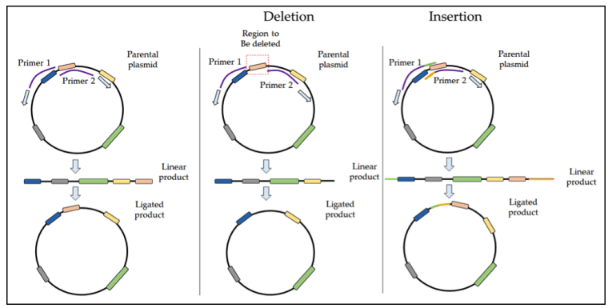
Inverse PCR method
Back-to-back primers amplify the whole plasmid
linear product is then self-ligated to form circular DNA

Inverse PCR for deletions
Primers are designed to anneal on either side of the targeted deletion zone
amplification proceeds outwards, excluding that region from the product
after ligation the construct lacks that domain
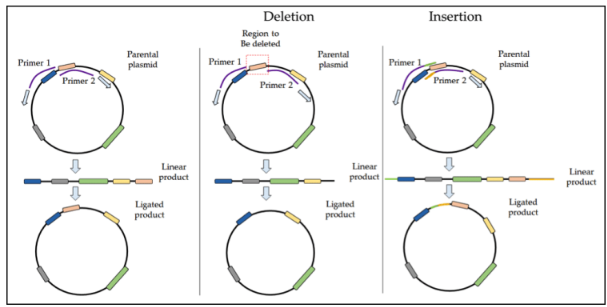
Inverse PCR for insertions
Overlapping primers are used with flanking sequences containing the appropriate extra bases
Application example of inverse PCR
Larger insertions or deletions such as removing a regulatory domain from a protein

Overlap extension PCR (OE-PCR)
A PCR variant
splicing by overlap extension / splicing by overhang extension (SOE) PCR
How OE-PCR performs site-directed mutagenesis
Mutagenic primers (b and c) and flanking primers (a and d) generate intermediate overlapping products AB and CD, which are denatured and used as template in a second PCR to make the full product AD
How OE-PCR makes chimeric genes
The same scheme is used but internal primers b and c are not mutagenic — they instead include nucleotides spanning the junction so that two different gene segments are spliced together
Final step of OE-PCR
The second PCR generates hybrid product AD, which is inserted into a vector for larger-scale production and verification of accurate joining
Three types of chemical mutagens
Intercalating agents, base analogues, and reacting chemicals
Intercalating agents
Chemicals that slip in between two base pairs of the double-stranded DNA helix, altering DNA morphology at that position so errors during replication are more likely; examples are acridine orange, ethidium bromide and proflavin
Base analogues
Chemicals morphologically similar to normal nitrogen bases that get incorporated in their place during replication; 2-aminopurine is an analogue of adenine and 5-bromouracil of thymine
Reacting chemicals
Mutagens that react directly with the nitrogenous bases and chemically modify DNA; nitrous acid removes amino groups from purines and pyrimidines, and EMS is another example
Ethyl methane sulfonate (EMS)
A chemical mutagen that alkylates individual DNA segments, leading to mispairings; a promising approach for producing novel plant varieties
Two categories of physical mutagens
Non-ionizing radiation (ultraviolet) and ionizing radiation (X-rays, gamma rays)
How UV radiation causes mutation
UV excites electrons to a higher energy level; DNA absorbs UV and cytosine and thymine are most vulnerable, with adjacent thymines pairing with each other as a bulky dimer
How ionizing radiation causes mutation
X-rays and gamma rays attack DNA hotspots and break the DNA
DNA hotspots
Sites where mutations occur up to 100 times more than the normal mutation rate, for example at an unusual base such as 5-methylcytosine
DNA shuffling
Shuffling segments from related genes to enhance the function of a particular protein
DNA shuffling procedure
The original set of related genes is digested into small fragments with appropriate restriction enzymes, the segments are mixed before reassembly, and reassembled segments keep their original natural order; new combinations are then tested for changed function
DNA shuffling example (β-lactamases)
Related β-lactamases from different enteric bacteria were shuffled, cloned onto a plasmid vector, transformed into host bacteria and screened for β-lactam resistance, yielding enzymes that degraded certain penicillins and cephalosporins faster and made hosts up to 500-fold more resistant
Why LDH prefers NAD over NADP
The binding pocket has an aspartic acid whose negatively charged carboxyl repels the negatively charged phosphate of NADP
Effect of mutating aspartic acid to serine in LDH
It removes the repulsion so that either NAD or NADP can bind
Effect of adding a positively charged lysine in LDH
It makes the binding pocket more attractive to NADP
Why change cofactor or substrate specificity
To make the product of the enzyme reaction less costly or to change it chemically; demonstrated with several NAD/NADP-dependent dehydrogenases
Rationale for engineering disulfide bonds
Since proteins are prone to unfolding, adding disulfide linkages increases thermal and solvent stability
How a disulfide bond is engineered
Two amino acids are changed into cysteines by site-directed mutagenesis; under oxidizing conditions the two cysteines form a disulfide bond holding the protein together at that site
Prerequisite for engineering disulfide bonds
The tertiary structure of the protein must be known so the cysteines can be inserted in appropriate positions
Effect of loop length on engineered disulfide stability
In general, the longer the loop of amino acids between the two cysteines, the greater the increase in stability
Risk of engineering disulfide bonds
If the two cysteines are not properly aligned, the linkage can create a strained conformation and decrease protein stability
T4 lysozyme disulfide example
Three disulfide bonds were added at three locations (residues 9–164, 2–97, and 21–142) to increase its stability
Typical location of hydrophobic vs polar residues
Hydrophobic residues such as Val, Leu, Ile, Phe and Met tend to be buried in the interior, while polar side chains are exposed to solvent
Trypsin inhibitor finding
Hydrophobic amino acids on the trypsin inhibitor stabilize the protein in an enthalpy-driven manner — a novel and unexpected phenomenon
Ion pairing
The most commonly observed contribution to the stability of the entropically unfavorable folded conformation of proteins
Why weak interactions still matter
Although noncovalent interactions are relatively weak, many small stabilizing interactions add up to make an important contribution to overall conformer stability
Directed evolution
Improving the properties of an enzyme by iterative cycles of mutagenesis, high-throughput screening or selection, and identification of improved variants
Four steps of directed evolution
Introduce random mutations into a target gene (e.g. by error-prone PCR); transfer mutated genes into a suitable host and express them to make a large variant library; identify improved variants by high-throughput screening or selection; isolate the gene(s) encoding improved variants for another cycle
Error-prone PCR (epPCR)
The method used in directed evolution to introduce random mutations into a target gene
Recombining domains
A related approach to directed evolution in which functional domains from different proteins are deliberately recombined
FokI
A type II restriction enzyme with distinct N-terminal and C-terminal domains that function in DNA recognition and DNA cutting respectively
Novel restriction enzyme example
Linking the cleavage domain of FokI to different sequence-specific DNA binding domains creates new restriction enzymes
Role of the Gal4 domain in the hybrid nuclease
When the FokI nuclease domain is attached to the Gal4 recognition domain, that DNA-binding domain determines the sequence specificity of the hybrid protein
Gal4 protein
A transcriptional activator in yeast that recognizes a 17 base pair consensus sequence and has two domains — a DNA binding domain and a transcriptional activating domain
Gal4-FokI hybrid construction
The N-terminal 147 amino acids of Gal4 are fused to the FokI nuclease domain, giving a hybrid that binds the Gal4 consensus sequence and cleaves DNA at that location
Linker used to join domains
A sequence encoding a linker peptide such as (Gly-Gly-Gly-Gly-Ser)
Cleavage position of the hybrid enzyme
Cleavage occurs several bases to the side of the recognition sequence, as in the native FokI restriction enzyme (9th and 13th bases)
Affinity tags
Tools fused to a protein of interest that streamline purification by binding to a tag-specific resin
Why tag selection matters
The purification tag can affect expression level and solubility, facilitate correct folding, protect from proteolysis, redirect proteins to a cellular compartment, and it determines the affinity resin used
Two classes of purification tags
Peptide tags and protein tags
Peptide tags
Mostly biochemically inert — they generally don't affect protein folding or solubility and don't interfere with protein function; examples include His-tag, Flag-tag, Spot-tag, Strep-tag and C-tag
Protein tags
Larger tags such as Maltose Binding Protein (MBP) and Glutathione-S-Transferase (GST) that can increase a protein's solubility and facilitate correct folding
Removing tags after purification
Depending on the downstream application, protein tags may be removed by proteolytic cleavage, while peptide tags can remain on the protein of interest
Affinity purification workflow
Bind the target protein to the affinity resin, wash away other components of the complex protein mixture, elute the target, then desalt it using a size-exclusion resin (can be automated)