Week 7: School age
0.0(0)
Studied by 0 people Call Kai
 Learn
Learn Practice Test
 Spaced Repetition
 Match
Match Flashcards
 Knowt Play
Card Sorting
1/47

Earn XP
Description and Tags
Last updated 12:10 PM on 10/11/26
Name | Mastery | Learn | Test | Matching | Spaced | Call with Kai | Chat |
|---|
No analytics yet
Send a link to your students to track their progress
48 Terms
1
New cards
physical changes
although the changes are more difficult to observe directly, the physical changes in middle childhood are just as impressive as those in early childhood
2
New cards
growth patterns
5cm to 8cm in height and 2.75kg each year
3
New cards
_____ _____ coordination continues to improve, children show _____ in strength and speed, and _____ ___ __________ also gets better
large muscle
increases
hand-eye coordination
increases
hand-eye coordination
4
New cards
Increasingly good _____ makes writing possible as well as drawing, cutting and many other skills
fine motor coordination
5
New cards
myelinization
Steady increase in the myelinization of neural axons across the cerebral cortex with sensory and motor areas affected first which may be linked to the
improvement in fine motor skills and hand eye coordination
improvement in fine motor skills and hand eye coordination
6
New cards
_______ _________ _______ increases spatial perception
Right hemisphere Latarization
7
New cards
spatial cognition boys vs girls
boys score better than girls on spatial orientation
(boys early play preferences may enhance this ability)
(boys early play preferences may enhance this ability)
8
New cards
visual experience
visual experience is important in development of spatial perception
9
New cards
_/_ of overweight children become overweight adults
1/2
10
New cards
overweight and obese children are predisposed to ________ later in life
developing type II diabetes, and cardiovascular disease
11
New cards
BMI
weight /height squared
- universal number to measure obesity
- universal number to measure obesity
12
New cards
what is the flaw with BMI?
doesn't account for muscle mass - muscle weighs more than fat
- very problematic
- easy to misclassify
why do we still use it then?
- easy, fast and cheap
- accurate about 80% of time
13
New cards
_/_ children fail to meet the recommended daily duration of PA (60 minutes a day or more of moderate to vigorous intensity)
1/4
14
New cards
PA during COVID
decrease in PA (girls more than boys; upper/middle income while no difference in low and middle income families)
increase in screen time (boys more than girls)
increase in screen time (boys more than girls)
15
New cards
__% exceed the sedentary behaviour recommendation (no more than two hours per day of screen time or other passive non-school related activities
37%
16
New cards
concrete operational stage (Piaget)
Increased inductive logic allows child to go from a specific experience to a general principle but deductive logic is still not strong
17
New cards
decentration
thinking that takes multiple variables into account
*perspective is everything
*perspective is everything
18
New cards
reversibility
understanding that both physical actions and mental operations can be reversed
*things can change
*things can change
19
New cards
Information-processing skills
memory function continues to improve and processing efficiency increases steadily with age (ability to make efficient use of short-term memory capacity)
20
New cards
Executive functions
cognitive processes that are necessary for cognitive control of behaviours
- selecting and successfully monitoring behaviours that facilitate the attainment of chosen goals
eg.
attentional control cognitive inhibition, inhibitionary control, working memory, cognitive flexibility in information processing and problem solving
- selecting and successfully monitoring behaviours that facilitate the attainment of chosen goals
eg.
attentional control cognitive inhibition, inhibitionary control, working memory, cognitive flexibility in information processing and problem solving
21
New cards
executive processes
advancement in information-processing skills
that involves devising and carrying out
strategies for remembering and solving
problems based on knowing how the mind
works (metacognition)
*executive processes are improved with the use of common information processing strategies
that involves devising and carrying out
strategies for remembering and solving
problems based on knowing how the mind
works (metacognition)
*executive processes are improved with the use of common information processing strategies
22
New cards
rehearsal
mental or vocal repetition
23
New cards
organization
grouping ideas, objects or words into clusters to help in remembering them (i.e. all animals, ingredients for lasagna)- this strategy is more applicable to knowledge you have experience with)
24
New cards
master basic grammar
basic grammar is mastered by 5/6 years and pronunciation in native language
25
New cards
expansion
children learn to maintain the topic of conversation, create unambiguous sentences, and speak politely or persuasively
26
New cards
Literacy
literacy, the ability to read and write, is the focus of
education in the 6-12 year old period
phonological awareness is an important skill
learning about meaningful word parts helps children to
better understand what they read
comprehension strategies are needed- sound-symbol
connection assists writing and spelling, grammar and
writing techniques must be taught (i.e. period and
capitalization)
education in the 6-12 year old period
phonological awareness is an important skill
learning about meaningful word parts helps children to
better understand what they read
comprehension strategies are needed- sound-symbol
connection assists writing and spelling, grammar and
writing techniques must be taught (i.e. period and
capitalization)
27
New cards
multiple intelligences - Gardner
1. Linguistic - ability to use language effectively
2. Logical/mathematical - numbers and logical problem solving
3. Musical - ability to appreciate and produce music
4.Spatial - ability to appreciate spatial relationships
5.Bodily/kinesthetic - ability to move in a coordinated way
6. Naturalist - ability to make fine discrimination among flora and fauna or patterns and designs of human artifacts
7. Interpersonal- sensitivity to the behaviour, moods, and needs of others
8. Intrapersonal- ability to understand oneself
2. Logical/mathematical - numbers and logical problem solving
3. Musical - ability to appreciate and produce music
4.Spatial - ability to appreciate spatial relationships
5.Bodily/kinesthetic - ability to move in a coordinated way
6. Naturalist - ability to make fine discrimination among flora and fauna or patterns and designs of human artifacts
7. Interpersonal- sensitivity to the behaviour, moods, and needs of others
8. Intrapersonal- ability to understand oneself
28
New cards
Sternberg's 3 components of intelligence
1. Contextual
- knowing the right behaviour for specific situation
2. Experimental
- learning to give specific responses without thinking about them
3. Componential
ability to come up with effective strategies
- knowing the right behaviour for specific situation
2. Experimental
- learning to give specific responses without thinking about them
3. Componential
ability to come up with effective strategies
29
New cards
Why is there no agreement on the measurement of intelligence
fluid - problem solving
crystallized - accumulation of knowledge
crystallized - accumulation of knowledge
30
New cards
__% of the Canadian population may experience learning problems that are a continuation of learning disabilities from early childhood
10%
31
New cards
modified programs and IEPS
exceptional children and children with learning accomodations
32
New cards
Personality
Freud believed challenges in middle childhood were to form emotional bonds with peers
(move beyond those with parents)
(move beyond those with parents)
33
New cards
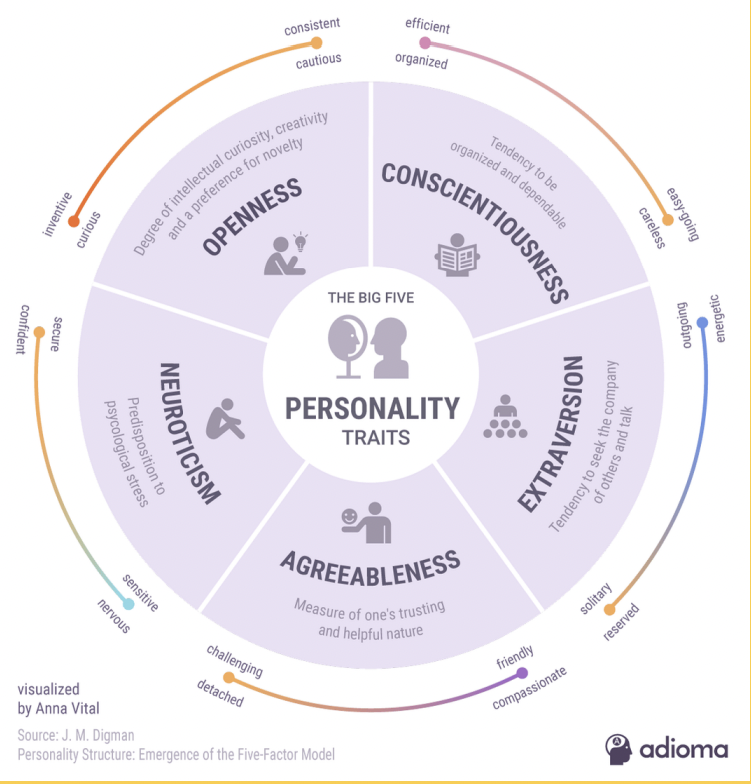
The big 5 personality
- the emergence of stable traits in middle childhood are
known to contribute to the development of feelings of
competence
- not only identifiable but also stable in middle childhood
known to contribute to the development of feelings of
competence
- not only identifiable but also stable in middle childhood
34
New cards
Industry vs inferiority
Erikson - develop a sense of your own competence through mastery of culturally defined learning tasks
35
New cards
Self concept - 2 new components:
from 6-12 kids understanding of themselves improves
by the end of middle childhood children's
self-concepts include two new components:
(1) psychological self
(2) valued self
by the end of middle childhood children's
self-concepts include two new components:
(1) psychological self
(2) valued self
36
New cards
psychological
- understanding one's stable internal traits
- psychological self becomes increasingly complex and
abstract
- development of self-efficacy
- psychological self becomes increasingly complex and
abstract
- development of self-efficacy
37
New cards
valued
global evaluation of one's self worth
self-esteem is quite stable in the short terms but somewhat less so over periods of several years
(eroding self-esteem)
self-esteem is quite stable in the short terms but somewhat less so over periods of several years
(eroding self-esteem)
38
New cards
active listening
empathize
be attentive
show understanding and acceptance
remain neutral
ask open ended questions
be attentive
show understanding and acceptance
remain neutral
ask open ended questions
39
New cards
open ended questions
Would you tell me more about ___?
Could you help me understand ___?
What are the good things and the less good things
about ___?
What do you think you will lose if you give up ___?
Could you help me understand ___?
What are the good things and the less good things
about ___?
What do you think you will lose if you give up ___?
40
New cards
social cognition
Children's ability to understand others is
enhanced by the development of a theory of
mind in early childhood
descriptions of other people move from
concrete to abstract (6/7 yo focus on
physical features in descriptions but 7/8 yo
begin to focus on inner qualities/traits)
enhanced by the development of a theory of
mind in early childhood
descriptions of other people move from
concrete to abstract (6/7 yo focus on
physical features in descriptions but 7/8 yo
begin to focus on inner qualities/traits)
41
New cards
family relationships
6-8 year olds rely on their parents' presence, support, and
affections despite spending less time with them
affections despite spending less time with them
42
New cards
Having meals together is the best predictor of...
- significantly better academic success
- fewer behavioural problems
- better psychological adjustment
-> teen years (less likely to use maladaptive coping strategies)
- better nutrition
- fewer behavioural problems
- better psychological adjustment
-> teen years (less likely to use maladaptive coping strategies)
- better nutrition
43
New cards
friendships
'best friend' becomes part of middle childhood
children are supportive of their friends
children are supportive of their friends
44
New cards
aggression
physical aggression becomes less common as children
learn the cultural rules about when and how much it is
acceptable to display anger/aggression
at every age boys show more physical aggression and
more assertiveness than do girls
relational aggression aimed at damaging another's self esteem or peer relationships is more common in girls
learn the cultural rules about when and how much it is
acceptable to display anger/aggression
at every age boys show more physical aggression and
more assertiveness than do girls
relational aggression aimed at damaging another's self esteem or peer relationships is more common in girls
45
New cards
TV aggression study
15 year longitudinal study of 6-9 year olds found TV violence leads to high amounts of direct physical aggression in adults of both genders and indirect aggression in females
*recall Bandura's social learning theory - what you see is what you imitate, leading to eventual desensitization
*recall Bandura's social learning theory - what you see is what you imitate, leading to eventual desensitization
46
New cards
TV violence leads to:
- emotional desensitization regarding violence
- a belief that aggression is a good way to solve problems
- a reduction in pro social behaviour (voluntary behaviour designed to help others)
- a belief that aggression is a good way to solve problems
- a reduction in pro social behaviour (voluntary behaviour designed to help others)
47
New cards
TV should be considered an _____ ______
educational medium
*positive and negative behaviours can be learned
*positive and negative behaviours can be learned
48
New cards
child resilience in the context of COVID-19
Ontario children faced the largest school closures compared to all other provinces and territories in Canada
Oscillators between in-person and virtual schooling, extracurricular cancellations, and loss of social interactions
children with siblings, pets, and close family members showed higher levels of resilience
Oscillators between in-person and virtual schooling, extracurricular cancellations, and loss of social interactions
children with siblings, pets, and close family members showed higher levels of resilience