ANAT - M3: S3: Axial Muscles

0.0(0)
Studied by 0 people
call kaiCall Kai
learnLearn
examPractice Test
spaced repetitionSpaced Repetition
heart puzzleMatch
flashcardsFlashcards
GameKnowt Play
Card Sorting

1/19

encourage image

There's no tags or description

Looks like no tags are added yet.

Last updated 9:51 PM on 10/4/26
Name
Mastery
Learn
Test
Matching
Spaced
Call with Kai
Chat

No analytics yet

Send a link to your students to track their progress

20 Terms

1
New cards

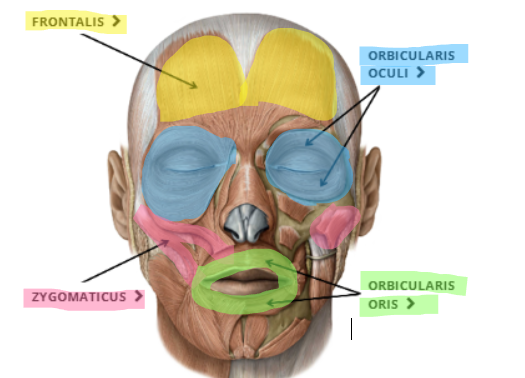
Frontalis

the muscle that covers the frontal bone and lifts the eyebrows, causing the forehead to wrinkle.

<p><span style="background-color: inherit;">the muscle that covers the frontal bone and lifts the eyebrows, causing the forehead to wrinkle.</span></p>
2
New cards

Orbicularis Oculi

a muscle surrounding the eye that forcefully closes the eye when contracted. It originates on the frontal and maxillary bones. 

<p><span style="background-color: inherit; line-height: 20.7px;">a muscle surrounding the eye that forcefully closes the eye when contracted. It originates on the frontal and maxillary bones.</span><span style="line-height: 20.7px;">&nbsp;</span></p>
3
New cards

Orbicularis Oris

surrounds the mouth and enables the puckering of lips. It originates on the maxillary bones or mandible and sometimes referred as a kissing muscle.
<p><span style="background-color: inherit;">surrounds the mouth and enables the puckering of lips. It originates on the maxillary bones or mandible and sometimes referred as a kissing muscle.</span></p>
4
New cards

Zygomaticus

extends from the zygomatic arch to the corners of the mouth. It draws the angle of the mouth superiorly and posteriorly, causing one to smile. 

<p><span style="background-color: inherit; line-height: 20.7px;">extends from the zygomatic arch to the corners of the mouth. It draws the angle of the mouth superiorly and posteriorly, causing one to smile.</span><span style="line-height: 20.7px;">&nbsp;</span></p>
5
New cards

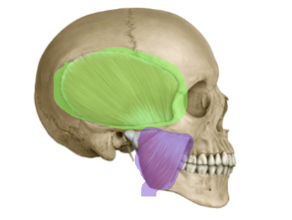
What is mastication and what muscles are involved.

The process of chewing. These muscles include the masseter and temporalis

<p>The process of chewing. These muscles include the masseter and temporalis</p>
6
New cards

Temporalis

a fan-shaped muscle that extends from the temporal fossa of the parietal bone to the coronoid process of the mandible. elevates and pulls the mandible posteriorly (retract). 

<p><span style="background-color: inherit; line-height: 20.7px;">a fan-shaped muscle that extends from the temporal fossa of the parietal bone to the coronoid process of the mandible. elevates and pulls the mandible posteriorly (retract).</span><span style="line-height: 20.7px;">&nbsp;</span></p>
7
New cards

Masseter

powerful muscle that extends from the zygomatic arch to the angle of the mandible (lower jaw). Its action is to elevate and protract (move forward) the jaw.
<p><span style="background-color: inherit;">powerful muscle that extends from the zygomatic arch to the angle of the mandible (lower jaw). Its action is to elevate and protract (move forward) the jaw.</span></p>
8
New cards

Anterior sternocleidomastoid

flexes the neck with bilateral contraction (when matching muscles on both sides of the body contract or tighten at the same time), and rotates the head to the opposite site with unilateral contraction.

inferior attachment: sternum & clavicle 

superior attachment: mastoid process of temporal bone

<p><span style="background-color: inherit;">flexes the neck with bilateral contraction (</span>when matching muscles on both sides of the body contract or tighten at the same time)<span style="background-color: inherit;">, and rotates the head to the opposite site with unilateral contraction.</span></p><p><span style="background-color: inherit;">inferior attachment: sternum &amp; clavicle&nbsp;</span></p><p><span style="background-color: inherit;">superior attachment: mastoid process of temporal bone</span></p>
9
New cards

two main posterior muscles that move the head:

the semispinalis capitis and the splenius capitis. 

<p><span style="background-color: inherit; line-height: 20.7px;">the semispinalis capitis and the splenius capitis.</span><span style="line-height: 20.7px;">&nbsp;</span></p>
10
New cards

semispinalis capitis

extends the neck with bilateral contraction, and turns the face slightly to the opposite side with unilateral contraction.(attaches to occipital bone and lies on each side of the spine.)

<p><span style="background-color: inherit;">extends the neck with bilateral contraction, and turns the face slightly to the opposite side with unilateral contraction.(attaches to occipital bone and lies on each side of the spine.)</span></p>
11
New cards

splenius capitis

extends the neck with bilateral contraction, and causes flexion and lateral rotation of the neck with unilateral contraction.(attaches to occipital bone, spleneus means bandage bc it looks like one)

<p>e<span style="background-color: inherit;">xtends the neck with bilateral contraction, and causes flexion and lateral rotation of the neck with unilateral contraction.(attaches to occipital bone, spleneus means bandage bc it looks like one) </span></p>
12
New cards

Thorax and contains what

The region of the body between the neck and abdomen - contains intercostal muscles (groups of muscles situated in the gaps between your ribs).

<p>The region of the body between the neck and abdomen - contains intercostal muscles (groups of muscles situated in the gaps between your ribs).</p>
13
New cards

External intercostal muscles

the most superficial, and their fibres run anteriorly and inferiorly between the ribs. They aid in inspiration. (inhaling)

<p>t<span style="background-color: inherit; line-height: 20.7px;">he most superficial, and their fibres run anteriorly and inferiorly between the ribs. They aid in inspiration. (inhaling)</span></p>
14
New cards

Internal intercostal muscles

lie deep to the externals, and their fibres run posteriorly and inferiorly. They aid in expiration 

<p><span style="background-color: inherit; line-height: 20.7px;">lie deep to the externals, and their fibres run posteriorly and inferiorly. They aid in expiration</span><span style="line-height: 20.7px;">&nbsp;</span></p>
15
New cards

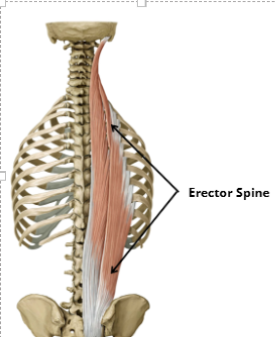
Erector spinae muscles

are a group of muscles that help to keep the spine erect. They run down both sides of the spinal column. 
<p><span style="background-color: inherit; line-height: 20.7px;">are a group of muscles that help to keep the spine erect. They run down both sides of the spinal column.</span><span style="line-height: 20.7px;">&nbsp;</span></p>
16
New cards

The____________ muscles facilitate movement of the trunk, and aid in breathing.  

abdominal wall

17
New cards

External Oblique

most superficial of the anterolateral abdominal wall musculature. Its fibres run anteriorly and inferiorly.  

-bilateral: flexes the vertebral column and compresses the abdominal wall. Used in forced expiration. 

-Unilateral: lateral flexion and rotation of the vertebral column. 

<p><span style="background-color: inherit; line-height: 20.7px;">most superficial of the anterolateral abdominal wall musculature. Its fibres run anteriorly and inferiorly.&nbsp;</span><span style="line-height: 20.7px;">&nbsp;</span></p><p><span style="background-color: inherit; line-height: 20.7px;">-bilateral: flexes the vertebral column and compresses the abdominal wall. Used in forced expiration.</span><span style="line-height: 20.7px;">&nbsp;</span></p><p class="Paragraph SCXO243720503 BCX0" style="text-align: left;"><span style="background-color: inherit; line-height: 20.7px;">-Unilateral: lateral flexion and rotation of the vertebral column.</span><span style="line-height: 20.7px;">&nbsp;</span></p>
18
New cards

Internal Oblique

lies deep to the external oblique, and its fibres run anteriorly and superiorly. 

-Bilateral: flexes the vertebral column and compresses the abdominal wall 

-Unilateral: lateral flexion and rotation of the vertebral column. 

<p class="Paragraph SCXO200168138 BCX0" style="text-align: left;"><span style="background-color: inherit; line-height: 20.7px;">lies deep to the external oblique, and its fibres run anteriorly and superiorly.</span><span style="line-height: 20.7px;">&nbsp;</span></p><p class="Paragraph SCXO200168138 BCX0" style="text-align: left;"><span style="background-color: inherit; line-height: 20.7px;">-Bilateral: flexes the vertebral column and compresses the abdominal wall</span><span style="line-height: 20.7px;">&nbsp;</span></p><p class="Paragraph SCXO143571335 BCX0" style="text-align: left;"><span style="background-color: inherit; line-height: 20.7px;">-Unilateral: lateral flexion and rotation of the vertebral column.</span><span style="line-height: 20.7px;">&nbsp;</span></p>
19
New cards

Transversus Abdominis

The transversus abdominis runs horizontally, deep to the internal oblique. 

-Bilateral: flexes the vertebral column and compresses the abdominal wall. Used in forced expiration. 

-Unilateral: lateral flexion of the vertebral column. 

<p><span style="background-color: inherit; line-height: 20.7px;">The transversus abdominis runs horizontally, deep to the internal oblique.</span><span style="line-height: 20.7px;">&nbsp;</span></p><p><span style="background-color: inherit; line-height: 20.7px;">-Bilateral: flexes the vertebral column and compresses the abdominal wall. Used in forced expiration.</span><span style="line-height: 20.7px;">&nbsp;</span></p><p class="Paragraph SCXO218008179 BCX0" style="text-align: left;"><span style="background-color: inherit; line-height: 20.7px;">-Unilateral: lateral flexion of the vertebral column.</span><span style="line-height: 20.7px;">&nbsp;</span></p>
20
New cards

Rectus Abdominis

The rectus abdominis lies on either side of the linea alba (line of connective tissue down the middle of the abdomen for muscle attachment.)  and is separated by tendinous intersections. 

-Flexion of the trunk  

-Forced expiration 

<p><span style="background-color: inherit; line-height: 20.7px;">The rectus abdominis lies on either side of the <strong>linea alba </strong>(line of connective tissue down the middle of the abdomen for muscle attachment.)&nbsp; and is separated by tendinous intersections.</span><span style="line-height: 20.7px;">&nbsp;</span></p><p><span style="background-color: inherit; line-height: 20.7px;">-Flexion of the trunk&nbsp;</span><span style="line-height: 20.7px;">&nbsp;</span></p><p class="Paragraph SCXO253056415 BCX0" style="text-align: left;"><span style="background-color: inherit; line-height: 20.7px;">-Forced expiration</span><span style="line-height: 20.7px;">&nbsp;</span></p>



