Social Psychology Lab Midterm
 Call Kai
 Learn
Learn Practice Test
 Spaced Repetition
 Match
Match Flashcards
 Knowt Play
1/250

There's no tags or description
Looks like no tags are added yet.
Name | Mastery | Learn | Test | Matching | Spaced | Call with Kai | Chat |
|---|
No analytics yet
Send a link to your students to track their progress
251 Terms
Nuremberg Code (1747)
Developed following the Holocaust and Nazi Germany regime. Performed medical experiments on imprisoned individuals who wrestle unable to consent. Key principles include:
Voluntary informed consent
Scientific value to society
Based on prior research
Avoids or minimizes physical and psychological harm
No death or disability injury will expectedly result
Risk is proportional to importance of problem
Appropriate precautions to protect participants is in place
Scientifically qualified researchers are conducting this
Participants have the right to withdraw
Researcher must stop the experiment if it becomes too dangerous
Declaration of Helsinki (World Medical Association 1964)
Created in response to the broader history of unethical medical experimentation during World War II
Consistently revised and updated (most recently in 2024)
Evolving ethical medical research involving human participants
Global gold standard where IRB is not available
Belmont Report
Respect for persons
Autonomy and informed consent when participating
Beneficence
Minimize snd maximize potential benefits for study participants
Is everything we’re doing necessary?
Justice
Burdens and benefits should be fairly disturbed
Developed from Tuskegee studies
Little Albert (1920)
Can emotional responses be conditioned?
Ethical concerns:
Protected population
Don’t deliberately cause psychological harm
Lacked informed consent by today’s standards
No assent from the child
Milgram (1960)
How far will people go in obeying authority?
Ethnical concerns:
Deception
Participant distress
Freedom to leave the study
Lack of informed consent
Tearoom Trade (1960s)
Observed men engaging in sexual encounters in public restrooms. Obtained information to be able to identify some participants and conducted interviews with them under misleading circumstances
Ethical concerns:
No informed consent
Deception
Participants were not told what researcher was doing and that he was researching the topic
Sensitive personal information
Lack of privacy
Risk of social harm
Stanford Prison Experiment (1971)
How do social roles (based in authority) affect behavior?
Ethical concerns:
Psychological distress
Freedom to withdraw without consequences
Researchers actively involved in in study situation
Zimbardo was a Principal Investigator as he served as the “Prison Superintendent” and involved himself in the project
Lack of protection of participants
Institutional Review Board (IRB)
Third-party ethical committee that determines the benefits, harms, necessity of research parameters and procedures.
Consent form
Risks
What are the possible negative effects that could occur?
Benefits
What will I gain from being in this research?
We often say the benefit for college students is being able to contribute to the research question and move the field along through their participation
Getting paid to take the study is not considered a benefit
Informed
How long will the study take? What is required of me or expected?
Confidentiality
What information about me will be shared, if at all?
Privacy/Security
How will my responses be protected and secured?
Withdrawal
What will happen if I no longer with to participate in the study?
Social Psychology
Scientific study of how people’s thoughts, feelings, and behaviors are influenced by the actual, imagined, or implied presence of others
Kurt Lewin (1890-1947)
Founder of Social Psychology
Focused on APPLIED psychology principles
Established that behavior stems from a person and their environment
Nature vs. nurture debate
B = f(P,E) ← his equation idea
Behavior is a function of personal characteristics and environmental characteristics
Studies group dynamics, such as social action (protests), prejudice, and leadership styles
Norman Triplett (1861-1934)
Studied how competition plays a role in individual performance
First official experiment in social psychology
Examined social facilitation- working around (in competition with or simply in the presence of another) is faster than working alone
Studied in children at first- eyeballed results, original experiment not actually significant, but this is well established concept now
Later studies found: we are especially better at performing simple tasks with groups than complex ones, because others can distract us when we need to focus at the task at hand
His research contributions today: big in the world of sports psychology (e.g., think about social loafing)
Floyd Allport (1890-1978)
Main contribution: determined how we properly assess and measure outcomes
Predominantly interested in attitudes
Example: conformity, personality
Very well known in personality research for developing many personality traits and using statistics to “boil” it down to a few
Intelligence, temperament, self-expression, and sociality
Vignettes
Scenario-based descriptions that differ based on what is measured
Ex: Sally drinks __ beers a week (0, 3, 8 → all different conditions)
Outcome: Injunctive norms
Beliefs on whether people would approve or disapprove of the behavior
How should someone respond if being asked whether they thought Sally had a drinking problem?
Descriptive Statistics
Summarize and organize characteristics of a data set
After you collect data, the first step in analysis is to describe the characteristics of the responses
Three parts
Distribution- concerns frequency of each value (e.g., skewed, normally distributed)
Central tendency- averages of variables (e.g., mean, median, mode)
R values
Correlation coefficient r, measures the strength and direction of a linear relationship between two variables on a scatter plot. The value of r is always between +1 and -1
Correlation
DOES NOT EQUAL CAUSATION
Relationships or “association” between 2 variables
Denoted by “r”
Values range from -1 to +1 (but cannot exceed +/- 1)
Statistical Significance (P-value)
Indicates whether the results might have occurred by chance.
P-value
Statistical significance test to determine the probability of weather the observed result occurred by chance, given the null hypothesis
Cut off value for significance: at or below .05
Theory
A framework set of ideas intended to explain phenomena. Testable hypotheses can be drawn. One study cannot “prove” a theory and studies support or do not support a theory.
Model
Close to the theory, but not quite theorized yet. Not enough evidence to conceptualize it. More statistically based and tested.
Hypothesis
A tentative supposition about the relationship between two variables. Must be testable.
Experiment Research
Investigates a cause-and-effect relationship with random assignment. We can identify cause and effect because of random assignment.
Quasi-experimental research
Investigates cause-and-effect relationships, but lacks random assignment
Non-experimental research (observational research)
Describes and explores relationships between variables without manipulating them
Researchers observe and measure variables as they naturally occur, without intervening or controlling them
Correlational research
Type of non-experimental research that investigates the relationship (or correlation) between two or more variables
Gathers information about two or more variables without researcher intervention
Strengths: Estimates the strengths and direction of relationships among variables in the natural environment
Limitations: Does not permit determination of cause and effect relationships among variables
Hierarchy of study designs for testing a theory and causality

Cross Sectional Correlational Research
Occurs at one point in time and is sometimes retrospective (looking back in time)
Third variable problem
Confounding or unconsidered variables influences both the variables being studied, creating a spurious correlation
Spurious Correlation
One that statistically shows significance, but in actuality is not present
Confounding Variable
A third variable (X) influences both the independent variable (IV) and the dependent variable (DV), making it appear that the IV causes the DV, when in reality X is the true cause
Longitudinal Studies
Conducted with the same participants over a period of time (also called prospective or cohort studies)
Laboratory Experiment
Manipulates something about the environment to impact behavior
Usually conducted in-person, in a controlled environment
Occasionally could be conducted online depending on study software used
Strengths: Permits determination of cause and effect relationships among variables
Limitations: Data obtained in artificial laboratory environment may lack generalizability to the real world
Field Experiment
Manipulates independent variable and measures its impact on the dependent variable in a natural setting
Example: going to a learning center/school setting
Strengths: Permits determination of cause and effect relationships and generalization of findings to the real world
Limitations: Experimental treatments may be les potent and harder to control when presented in the natural environment
Natural (Quasi) Experiment
Gathers information about the behavior in a real-world setting without manipulation of the environment
Example: park, hospital setting, athletic event
Randomized Control Trials (RCTs)
Testing the effectiveness of a treatment
Single-Blind
Participants do not know if they are in the control and experimental group
Double-Blind
Participants and researchers do not know if which people are in the control and experimental group
Triple-Blind
Participants, researchers, and those analyzing the data do not know the condition the participants are in (blind to what the research questions in, what the participant has to do)
Random Assignment
Randomly assigning a large enough sample to two different groups, we can assume that those two groups are statistically equivalent on all potentially confounding variables
Any differences in the DV between groups that we find can be attributed to the manipulation (IV)
However, confounding variables can still arise during experimental procedures despite this
Quasi Experiments
No random assignment
Often self-reflection
Two or more pre-existing groups function as the IV and differences in a DV are examined
Example: people who elect to join a certain treatment program vs people who don’t
Example: people who have a certain condition or have met a certain milestone
Cannot make causal claims
Other strategies in hypothesis testing
Effect size
The power of an intervention
Cost-benefit analysis
Odds ratio
Factor Analysis
Reveals clusters of variables to form a factor, which is a composite of many variables
Meta-Analysis
“Study of studies” analyze the accumulated results, data analysis combines studies to lead solid conclusions
Leading Question
Pushing your respondent to respond a certain way
Implies that you should be concerned- question bias

Loaded Question
Has a presumption attached otherwise it
Assumes that everyone enjoys drinking alcohol

Double-Barreled Question
Asking multiple things at the same time
Asking two things in the question where someone can be satisfied/dissatisfied in your social life and feel different about the other one

Absolutes
Always is definitive

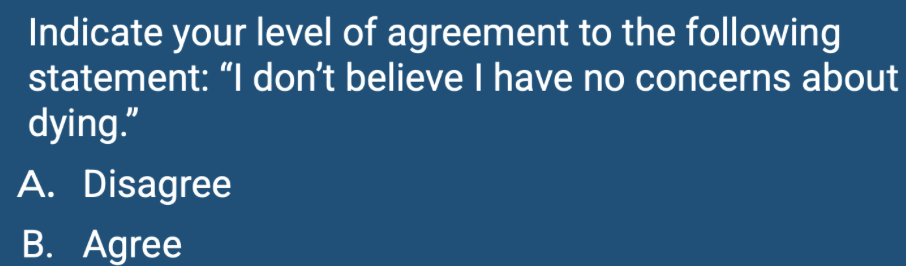
Double-negatives
Makes it hard to understand and interpret the question
Gambling
Risking something of value (e.g., money) on an event that has an uncertain outcome in hopes of winning something more of value.
Oftentimes the chance of winning is not in our favor
Types: sports betting, prediction markets, casino games/going to a casino, lottery, placing a bet with a friend
Theory of Planned Behavior and Exposure to Advertising for Gambling
Among gamblers, greater gambling ad exposure, more likely to place bets and spend more than intended (Browne et al., 2019)
Theory of Planned Behavior
Attitude for gambling is already high →
Increased intentions →
Increased behavior

Online gambling vs in-person gambling
Tangibility of Spending Money
On average people spend more money and take more financial risks when gambling online than in-person
Why?
Online gambling is accessible 24/7
Digital payments makes money feel less real vs. handing over physical cash
Lowering of psychological barrier– tokens, chips, credits
Numbers are less meaningful than seeing the money physically disappear
We are more likely to take greater risks online than in-person
Variable Ratio Reinforcement
You will receive a reinforcement (e.g., reward/punishment) after a varying/changing number of times.
Gambling falls into upper right category
Reason why lesser forms of gambling, such as blind boxes, are considered gambling from a psychological lens even though they are not considered gambling at a legal level
Takes significantly more responses
Strongest form of conditioning
Highest response rate, constant and without pauses (pattern of responses), most resistant to extinction
Regions of the Brain impacted by gambling
Gambling impacts the brain’s reward systems, impulsivity, learning, and self-control
Gambling wins and near misses have almost identical brain reactions (anticipation of being close). A near miss makes you more likely to gamble than a win
Nucleus Accumbens (Reward center)
Frontal Cortex (Planning/Judgement)
Amygdala (Emotions)
Ventral Tegmental Area (Reward)
Neurotransmitters of the brain impacted by gambling
Alterations in dopamine, serotonin, norepinephrine
Mood becomes tied to winning
Even if we lose there is a dopamine release, but not to the same response (dampened mood)
If we gamble enough to the addiction-level these pathways are going to be altered, the reward system is being re-wired
Creates a cycle of craving and loss even stimulates the brain, leading to repeated behaviors to chase the next dopamine rush
Dual Process Model of Cognition
Idea that there are two broad systems in which we process information
System 1- Fast, automatic, intuitive, emotional reactions, relies on peripheral cues/processing
System 2- Slow, deliberate, intention, takes energy and attention, less prone to cognitive biases
System 1 Thinking (Dual Process Model of Cognition)
Fast, automatic
Effortless, intuitive, emotional
Uses past experience to mental shortcuts (heuristics) to make judgments and decisions
Can also contribute to greater cognitive biases
High cognitive load can contribute to this, and lead to impaired decision-making
System 2 Thinking (Dual Process Model of Cognition)
Slow, deliberate
Analytical, logical, effortful
Can correct or override system 1’s decisions but require more cognitive effor to do so (when activated)
Gamification, Gambling, and Psychology Principles
Using game-like features to make something more engaging, motivating or rewarding
Keeps people’s attention (e.g., movement, sounds like bells/dings)
Related back to Pavlov’s dogs
Can be used as a form of distraction (e.g., visual overload, lights)
Lowers risk perceptions with inviting cues (e.g., colors)
Alleviate feelings of seriousness
Goal settings (challenges, achievements, badges)
Social comparison (e.g., rankings, leaderboards)
Positive reinforcement (e.g., early winnings, compliments)
Keeping you hooked
Commitment and experiential investment (e.g., leveling up early, winning badges can help make you feel accomplished)
Loss Aversion
Individuals are more likely to take action to avoid losses than to take action to secure gains

Prospect Theory
The pain of losing is psychologically twice as powerful as the pleasure of gaining
A $100 loss hurts more than the pleasure of receiving $100 gain
Demonstrates human decision-making is driven by cognitive shortcuts and emotional reactions to losses
System I thinking and heuristics
People become risk-seeking when trying to recover losses: they want to win and escape a loss
Overweight small probabilities; underweight moderate to high odds:
“I have a small chance of winning though” Jackpots appear more attainable than they are
Sunk Cost Fallacy
Investing time, money, effort into something simply because you have already invested
Past costs cannot be recovered and you may not continue to benefit from continuing
“I can’t stop now”
Why do we engage in heuristic/biased thinking from an evolutionary perspective?
Our brain loves to identify patterns- it is an evolutionary way we have evolved to surie (e.g., identifying sounds from a predatory)
False Patterns can occur- we think there may be a pattern, but there is not
Examples:
The slot machine is probably due for a payout soon’
There haven’t been winnings in a while
I have a good system for predicting winning numbers
I notice that XYZ always happens before a big win
I was so close to winning (Near Miss- cognitive distortion)
Overconfidence Bias
Overestimating accuracy of knowledge, predictions, or abilities
Confirmation Bias
Giving more weight to information to support your belief; overlooking contradictory info
Gambler’s Fallacy
Thinking that the previous (random) outcomes will affect what happens next
Illusion of Control
Thinking you can predict or influence the outcome that is actually determined by chance
Blowing the dice or wearing a lucky pair of socks
Reciprocity (Cialdini’s 7 powerful persuasion principles)
People repay what they receive
Free samples lead to purchases
Commitment & Consistency (Cialdini’s 7 powerful persuasion principles)
We stick to what we say
Signing a pledge leads to follow through
Social Proof (Cialdini’s 7 powerful persuasion principles)
We follow the crowd
Best-seller tag
Authority (Cialdini’s 7 powerful persuasion principles)
We trust experts & leaders
Doctor endorsement
Liking (Cialdini’s 7 powerful persuasion principles)
We say yes to people we like
Friendly salesperson
Using someone well-liked or known
Ways to increase this principle:
Increasing number of similarities (e.g., same age, gender, race, etc.)
The more characteristics that someone shares the more we will like the other person
These can be physical characteristics, shared values or identities, or something else
Example: Sharing a birthday
Familiarity
We tend to like something the more that we are exposed to it
Related to mere exposure effect
Even if our initial reaction was not positive, with more exposure it could become positive, but depends on attitude stability (strength)
Compliments
Increase liking, as it boosts our ego and self-worth/self-esteem
However, it also taps into reciprocity as we feel the desire to do something favorable for the implementer (e.g., buy their product)
Scarcity (Cialdini’s 7 powerful persuasion principles)
Limited = More valuable
Only 2 left in stock
Unity (Cialdini’s 7 powerful persuasion principles)
We belong with “out people”
Shared identity in groups
Short-Term Psychological Effects of Gambling
Excitement and thrill or irritability, anger, or sadness
Temporary financial gain or losses
Stress, anxiety, regret related to betting outcomes
Stigma
Prejudicial attitudes created socially through defining people by their problem using judgement and labeling (self-stigmatization exists as well)
Effects of Stigma
Stereotyping/labelling
Separating/Exclusion/Isolation
Rejection
Negative emotional reactions
Anger, pity, fear, irritation
Status loss/devaluation
Morally/flawed, untrustworthy
Discrimination
Hiding Gambling Problem
Further stigmatizing; 92.5% of people say they could tell when it was being hidden
Personal Responsibility
Main reason for stigmatization (e.g., viewed as in your control)
Self-Stigma
Believing and agreeing internally with public stigma; diminishes self-esteem
Psychological Effects of a Gambling Problem
Depression
Symptoms of guilt, shame, and hopelessness, especially after a large loss or a losing streak, can lead to depressive episodes. These symptoms also affect the self-esteem and self-worth of the gambler
Isolation
Problem and disordered gambling can result in altered attitudes and behavioral issues in some gamblers, causing them to experience loneliness in their personal lives
Anxiety
Nonstop experiences of anticipatory anxiety (before gambling) and increased stress levels during gambling can form an unhealthy psychological bond, leading to an increased chance of developing an anxiety disorder
Gambling and Adult Suicide Risk
Gambling as a precipitating factor in deaths by suicide
0.44% of the cases were classified as gambling-related
Gambling and Confounds In Adult Suicide Risk
Psychiatric comorbidity
Depression
Alcohol/drug abuse
Impulse personality
Poverty/life hardships
Gambling and Relationships
Damaged relationships
Work
Hiding or concealing gambling behaviors
Reduced job performance
(Rare) harms to business or lost trust from criminal activity
Family
Trust issues or violence
Separation or divorce
Emotional distress and neglect with children
Friends
Withdrawing from social activity
Problem Gambling
Any gambling behavior that causes stress, financial strain, or relationship issues
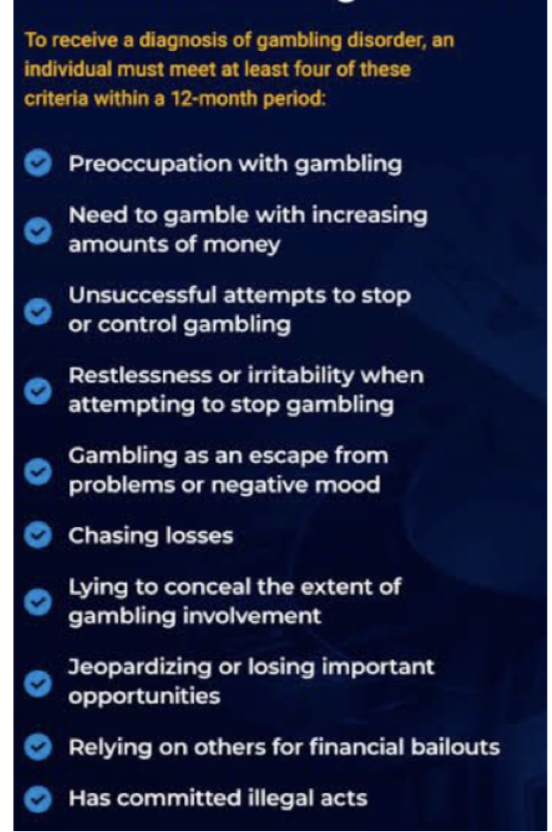
Gambling Disorder
Clinically diagnosed mental health condition (classified as an addictive disorder) that meets specific DSM-5 criteria of compulsive loss of control
Halo Effect
Using spokesperson’s attractiveness to show product attractiveness
Mood Setting
Using music to set the tone. Using humor or laugh tracks.
Laugh tracks are an example of social proof
More = Better
More arguments = more convincing. Bigger price = better quality
Thinking that a bigger diamond is more expensive than a smaller one
Availability Heursitic
Capitalizing on what is currently popularly (or seemingly popular)
Credibility
Emphasizing brand longevity, popularity, and how trusted or well known it is
Primary Effect
Early information can impact later interpretation
If we are told something early on, it might be enough to sway us
Peak-End Rule
We remember the most intense part at the end
Recency Heuristic
Recent information can impact your judgement
Many food recalls might impact our decision to eat/purchase salads
Foot-In-The-Door
Starting with a small request and moving to a bigger one
Small engagement, builds brand loyalty
Keeping up with streaks, to then feel committed
Listening to a couple of songs from a new artist, then buying the album (or multiple)
Free month of a subscription service with all the premium features, now you feel like you can’t go back and buy the premium subscription next month
People like to stay consistent, if they say yes to one thing, they will likely say yes to the next, if the ask isn’t too large
Example: Peal Factory
Example: Warby Parker At Home Try On
Try on a bunch of glasses at home and return the ones you don’t like
Odds are you will be sending more because of this tactic and additional, concepts (e.g., personal experience, commitment and consistency)
Door-In-The-Face
Starting with a large request, then conceding with a smaller one
Example: When you cancel your subscription, there is a pop-up that asks if you are sure. And presents you with an even lower limited time subscription offer (e.g., $2.99/month for 6 months)
What is more effective, foot-in-the-door or door-in-the-face?
Some studies have shown door-in-the-face, but it depends on context
Urgency
Existing offers, countdowns or clock, false deadlines
Taps into System 1 Thinking
What does red represent in advertising?
Visceral, bold, courageous, energetic
Stimulates appetite and the pituitary gland
Examples: CNN, Pinterest, Coca-Cola, Target, Canon, Lego, Kellogs
What does orange represent in advertising?
Friendly, cheerful, confident, fun, vitality
Lighter shades appeal to upscale market
Examples: Nickelodeon, Amazon, Fanta, Payless, Shutterfly
What does purple represent in advertising?
Wise, creative, imaginative, royalty
Lavender evokes nostalgia, sentimentality
Examples: T-Moble, Yahoo, Taco Bell, Hallmark
What does black represent in advertising?
Prestige, serious, bold, classic, powerful
Works well for expensive products
Examples: Prada, D & G, Outdi, Chanel
Priming
Useful tool for exposing people to a stimulus, which then impacts how they think or respond without direct conscious awareness
Out brain makes associations automatically, and this tool helps bring these cues together
Example: When we see Curious George, Minions, banana bread, a smoothie, we are more likely to think of banannas
Subliminal Priming
Having fast cues displayed that the human eye cannot catch, such as “Eat Popcorn if Hungry” during a movie, which leads to individuals following that behavior, purchasing popcorn