CHEM 2510 / Topic 6c: GC & HPLC
 Call Kai
 Learn
 Practice Test
 Spaced Repetition
 Match
 Flashcards
 Knowt Play
1/47

There's no tags or description
Looks like no tags are added yet.
48 Terms
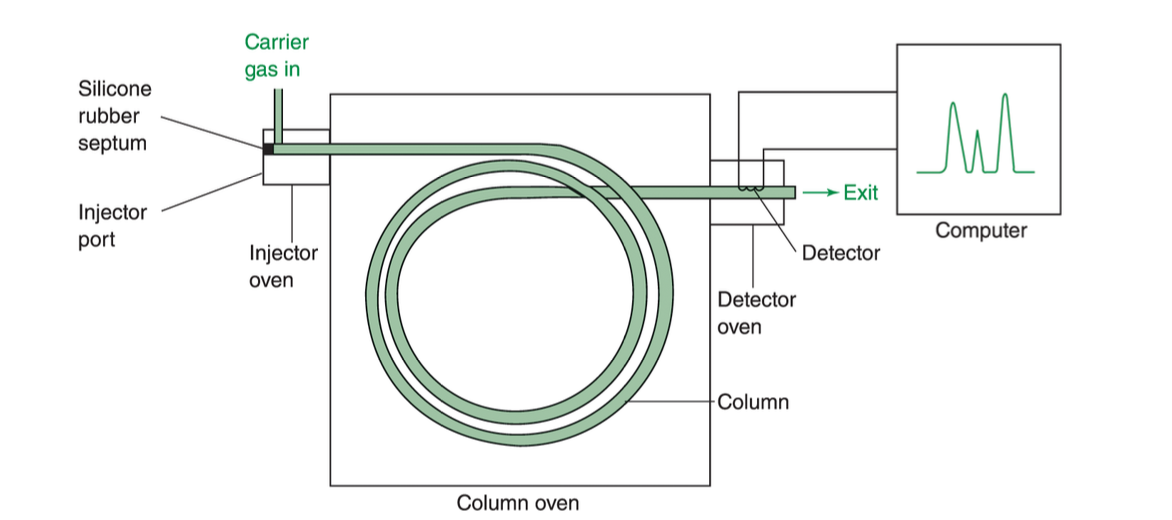
How does GC generally work?
Sample (gas/liq) injected → vaporized → carried by inert carrier gas (MP) thru column
Separation ∴ based on differential distribution/partitioning of components b/w MP (carrier gas, doesn't interact) and SP (coated on column, retains analytes)
What are the four factors when deciding the type of column in GC?
• Spl amt that can be handled.
• Sep eff.
• # of X that can be sepped.
• t required for sep.
Comes in two types of columns: packed & capillary/open-tubular.
What are the three requirements for the MP?
• Chemically inert to SP (He, Ar, N2 used usually)
• With packed columns, flow rates b/w 25–150 mL/min.
• With capillary columns, flow rates b/w 1–10 mL/min.
• What materials typically used to construct packed columns?
• What is the role and typical composition of the particulate solid support in packed columns?
• Typically constructed from glass/stainless steel (Cu/Al w/ lengths of 2–6 m + internal bore 2–4 mm).
• Column filled w/ particulate solid support for SP (usually silica skeletons of diatoms and fluorocarbon polymers).
N = 3000–10,000
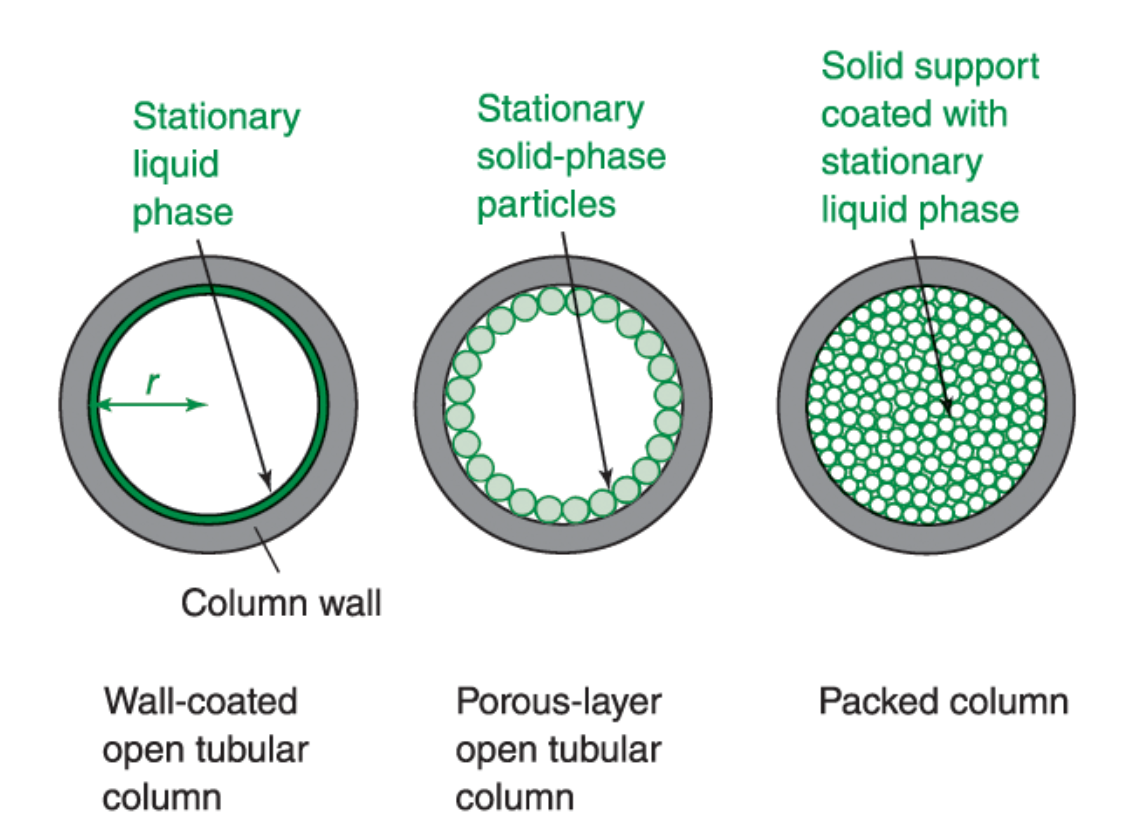
• What materials and dimensions are typically used to construct capillary/open-tubular columns?
• What are the two types of CC?
• Constructed from silica coated w/ protective polymer (100 m in length + bore 150–300 µm (although 530µm megabore also avail)].
• Wall-coated open tubular columns & support-coated open tubular columns.
• How is the SP arranged in WCOT columns?
• How is the SP arranged in SCOT columns?
• WCOT: Coated on capillary’s inner walls.
• SCOT: Thin film layer of sld support (e.g. diatom skeleton) coated w/ liquid SP attached to capillary’s inner wall.
Generally, why are CCs better than PCs in chromatographic resolution?
• ↑ N (> 100,000) → ↓ w → ↑ R.
• ↓ analysis t.
• ↑ sens.
• ↓ spl capacity.
What primarily determines elution order in GC?
> ↑ bp diffs of cpds → easy sep.
> Similar bp → need SP-solute interacs.
∴ SP matters most when bp’s are close.
When does SP choice become critical in GC?
> SP doesn’t change N much.
> SP changes α (selectivity).
∴ Determines whether two similar compounds separate at all
How does SP polarity affect GC separation?
> Nonpolar solutes → nonpolar SP.
> Polar solutes → polar SP.
> ↑ interac → ↑ ret → ↑ sel.
What four properties must a GC stationary phase have, and why for each?
• Chemically inert ← no rxns (pure partitioning).
• Stable in hot temps ← GC runs hot.
• Low volatility ← SP must stay in column.
• Polarity match ← sep possible.
How is SP polarity controlled in GC?
∆R-group → ↑ SP pol → ↑ sel.
How does sample injection work in GC?
> Autosamplers introduce spl directly into heated injector port or directly onto the head of the GC column.
> Injection volumes 0.5–2 µL typical for liq spls (for CCs).
> Spls injected rapidly (<1 second) thru septum into evap zone of heated injector port.
> Injector port temp elevated to >250 ºC to promote flash vaporization.
What are the three ways to inject samples into a CC?
• Split injection.
• Splitless injection.
• On-column injection.
How does split injection work?
Inject spls → CC → small spl % enters column. 0.2–2% of spl.
How does splitless injection work?
Inject spl → CC → high spl % enters column. ≈ 80% of spl.
How does on-column injection work?
Direct injection of thermally unstable spls onto CC. 100% of spl.
What are the five main detectors in GC?
• Thermal conductivity detector.
• Flame ionization detector.
• Electron capture detector.
• Nitrogen-phosphorus detector.
• Mass spectrometer.
How does TCD work?
> Thermal conductivity = ability to transfer heat.
> He has very high thermal conductivity.
> Pure He → filament cools efficiently (baseline).
> X mixes w He → ↓ conductivity.
> Filament loses less heat → stays hotter.
> Hot filament → resistance changes → ΔV
> Detector measures ΔV → chromatographic peak
What are the three advantages of TCD compared to other detectors? What’s the one disadvantage?
• Universal in nature.
• Large linear dynamic range.
• Non-destructive.
• … poor DL compared to other detectors.
How does FID work?
> Column effluent enters H2/air flame.
> Org cpds burn in the flame → ions + electrons.
> Voltage (≈ 300 V) pulls charges to electrodes.
> Moving charges = current.
> More carbon → more ions → bigger current → voltage collects charges → current → signal → peak proportional to carbon content
What are the two advantages of FID compared to other detectors? What’s the one disadvantage?
• DL is 1000 times smaller than TCD.
• Large linear dynamic range.
• … destructive.
How does ECD work?
> Detector has a radioactive source (63Ni) → spits out high-energy electrons.
> Electrons ionize the carrier gas → steady electron current (baseline).
> EN-ive X enters (e.g. halogenated compounds).
> X captures electrons.
> Fewer electrons moving → current drops = peak.
What is the one advantage of ECD compared to other detectors? What are the three disadvantages?
• Selective for EN-ive cpds.
• …DLs small for said cpds.
• …poor linear of dynamic range.
• …radioactive.
How does NPD work? What are the two advantages of NPD compared to other detectors?
Modified FID but especially sensitive to N- & P- containing cpds.
• Response factor is 104–106 times greated than response factor for C.
• Sensitive detector.
Why is GC limited in what it can analyze?
Requires X = volatile + thermally stable
• How can non-volatile X be analyzed be GC?
• Why was high performance liquid chromatography (HPLC) developed?
• Chemical modification to increase volatility.
• To analyze non-volatile + thermally unstable cpds.
What does HPLC use to achieve sep?
↑ P → force liq thru column packed w/ particulates → ↑ SA ↑ interactions ↑ res
What are the six types of HPLC?
• Reverse phase.
• Normal phase.
• Hydrophilic interaction.
• Ion-exchange.
• Size-exclusion.
• Adsorption.
Why do small GC columns work?
• GC uses gases → diffusion is fast.
• Smaller column diameter → Solute reaches SP faster.
• faster eq → ↓ bb
Why HPLC is different compared to normal LC?
> Liq diffuse 100x slower than gases.
> Open tubular column → solute would take forever to hit SP b/c middle of column = no SP → liq must travel → diffuse sideways → slow eq → bb.
> No open-tubular columns in HPLC = Packed particles put SP everywhere.
> Solute travels a very short distance → less time to equilibrate (time to eq = distance/diffusion) → compensates for slow liquid diffusion.
• What materials are typically used to construct HPLC columns?
• What is the role and typical composition of the particulate solid support in HPLC columns?
• Why do smaller particles increase resolution?
• How does decreasing particle size affect res at constant vs increased FR?
• Typically constructed from stainless steel (w/ lengths 30–300 mm + bore b/w 2.1–4.6 mm).
• Columns filled w/ microporous silica irregular-/spherical-shaped particles .
• ↓ particle size → Solute always close to SP → ↓ diffusion dis ↑ equilibration faster ↓ bb ↑ res
• same FR → ↓ particle size ↑ equilibration faster ↓ bb ↑ res OR increase FR → ↓ particle size → equilibration still fast enough → bb stays same → res stays same
Why can unbonded liq stationary phases be problematic?
• They can dissolve slightly in the mobile phase and be lost.
• How is loss of stationary phase prevented in HPLC?
• What is the SP in reverse-phase HPLC?
• By covalently bonding the liq film to silica surface.
• Liq film chemically bonded to silica support.
• How are bonded SPs chemically prepared?
• What bond forms b/w silica and SP?
• By reacting silica -OH groups with organochlorosilanes.
• Si-O-Si linkage w/ HCl released
Why is reverse-phase called reverse-phase?
Normal-phase
• SP = polar (silica).
• MP = nonpolar.
• Polar compounds stick longer.
Reverse-phase
• SP = nonpolar (C18, C8, etc).
• MP = polar (water, MeOH, ACN).
• Nonpolar compounds stick longer.
How does MP polarity control elution in reverse-phase chromatography work?
> Most polar solutes → elute first.
> Most hydrophobic solutes → stick longer → elute last.
> MP starts very polar (mostly water).
> Hydrophobic solutes prefer the nonpolar SP.
> Add organic solvent → MP less polar.
> Hydrophobic interactions bw solute and SP weaken.
> Solute desorbs → elutes w/ “new” MP.
How does solute hydrophobicity affect retention and elution in reverse-phase HPLC?
More hydrophobic solutes bind more strongly to the nonpolar SP and require higher organic solvent content to desorb and elute.
What are two ways that the solute can associate w/ SP?
• partitioning → solute dissolves into the SP (embedded)
• adsorption → solute sticks to SP surface only
How do column length and particle size affect resolution in HPLC?
↑ L or ↓ dₚ → ↑ N → ↑ R, but R scales with √N
Why does a large increase in efficiency give only a modest increase in resolution
Because resolution is proportional to √N, not N.
How do smaller particles result in a higher pressure to increase resolution?
> ↓ dp → tighter packing.
> Harder for liquid to flow.
∴ ↑ backpressure (needs UHPLC)
How do smaller particles result in a lower DLs to increase resolution?
> narrower peaks → taller peaks.
> ↑ S/N.
> Easier to detect small amts.
What happens in each of the two elution modes in HPLC?
• Isocratic: MP polarity never changes and weakly retained solutes elute early while strongly retained solutes elute very late.
• Gradient: MP starts polar, then an organic solvent gradually increases, resulting Mp becoming less polar → early polar solutes separate then hydrophobic solutes pushed off SP later.
What’s the problem with isocratic elution?
> One MP strength can’t satisfy all cpds.
> If MP is set weak (very polar) → polar cpds separate nicely, nonpolar cpds stick forever → late peaks take forever + broaden.
> If MP is set strong (more organic) → polar cpds barely retain, nonpolar cpds elute faster → early peaks crash together.
> MP never changes → either optimize early peaks or late peaks, not both.
What’s the solution to isocratic elution’s problem?
> Early in run = use weak MP → good ret → good sep.
> Later in run = strong MP → faster desorption → prevents late bb + run time reduced.
What are the two types of HPLC detectors?
spectroscopic & electrochemical.
What are the 3 types of spectroscopic detectors and the 4 types of electrochemical detectors?
Spectroscopic: UV/Vis absorption, fluorescence, MS.
Electrochemical: amperometry, voltammetry, coulometry, conductivity.