Acid-base balance
 Call Kai
 Learn
 Practice Test
 Spaced Repetition
 Match
 Flashcards
 Knowt Play
1/28

There's no tags or description
Looks like no tags are added yet.
29 Terms
What are acids?
Molecules that give up or donate hydrogen ions.
What is an example of an acid that naturally occurs in the body?
Carbonic acid
What are bases?
Bases are molecules that can accept hydrogen ions.
What is an example of a base?
Bicarbonate
What pH balance is the body always trying to maintain?
7.4
What pH values mean death?
below 6.8 and at 8.0
Chemical regulation is _________.
Immediate
What can buffer systems do to correct pH balance?
They can absorb or release H+ ions.
What do plasma proteins do to H+ ions?
buffer them
Which system is the first to react to pH change of ECF and how quickly does it react?
The carbonic acid-bicarbonate buffer system is the first to react in mere seconds.
What does the carbonic acid-bicarbonate buffer system formula look like?
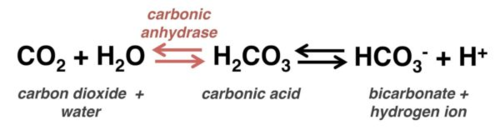
How long does biological regulation of pH take?
2-3 hours
What happens during biological regulation of pH?
Cells buffer by exchanging H+ and K+ ions in and out of the cell. Remember that H+ ions are in the ECF and K+ ions are primarily in the ICF.
What happens during acidosis?
Excess H+ and K+ will go inside cell and cell will balance by sending K+ out. When acidosis is corrected, they will exchange back.
What happens during alkalosis?
Not enough H+ in serum, so it moves outside the cell, exchanging for K+ to then go inside the cell.
What two physiological regulation systems are there?
Lungs and kidneys
How long is the lung buffer system?
Minutes to hours
Give some ways the lung buffer system works?
Can control CO2 by rate and depth of respiration
CO2 and H2O equal HCO3 (carbonic acid) which can split to H+ and HCO3 (bicarb, a base)
Acid pH (excess H+ ions) stimulates respiratory center chemoreceptors.
Rate and depth of resp increases, “blowing off” more CO2, which essentially gets rid of a part of the acid molecule, balancing pH.
How long does the kidney buffer system take?
Few hours to days
What are some things the kidney balance does?
Reabsorb or excrete bicarbonate (base)
Excrete H+ ions by adding to phosphate or ammonia, then excretes the compound (depending on if it wants to get rid of it or keep it)
What are the steps of acid-base balance assessment?
Identify if its either acidosis or alkalosis
Cause of the imbalance: Respiratory to metabolic
Body’s attempt to correct the pH compensation
What are the components of the ABG?
pH shows acid-base balance
PaCO2 shows lung ventilation, remember CO2+water=an acid
PaO2 doesn’t affect pH, but shows lung effectiveness
O2 saturation, done with a pulse oximeter, norm is 95%
Bicarbonate: reflects renal ability to balance pH by excreting or reabsorbing a base
ABG normal values
pH: 7.35-7.45
PaCO2: 35-45 mmHg
HCO3: 22-26 mEq/L
PaO2: 80-100 mmHg
O2 sat: 95-99%
What are some causes of these imbalances:
Respiratory acidosis
Respiratory alkalosis
Metabolic acidosis
Metabolic alkalosis
-Hypoventilation
-Hyperventilation
-Kidneys are unable to secrete enough acids
-Direct increase of base of decrease in acid
What are some nursing interventions for respiratory acidosis?
Measures to improve gas exchange
Provide supplemental O2
Maintain hydration
Increase RR which increases H+
What are some nursing interventions for respiratory alkalosis?
If caused by anxiety, encourage pt to relax and breath slowly
Breathe into paper bag
What are some nursing interventions for metabolic acidosis?
Treat underlying problem: poor perfusion, renal issues, diabetes, and GI losses
May need to administer sodium bicarbonate
What are some nursing interventions for metabolic alkalosis?
Treat underlying issue: vomiting, gastric suction, hypokalemia, excessive bicarbonate intake
ABG interpretation steps:
Analyze the pH: determine if it is acidosis or alkalosis
Analyze the PaOC2
Analyze the HCO3
Match either the PaCO2 or the HCO3 with the pH
Determine if the body is compensating (pH in normal range)-acute/uncompensated, partially compensated, and fully compensated