Fisheries Vocab
 Call Kai
 Learn
Learn Practice Test
 Spaced Repetition
 Match
Match Flashcards
 Knowt Play
1/115

There's no tags or description
Looks like no tags are added yet.
Name | Mastery | Learn | Test | Matching | Spaced | Call with Kai | Chat |
|---|
No analytics yet
Send a link to your students to track their progress
116 Terms
Fishery
The industry or occupation devoted to catching, processing, or selling aquatic animals
Subsistence fishing
Fishing for yourself or family, for food
Regionally specific
Fishing practices that are tailored to local environments and cultures
Commercial fishing
Fishing for trade or money. Fishing for economic purposes
Recreational fishing
Fishing for recreation rather than subsistence. Fish do not necessarily have to be kept (catch and release)
Catch and release fishing
Recreational fishing in which fish are caught and then released rather than kept
Demersal
Living on or near the seafloor
Salt cod
Cod preserved by drying and salting. Also called bacalao
Inlanders
People living 10 miles away from a coast, where historically fish were unable to be transported to
Exclusive Economic Zones
EEZ. 200 mile limits around country land mass where fishing rights are exclusive to that country. It gives coastal nations control over fisheries within 200 nautical miles and encompasses 90% of global fisheries. Reduced conflicts over fishing grounds.
Stock
A group of organisms of the same species that live in the same area and interbreed
Catch
All organisms caught during a fishing or harvesting event, including organisms that may later be discarded at sea
Landings
All organisms brought back to shore
Discards
Organisms that are caught but not landed and are discarded at sea, whether dead or alive
Bycatch
Organisms that are caught unintentionally because they are not the target of the fishery
Artisanal fishers
Mom and pop small scale local/regional fisheries
Food and Agriculture Organization
FAO, an agency of the United Nations (UN) whos goal is to defeat hunger and improve nutrition and food security. They monitor global fish stocks
Underexploited fishery
An underdeveloped or new fishery believed to have significant potential for expansion in total production
Moderately exploited fishery
A fishery exploited with a low level of fishing effort and believed to have some limited potential for expansion in total production
Fully exploited fishery
A fishery operating at or close to an optimal yeild level with no expected room for further expansion. It does not necessarily mean a fishery has collapsed, just that it cant expand and is at optimal yeild.
Overexploited fishery
A fishery exploited at or above a level believed to be sustainable in the long term, with no potential room for further expansion and increased risk of stock depletion or collapse
Depleated fishery
A fishery where catches are well below historical levels regardless of the amout of fishing effort exerted
Recovering fishery
A depleated fishery in which catches are increasing again
Fisheries ecology
A newer field that combines ecological sciences and fisheries sciences
Gross growth efficiency
The amount of prey carbon converted to predator carbon
Trophic transfer efficiency
The ratio of predator efficiency to proportion of prey production taken by predator
Carrying capacity
The maximum amout of organisms an ecosystem is able to support without environmental degradation
Production
Results from growth. The organic material made by an organism
Surface mixing
The mixing of surface layers by tides, currents, upwellings, and winds.
New production
Made during photosynthesis
Regenerated production
Recycling of nutrients in the photic zone
Primary production is quantified as…
The mass of C/area/time
Net primary production
The carbon that remains AFTER respiration
Gross primary production
Total amount of fixed carbon
Marine orgaism primary production
Produce 3-60×10^9 tons of organic carbon annually, about 40% of global production
What are the three basic frameworks for life history strategies?
r-K theory, bet-hedging theory, age-specific models based on optimal reproductive effort
Where does almost all of primary production in the ocena happen?
The first 200 meters of the water column
What is the r-K theory?
If a population is under stable conditions, nearing carrying capacity, with strong intraspecific competition, then natural selection will favor K-selection resulting in delayed reproduction, resulting in higher longevity.
What is r in the r-K theory?
Producing many many offspring, having reduced longevity
What is K in the r-K theory?
Producing fewer offspring, having higher longevity
Bet-hedging theory
Predicts that environmental variability will cause high and variable juvenile mortality. Results in K-selection, unless environmental conditions are stable and juvenile mortality is constant, under which r-selection is favored
What are age specific models?
Specific models based on distinct age classes, that require specific information, and predict r-K selection based on each specific age class.
What does production result from?
Growth
Indeterminant growth
Never really stop growing, just slows way down
Fish and some molluscs
Determinate growth
Grow fast at a young age, then slow down to a stop at a certain age
crustaceans, birds, mammals
What indeterminate growth curve is commonly used?
Bertalanffy growth curve
In a Bertalanffy growth curve, what does Lt represent?
Predicted length at time t
In a Bertalanffy growth curve, what does L∞ represent?
Maximum length predicted
In a Bertalanffy growth curve, what does K represent?
Growth coefficient
In a Bertalanffy growth curve, what does t0 represent?
Theoretical birth size
What are some ways to measure growth?
Molecular tools, Energetic approaches, Captive studies, Mark and recapture, Length-frequency analysis, Radiocarbon uptake, RNA/DNA analysis, Back calculation
In what oceanic sites/conditions is production expected to be highest?
Upwelling sites
What does upwelling intensity depend on?
Wind strength and seasons
Spatial scales in movement patterns
Individual to population. Patrolling/ranging to migration
Temporal scales in movement patterns
Diel to interannual. ontogenic.
What is the most abundant source of information for movement patterns of fish?
Catch or landing data
In situ monitoring
Direct observation methods such as snorkeling, scuba, ROVs, ect.
Remote sensing
Sonar systems, Lindar, and Telemetry
Lindar
Light detection and ranging systems that shine a beam of light into the water and measure the spectral characteristic and intensity of the light that is reflected back
Telemetry
Satelite and acoustic. Allow remote estimation or calculation of location and possibly other abiotic information
Genetics and natural tags
Uses parasites and trace elements, as they are site specific.
Home ranging
Area a fish uses on a regular bases. Governed by resource availability, predation pressure, and conspecific density
What are the two phases of development
Growth and ontogeny
Growth
Leads to changes in size or abundance of existing features
Ontogeny
Leads to the appearance of new features and reorganization
What is the relationship between survivorship and development?
Survivorship increases as larvae move through each stage of development successfully
What is larval starvation threshold?
The point where larvae are capable of eating on their own and no longer relying on nutrient reserves. They have to eat, or die. Most vulnerable stage.
Ocean stability hypothesis
When the ocean is calm, you get patches of high food concentration, which supports larval survival. Rough waters disperse prey and densities become too low to support larvae. Dense patches are more important thatn evenly distributed prey.
Match-mismatch hypothesis
Interannual variation in larval survivorship would be due to a mismatching in hatching time and peak primary production cycle. Spawning peaks should be juuuuust in front of primary production peaks so there is enough food to sustain everyone. Cycles must be matched up for larvae to find food.
Member-vagrant hypothesis
Physical factors are predominantly stressed rather than biotic. The relationship between spawning time and stable ocean conditions that retain larvae is an important predictor of recruitment.
Where in the ocean do planktonic larvae settle the most
Inside gyres
Bigger is better hypothesis
The faster a larvae grows, the quier mortality rates decrease
What oceanographic features can affect recruitment?
Upwelling, large scale atmospheric events like ENSO and PDO, current patterns, water temperatures,
Compensation
Regulatory mechanism that allows stock to withstand additional fishing mortality and to recover from low spawner abundances
Allee Effect
Lower than expected recruitment at low population levels
Depensation
Caused by reductions in proportional mortality of larvae
If spawning females cannot find mates when stock is too low
If fertilization rates of broadcast spawners are dependent upon sperm concentration
Hyperstability
When catch rates overestimate actual abundance. Main cause of unexpected stock crashes
What drives fluctuations in population size
Processes that affect production and survival of eggs and larvae
growth of mortality during the juvenile and adult stage
behavioral processes such as migration or density dependent habitat use
Demographics
structures of population such as age, fecundity, recruitment, ect
Fecundity
reproductive capacity
Recruitment ecologically
Number of individuals that reach a specific life stage, usually when they metamorphosis from larval stage
Recruitment fisheries
Number of individuals that reach a size where they enter the fishery
What factors affect recruitment
Abundance and distribution of mature adult population (spawning biomass)
Number and viability of eggs produced
Subsequent survival of eggs and larvae
Autocorrelation
Where one thing is dependent on the other and so on so forth. In recruitment relationships, year 2 is dependent on year 1 for example. The more years you have the better.
What are the three spawner-recruit models
Beverton and Holt, Ricker, and Shepherd

What type of recruitment model does this look like?
Beverton and Holt model
In recruitment models, what does R S a b stand for
R= mean recruitment
S= spawner abundance or biomass
a= recruits per unit spawner at low stocks
b= density dependence of relationship
What does the Beverton and Holt model describe
an asymptotic curve with consistently high mean recruitment at high spawner abundance
What does the Ricker model describe
A parabolic shaped curve and is based on increasing density dependent mortality at higher spawner abundance

What type of recruitment model does this look like
Ricker
What describes the Shepherd model
Uses 3 parameters so the curves can be more complex
c= determines shape of the curve
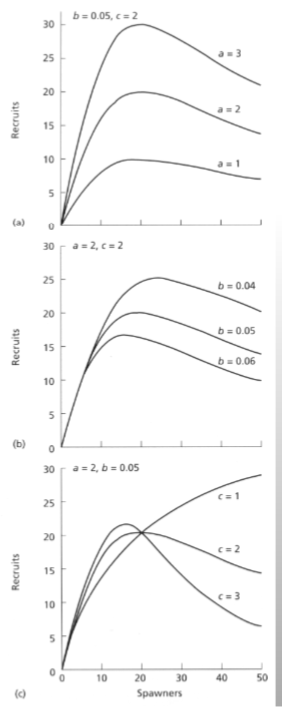
What model does this look like
Shepherd
Ovipary
External eggs and fertilization
Aplacental vivipary
Internal fertilization, live birth with maternal input (matrotrophy)
Oophagy
Mom ovulated eggs which embryos eat in utero
Histotrophy
Glycoprotein secreted by uterine vili (uterine milk)
Adelphophagy
Larger embryos eat the smaller ones
Pseudo-placenta
Umbilicus connection from mom to embryo
What is different about male and female gonad mass by body size?
Males increase linearly, females increase exponentially
What is the relationship between fecundity and body size?
Fecundity (# eggs) increase exponentially with body size