exam 2 dr dolan microbiology
 Call Kai
 Learn
 Practice Test
 Spaced Repetition
 Match
 Flashcards
 Knowt Play
1/71

There's no tags or description
Looks like no tags are added yet.
Name | Mastery | Learn | Test | Matching | Spaced | Call with Kai | Chat |
|---|
No analytics yet
Send a link to your students to track their progress
72 Terms
Bordetella pertussis
***aerobic, fastidious, use special techniques to identify
whooping cough, pertussis
Candida albicans
fungal infection due to any species of the genus Candida (*****YEAST). thermally dimorphic, escomicota
member of mucosal microbiota
ORAL THRUSH, VAG YEAST INFECTIONS, UTI, DENTERSTONITIS, major cause of death in cancer patients
Ehrlichia chaffeensis
is an obligate ****intracellular, Gram-negative species of Rickettsiales bacteria, INSECT VECTOR DISEASE
Haemophilus influenzae
Gram-negative, non-motile, coccobacillary, facultatively anaerobic, capnophilicpathogenic bacterium of the family Pasteurellaceae. The bacteria are mesophilic and grow best at temperatures between 35 and 37 °C
****REQUIRES ELEVATED LEVELS OF CO2
UPPER RESPIRATOTY INFECTIONS, EAR INFECTIONS including pneumonia, meningitis, or bloodstream infections.
Moraxella catarrhalis
fastidious, nonmotile, ***Gram-negative****, aerobic, ***oxidase-positive ***diplococcus*** that can cause infections of the respiratory system, middle ear, eye, central nervous system, and joints of humans.
This bacterium has been known to cause otitis media, bronchitis, sinusitis, and laryngitis.
Streptococcus pyogenes
***Gram-positive, aerotolerant beta hemolytic
ranging from mild superficial skin infections to life-threatening systemic diseases. The most frequent manifestations of disease are commonly known as scarlet fever. Infections typically begin in the throat or skin. The most striking sign is a strawberry-like rash. Examples of mild S. pyogenes infections include pharyngitis (strep throat) and localized skin infection (impetigo).
Louis Pasteur
postulated that rabies was caused by a virus
Ivanovski and Beijerinck
showed a disease in tobacco was caused by a virus
Viruses
-noncellular particles with a definite size, shape, and chemical composition
-obligate intracellularparasites
-Most
All viruses contain
capsid, nucleic acid.
capsid
protein shell that protects the nucleic acid
nucleic acid
either rna or dna never both
many viruses contain
envelope- piece of host cell membrane wrapped around the capsid
and spike fibers - proteins that help attach to host cell
those lacking an envelope are
naked
Helical
Continuous helix of capsomers
Forms cylindrical nucleocapsid
Icosahedral
20-sided with 12 corners
Viral envelope
mostly animal viruses
Exposed proteins on the outside of the envelope, called spikes, areessential for attachment of the virus to the host cell
Complex viruses: atypical viruses
Poxviruses lack a typical capsid and are covered by a dense layer oflipoproteins
Some bacteriophages have a polyhedral nucleocapsid along with ahelical tail and attachment fibers
Viral genome
either DNA or RNA but never both
Carries genes necessary to invade host cell and redirect cell'sactivity to make new viruses
DNA viruses
Usually double stranded (ds) but may be single stranded (ss)
Circular or linear
RNA viruses
Usually single stranded, may be double stranded, may be segmentedinto separate RNA pieces
ssRNA genomes ready for immediate translation are positive-senseRNA
ssRNA genomes that must be converted into proper form are negative-sense RNA
Information flows in one direction and one direction only
DNA -> RNA -> Protein -> Trait
Animal Virus Replication
1. Adsorption
2. Penetration
3. Uncoating
4. Synthesis
5. Assembly
6. Release
Adsorption
the virus attaches to its host cell by specific binding of its spikes to cell receptors
penetration
The virus is engulfed by the cell membrane into a vesicle or endosome and transported internally.
Endocytosis - entire virus is engulfed and enclosed in a vacuole orvesicle
Fusion - envelope merges directly with membrane resulting innucleocapsid's entry into cytoplasm
uncoating
Conditions within the endosome cause fusion of the vesicle membrane with the viral envelope, followed by release of the viral capsid and RNA into the cytoplasm.
Synthesis
under the control of viral genes, the cell syntheses the basic components of new viruses. rna molecules, capsomers, and spikes
assembly
Viral spike proteins are inserted into the cell membrane for the viral envelope; nucleocapsid is formed from RNA and capsomers
release
Enveloped viruses bud off of the membrane, carrying away an envelope with the spikes. This complete virus or virion is ready to infect another cell.
2 ways:
Budding - exocytosis; nucleocapsid binds to membrane which pinchesoff and sheds the viruses gradually; cell is not immediately destroyed
Lysis - nonenveloped and complex viruses released when cell diesand ruptures
comparison of bacteriophage and animal virus
bacteriophage vs animal
1. precise attachment of special tail fibers to cell wall VS Attachment of capsid or envelope tocell surface receptors
2. injection of nucleic acid through cell wall NO uncoating of nucleic acid VS Whole virus is engulfed and uncoated,or virus surface fuses with cellmembrane; nucleic acid is released
3. Occurs in cytoplasm (no nucleus present)Cessation of host synthesisViral DNA or RNA replicatedViral components synthesized VS Occurs in cytoplasm and nucleus
4. Lysogeny VS Latency, chronic infection, cancer
5. Cell lyses afterbeing weakened by viral enzymes VS Some cells lyse; enveloped virusesbud off host cell membrane
6. very sudden VS Sudden (lysis) or slow (budding)

Bacteriophages
bacterial viruses (phages)
Steps in Phage Replication
1. Adsorption - binding of virus to specific molecules on hostcell
2. Penetration - genome enters host cell
3. Replication - viral components are produced
4. Assembly - viral components are assembled
5. Maturation - completion of viral formation
6. Lysis & Release - viruses leave the cell to infect other cells
Cultivating and Identifying Animal Viruses
Obligate intracellular parasites
Require appropriate cells to replicate
Methods used: Cell (tissue) cultures - cultured cells grow in sheets that support viral replication and permit observation for cytopathic effects
Bird embryos - incubating egg is an ideal system; virus is injectedthrough the shell
Live animal inoculation - occasionally used when necessary
Prions
misfolded proteins, contain no nucleic acid•
Extremely resistant to usual sterilization techniques• Cause transmissible spongiform encephalopthies - fatal neurodegenerative diseases
prions diseases
Common in animals
Scrapie in sheep and goats
Bovine spongiform encephalopathies (BSE), a.k.a. mad cowdisease
Wasting disease in elk
Humans - Creutzfeldt-Jakob Syndrome (CJS)
A mesophile
an organism that grows best at moderate temperatures
20c-45c also the temp of warm blooded animals
Nutrition
Process by which chemical substances (nutrients) are acquired from the environment and used in cellular activities
Essential nutrients
Must be provided to an organism
Macronutrients
Required in large quantities
Play principal roles in cell structure and metabolism• CHONPS
Micronutrients or trace elements
Required in small amounts
Involved in enzyme function and maintenance of protein structure
Manganese, zinc, nickel
Organic nutrients
Contain carbon and hydrogen atoms
Usually produced by living things
Methane (CH4), carbohydrates, lipids, proteins, and nucleic acids
Inorganic nutrients
Atom or molecule that contains a combination of atoms other than carbon and hydrogen
Metals and their salts (magnesium sulfate, ferric nitrate, sodiumphosphate), gases (oxygen, carbon dioxide) and water
Heterotroph
Must obtain carbon in an organic form made by other living organismssuch as proteins, carbohydrates, lipids, and nucleic acids
Autotroph
Organism that uses CO2, an inorganic gas as its carbon source
Not nutritionally dependent on other living things
Chemotroph
Gain energy from chemical compounds
Phototrophs
Gain energy through photosynthesis
Photoautotrophs
Makes free oxygen during photosynthesis
Chemoautotrophs
survive totally on inorganic substances
Use inorganic forms of carbon
Saprobes
Feed on organic detritus from dead organisms• Opportunistic pathogen• Facultative parasite
Parasites
Derive nutrients from living host
Pathogens
Some are obligate parasites
Metabolism
all chemical and physical workings of a cell
Catabolism
degradative; breaks the bonds of larger moleculesforming smaller molecules; releases energy
Anabolism
biosynthesis; process that forms larger macromoleculesfrom smaller molecules; requires energy input
Enzymes
biological catalysts• Increase the rate of a chemical reaction by lowering the energy ofactivation (the resistance to a reaction)
aerobic respiration
Series of enzyme-catalyzed reactions in which electronsare transferred from fuel molecules (glucose) to oxygen asa final electron acceptor
glycolysis
Glucose (6C) is oxidized and split into 2 molecules of pyruvate (3C)• NADH is generated
^Starts by burning ATP to energize the process• Phosphorylated glucose splits in two• Each half goes thru the same set of subsequent reactions
(apart of aerobic respiration)

Kreb's Cycle
Processes pyruvic acid and generates 3 CO2 molecules• NADH and FADH2 are generated
(apart of aerobic respiration)
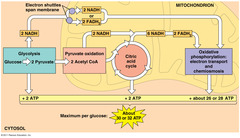
Electron transport chain
Accepts electrons from NADH and FADH• Generates energy through sequential redox reactions calledoxidative phosphorylation
(apart of aerobic respiration)

Glycolysis: Inputs and Outputs
inputs: Glucose. ATP (2) NAD. ADP
outputs: Pyruvate ADP NADH+H+ ATP (4)
atp yield: Burn 2 Make 4 Net Yield: +2ATP
fate of pyruvate

transition step
In eukaryotic cell, corresponds to movement from cytoplasm tomitochondrion
Coenzyme A is a carrier of two-carbon acetyl groups
Like electrons and protons, acetyl groups get an escort through the cell
inputs- Pyruvate CoA NAD
outputs- Acetyl-CoACO2NADH+H+
Krebs cycle
inputs: Acetyl CoA NAD FAD ADP
outputs: CO2 + CoA NADH+H+ FADH2 ATP

Electron Transport & Oxidative Phosphorylation
Final processing of electrons and hydrogen and the majorgenerator of ATP
Chain of redox carriers that receive electrons from reduced carriers (NADH and FADH2)
ETS shuttles electrons down the chain, energy is released and subsequently captured and used by ATP synthase complexes to produce ATP via Oxidative phosphorylation
Chemiosmosis
As the electron transport carriers shuttle electrons, they actively pumphydrogen ions (protons) across the membrane
Proton motive force
The resulting gradient of hydrogen ions
Hydrogen ions diffuse back through the ATP synthase complex
Causing the production of ATP
The Terminal Step of Aerobic Respiration
Oxygen accepts 2 electrons from the ETS and then picks up 2 hydrogen ions from the solution to form a molecule of water.
Oxygen is the final electron acceptor2H+ + 2e- + ½O2 → H2O
Electron Transport Chain
Recycle NADH and FADH2 back to NAD and FAD to start the process again
Dump used electrons onto the final electron acceptor• Generate large numbers of ATP molecules
INPUTS- NADH+H+FADH2 ADP O2
OUTPUTS- NAD FAD ATP H2O
Theoretic ATP Yield for Aerobic Respiration

AEROBIC
ANAEROBIC
FERMENTATION

Photosynthesis: The Earth's Lifeline
Ultimate source of all chemical energy in cells comes from the sun
Photosynthesis convert light energy into chemical energy in foods.
6CO2 + 6H2O-----> C6H12O6 + 6O2. (Glycolysis->Glucose)
Photosynthesis: Stage 1
Light-dependent Reactions:
Photons are absorbed by chlorophyll,carotenoid, and phycobilin pigments
Water split by photolysis
Releases O2 gas
Provides electrons to drive photophosphorylation
Released light energy used to synthesize ATP and NADPH
(INPUT) Sunlight H2O NADP ADP
(OUTPUT) O2 NADPH+H+ ATP
Photosynthesis: Stage 2
Light-independent reaction
Also known as dark reactions and the Calvin cycle
Uses ATP to fix CO2 to ribulose-1,5-bisphosphate
Ultimately gets converted to glucose
(INPUT)CO2 NADPH+H+ ATP
(OUTPUT) Glucose NADP ADP