Social psych
 Call Kai
 Learn
Learn Practice Test
 Spaced Repetition
 Match
Match Flashcards
 Knowt Play
1/316

There's no tags or description
Looks like no tags are added yet.
Name | Mastery | Learn | Test | Matching | Spaced | Call with Kai | Chat |
|---|
No analytics yet
Send a link to your students to track their progress
317 Terms
What is Social psychology?
The study of social behaviors among individuals + groups
Or
The Scientific study of how people think about, influence, and relate to eo
What is Sociology?
The study of broad groups in society + the resulting changes + consequences to society over time
What’s the difference between Social psych + Sociology?
Social psych lies at psychology’s boundary w sociology, but it focuses more of individual rather than groups
What 3 categories can Social psychology be split into?
The scientific study of:
Social thinking
Social imfluence
Social relations
What 4 things does Social thinking consist of?
How we perceive ourselves + others
What we believe
Judgements we make
Our attitudes
What 4 things does Social influence consist of?
Culture + Biology
Pressure to conform
Persuasion
Groups of people
What 4 things does Social relations consist of?
Helping
Agression
Attraction + intimacy
Prejudice
What are the 3 Big ideas of Social thinking?
We construct our social relaity
Our social intuitions are powerful, sometimes perilous
Attitudes shape, and are shaped by behavior
What are the 2 Big ideas of Social influences?
Social influences shape behavior
Dispositions shape behavior
What are the 2 Big ideas of Social relations?
Social behavior is also biological behavior
Feelings + actions toward people are sometimes negative + sometime not
What are 3 examples of where Social psych is applicable?
Individualistic vs Collectivist societies
Patriarchal vs Matriarchal society systems
Judicial, governing, academic, institutional systems
Who is a Notable figure in social psychology in the 19th century?
and what did he create?
Norman Triplett
The Competition machine
What did Norman Triplett do?
He conducted one of social psychology’s first laboratory experiments, cuz he was interested in Bicycle racing. So, he noticed that cyclists’ times were faster when they raced together than when each one raced alone in competition.
Explain the Competition machine
and what were the results of it?
2 fishing reels were mounted on a wooden frame, + connected with silk lines over pulleys to small flags. 40 Participants (aged 8 to 17) turned the crank as fast as possible to reel in a fixed distance, tracked by the position of the flags. But the Children had to complete the task both working entirely alone + working side-by-side in pairs (competing directly against each other while viewing each other's progress).
Results → Triplett discovered that most children wound the fishing reel more quickly when working side-by-side in competition than when working alone.
What is Social facilitation?
and who was it coined by?
The theory that in the presence of others, individuals preform better on tasks than if they were alone
Floyd Henry + Norman Triplett
What did other studies reveal about Social facilitation?
That on some tasks the presence of others hinders performance.
What did Floyd Henry Allport (20th century) write?
and what’s he considered?
the 1924 textbook social psych
the father of social psych
What did Kurt Lewin (post WW2) do?
Him + his students studied (1947) group dynamics and said that → The whole of a group are greater than the individuals that make up the group
What may Social psychology research + theory have implications for?
Other branches of psych, because they all have intersect with each other
In which 3 places does Social psychology research begin to emerge in the 20th century?
Germany
Italy
France
What are the 3 reasons Humans like to construct their own reality?
We like to have order in our world
We like predictable events
We like to attribute behavior to some cause
According to research, what is based primarily on culture?
Differences like preffered body size in mates, definition of social justice, and wether you’re expressive or reserved
When did Social psych texts begin to appear?
Year 1900
What do people construct their behavior to be?
Predictable
In the 1970s, what did the Feminist movement influence social psychologists to study?
Gender + sexism
What do the principles of Social thinking, influences, and relations affect?
and what do they have implications for?
Judicial procedures + Juror decisions
Human health + well being
What do the principles of Social thinking, influences, and relations Influence?
Behaviors that’ll enable an environmentally sustainable human future
What are 4 Social conditions that led to studies within social psychology?
1940s → Fascism in Europe
1950s → look-alike fashions + intolerance to differing views
1960s → riots + rising crime rates
1970s → sexism
What 3 things Constitute culture?
Ideas
Attitudes
Traditions
What are 2 Criticisms of Social psych?
Dangerous, cuz it can be used to manipulate ppl
Trivial, cuz it documents the obvious
What is Culture transmission?
Ideas, behaviors and traditions shared by ppl passed from one gen to the next
What do Correlational designs provide?
and what cant Correlational research do?
Limited information about casual connections between events
Establish cause + effect
What does Correlational research look at?
Natural associations
What do Experimental designs enable?
Researchers to examine causal connections but are limited
What does Experimental research look at?
Causal relations
What is a Theory?
An integrated set of principles/a scientfic shorthand that’s used to make predictions + explain events
What do the effects found in the Laboratory mirror?
The effects in the field
What 3 theories did Leon Festinger (post-ww2) create?
Proximity effect,
Social comparison,
cognitive dissonance
What is the Proximity Effect?
People are more likely to develop friendships + relationships with people who are physically close to them.
What is Informal social communication?
The casual + spontaneous exchange of information + opinions between people in everyday social interactions.
What is Social Comparison Theory?
The idea that people evaluate their own abilities, opinions, and behaviors by comparing themselves to others.
What is Dissonance?
An aroused state of uncomfortable tension
What is the 1980s Replication Crisis?
A concern that many scientific findings cannot be reliably reproduced when researchers repeat the original studies, and that nothing is being empirically replicated
What is the Publisher phenomenon/ the Publish or perish?
and why is it?
It’s how publishers want new studies + new findings
because its very hard to perfectly replicate research across decades + different populations than on paper
What are 2 examples of Fraud in Social psych?
Dietrich Staple (Social psychologist who fabricated numbers and got reported by his students)
Louisa Masria (Director of division of neuroscience who manipulated images the FDA used)
To try and solve the fraud problem of 1980, what 5 things did psychologists do?
Increase the reporting standards
Reduce procedural bias in/from older works
Increase the use of stricter adherence to P<.05 (Which is statistically significant)
Reduce bias to observe accurate statistical effects across studies
Use meta-analysis to compare statistical effects between research investigations
What is Risk of bias (ROB)?
The amount of bias in a study’s procedure and/or data analysis that could skew/make the findings
Does Risk of bias always mean research fraud?
No, Risk of bias can occur even when researchers are acting honestly + ethically.
What are the 2 reasons Research can have bias even without fraud?
Because:
Research rarely goes perfectly
Researchers can’t account for every single variable/deviation
Why can Participants' choices create empirical questions?
Because they have the ethical right to voluntarily participate in any aspect of a study which can affect the study's results.
When are the 3 times Risk of bias = Fraud?
If Data analysis is ineffectively reported ( e.g., group averages aren’t reported, but the authors report a significant difference)
Data is removed from analysis without empirical rationale
Procedure is largely inconsistent between participants or groups
What does the WEIRD dilemma stand for?
And what percentage of the global population is considered part of ‘W.E.I.R.D’?
W – Western
E – Educated
I – Industrialized
R – Rich
D – Democratic
12%
What is the WEIRD dilemma?
How so much psychological research relies on participants from W.E.I.R.D populations, which doesn’t represent the global population.
What are the 5 R’s of Indigenous partnerships in Canadian research?
Reciprocity (mutual benefit + exchange)
Respect
Relevance (relevant to the Indg community)
Responsibility (to conduct research ethically + protect participants)
Relationships (research should be built on trust, communication, collaboration)
What is Social psychology recognized as in the 21st century?
A pillar of understanding human behavior
What concepts are still referenced today in applied work?
Key concepts from seminal research (50s,60s,70s)
Why does Social behavior continue to evolve?
Because humans adapt their social behavior to changing environmental + societal demands → (eg, changing political climates, COVID-19 pandemic, social media)
What is Social media?
Technologies that facilitate the creation + sharing + aggregation of content through virtual communities + networks
How are Social identities captured in social media?
and how is communication facilitated?
By profiles
Thru text posts, comments, digital photos, videos, and/or other data that generates online interaction (e.g., polls, reactions, stickers)
What are the 5 ways that Social media differs from Old media?
It has greater:
Reach
Frequency
Usability (easier to use)
Relevancy (to society)
Permanence (can be accessed anywhere0

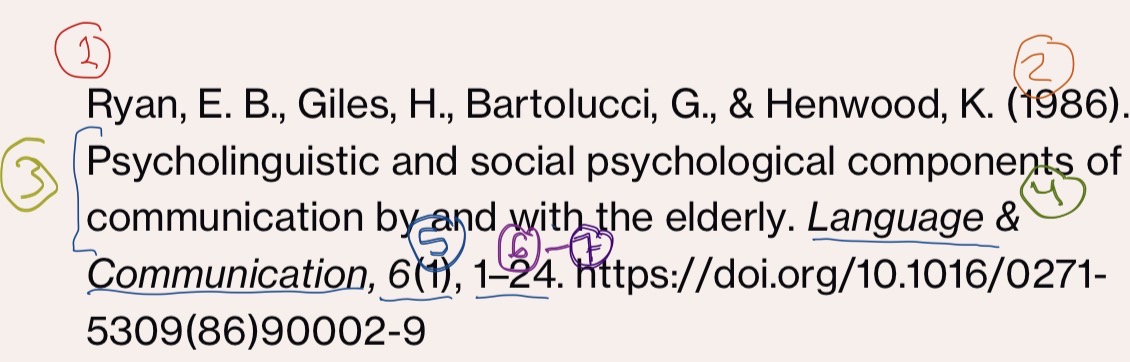
What are the 7 parts of a Reference/Citation?
1) Authors
2) Year of publication
3) Title
4) Journal volume
5) Issue
6) Chapter
7) Pages
What are the 6 things Research papers consist of?
Abstract
Introduction/Background
Aims/Hypothesis
Methodology
Results
Discussion
What is an Abstract in a research paper?
and what does it usually NOT contain?
A 250-word, at-a-glance summary of the entire study, that can include key words
All of the fine-grain details of a full study
What Findings does an Abstract typically report?
and how can it be organized?
The most notable findings for the primary outcome.
it can be split into sections or can be a general summary
What is the main purpose of the Introduction/Background section in a research paper?
and what does 2 things does it typically contain?
It “sets the scene” for the research,
A history of the problem/question + Points of controversy/debate among the literature
What is the Aim/Hypothesis of a research study?
What you are hoping to accomplish or answer with your study.
Why is a Hypothesis vital?
For Statistical testing, by testing the “null hypothesis” compared to the “experimental hypothesis”
Where do Hypotheses come from?
The Theoretical background established in the introduction
What is Methodology?
and what 6 things does it include?
How you conduct your study
Ethics approval
Information about the sample you recruited (and their relevant demographic information)
Materials needed
Measures used
Procedure of the study
Data analysis
What is the Results section of a research study?
The findings from your data analysis, reported in → Writing, tables, and figures
What is Quantitative research include in the Results section?
Statistical analyses (Numbers)
What does Qualitative research include in the Results section?
Thematic analysis of interview or written responses
What is the purpose of the Discussion section?
and what 2 things does it do?
To interpret the results
Identify the strengths + limitations of the study
Provide direction for future work
What does the Discussion section provide context for?
The numbers and/or themes found in your data analysis
What is Dyadic communication?
and what’s an example of it?
Non-verbal communication
When monkeys reacted to the ‘death’ of a robot monkey by gathering around it (what we categorize as: troop gathering + expression of sadness)
Who is the Communications model made by?
and what are the 3 steps of it?
Duck + McMahon, Hadjistavropoulos et al.; Prkachin & Craig; Rosenthal
Step A: the Action of communication (verbal + non-verbal)
Step B: the Interaction
Step C: the Transaction
What is Step A of the communication model?
Receiving verbal + nonverbal cues from who you’re communicating with
What is Step B of the communication model?
Our ability to receive the message + interpret the signals from Step A using our senses (vision, hearing,etc)
What is Step C of the communication model?
and what informs our response here?
When we decide the meaning of the message/action we witnessed/received based on how successfully or poorly we interpreted the communication
How we judged this communication
In the monkey example, what’s the Communication model represent?
Step A: the Action of communication → of the monkeys gathering around the dead monkey
Step B: the Interaction → Us capturing the behavior in our perception + categorizing it
Step C: the Transaction → where we look at the extended meaning of that message
What’s another example of the communication model?
Step A = a patient reflexively responds to getting a needle
Step B = The nurse witnesses the facial movements
Step C = The nurse assumes the patient felt pain during the injection
What 4 things does Verbal communication consist of?
Language → (Written/Spoken)
Structure
Sound
Semantics + Pragmatics
What 3 things does Structure consist of?
Phoneme
Morpheme
Grammar
What 2 things does Sound consist of?
Tone
Prosody
What are Phonemes?
the Smallest unit of spoken language, a Set of speech sounds that distinguish words in a given language
How do you form new words in Phonemes?
By changing the letters to make new words
(Eg, changing b in bat to c for cat)
How do Phonemes differ from one language to another?
In some languages one phoneme can have different tones/inflections to indicate meaning
(Eg, Dene, Mandarin Chinese, Navajo, Vietnamese)
What are Syllables?
the Rhythmic building blocks of words, what phonemes come together to form
How are Syllables counted?
By how many times our mouths open + our chins drop when pronouncing words
What are Morphemes?
And what are the 2 kinds of it?
the smallest unit of MEANING in language
Free + Bound
What are the 6 types of Free morphemes?
Nouns
Prefixes
Verbs
Adjectives
Prepositions
Articles
What are Bound morphemes?
and what are the 2 types of it?
Non words on their own but attach them to a free morpheme and then it gets meaning
Prefixes
Suffixes
What are Words?
and what are all words?
Single + Distinct units of language that communicate meaning
Abstract, becuz all are made up by us
What are Semantics?
How the patterns of phonemes, syllables, and morphemes (language sounds) earn their meaning as words or phrases
Why do we use Words?
and what do words convey?
To label different people, places, and things,
Some kind of judgment + greater meaning (eg, Was It a war crime or collateral damage? Surveillance or intrusion of privacy? Etc)
What are Pragmatics?
and what do they tie into?
How context around language sounds contributes to their meaning as words/phrases
Connotation
What is Connotation?
The emotional or cultural feelings/language tied to a word
What is Prosody?
The Audible qualities of spoken language that add meaning to standard language sounds (phoneme +morpheme), words, phrases, and sentences.
What 4 things does Prosody include?
Intonation
Stress
Rhythm
Volume
What is Intonation?
and what does it signal?
the Rise + fall of our voice as we speak
Emotions + Different sentence types → Fall-rise patterns (eg, Statements vs questions vs explanations)