clinic procedures sedation record & nitrous oxide unit
 Call Kai
 Learn
Learn Practice Test
 Spaced Repetition
 Match
Match Flashcards
 Knowt Play
1/37

There's no tags or description
Looks like no tags are added yet.
Name | Mastery | Learn | Test | Matching | Spaced | Call with Kai | Chat |
|---|
No analytics yet
Send a link to your students to track their progress
38 Terms
what should you always record at each visit?
Blood pressure, pulse, and respiration
ASA means
American society of anesthesiologists
ASA I
Normal healthy patient
ASA II
Patient with mild systemic disease
ASA III
Patient with severe systemic disease
ASA IV
Patient with severe systemic disease that is a constant threat to life
ASA V
Moribund patient who is not expected to survive without an operation
ASA VI
Declared brain-dead patient whose organs are being donated
ASA class “E”
Patient requires emergency procedure
informed consent
Required with each procedure
Patients/parents must understand the purpose of the procedure
How it will be accomplished, and what to expect
The benefits of this type of sedation
The risks associated with using/not using this sedation
Alternative viable options must also be offered
function of the respiratory system
Exchange O2 and CO2 across pulmonary/capillary membranes
levels of consciousness monitored by the patient’s…
response to verbal commands
Monitoring ventilation can be accomplished by
observation or auscultation
3 purposes of the reservoir bag
supplemental supply of O2 for pt
method of monitoring respiration
emergency method of providing positive pressure O2
Professionals who use N2O/O2 sedation and/or local anesthesia must be:
Certified in BSL for healthcare providers
Cardiopulmonary resuscitation (CPR)
Automated external defibrillator (AED)
Management of airway obstruction for adults, children, and infants
what’s in an emergency kit?
AED
Antagonist medications
Positive-pressure ventilation system.
Adequate suction to clear an airway
Advanced airway equipment, and
nitrous oxide storage
blue cylinder - nitrous oxide
green cylinder - oxygen
a full nitrous oxide cylinder
95% liquid & 5% vapor
pressure gauge of 750 psi at 75 degrees F
pressure doesn’t decrease until about 20% nitrous oxide
full O2 cylinder
2,200 psi
pressure gauge is accurate
at 0, there’s about 50 left
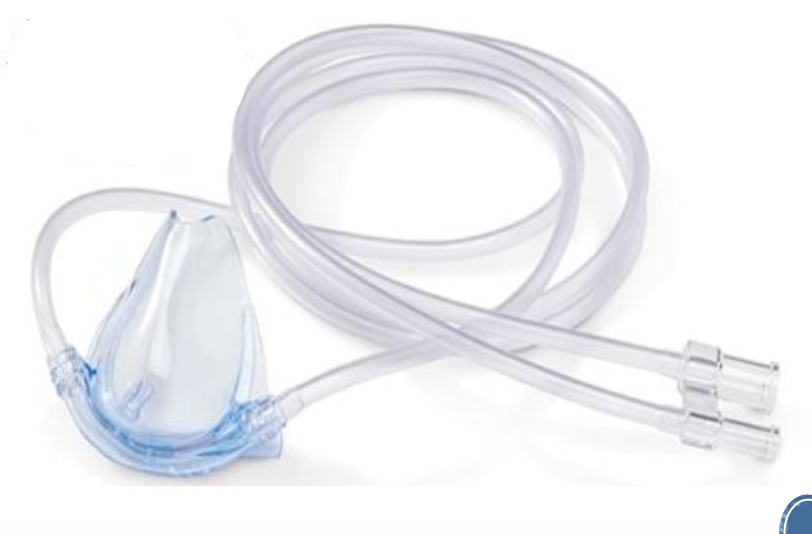
conduction tubing
Gas is delivered through tubing or hose stemming from the unit and attaching to the
breathing apparatus

breathing apparatus
Gas may be delivered to the patient through a nasal hood or a full-face mask
Nasal hood is designed to fit snugly over the patient’s nose
scavenging system
Helps to eliminate excess gas that is exhaled by the patient limiting the clinician’s exposure to exhaled N2O/O2

**what does nitrous oxide replace in the blood?
nitrogen
equipment safety
all units deliver a minimum of 30% oxygen
failsafe
titration
Administering a drug in incremental amounts until a desired endpoint is reached
ex. nitrous oxide
N2O/O2 PROCEDURE
Open (crack) the tanks open flowmeter
2. Attach scavenger system to high-speed suction and turn on
3. Attach breathing apparatus (nasal hood)
4. Turn on 100% O2 to 6 liters (if bag) or 4 liters (no bag) for at least 2 minutes
5. Push O2 flush if the reservoir bag isn’t inflating
6. Place the nasal hood on the patient
7. Check the reservoir bag
N2O/O2 ADMINISTRATION
1. Titrate N2O 5% every 2 minutes until 10% N2O is in the reservoir bag
2. Perform planned procedure
3. Terminate N20 from flowmeter
4. Administer 100% O2 for 5 minutes prior to discharge
Begin PO vital signs 2 minutes into the 5 minutes 100% O2 postoperatively
6. Ensure recovery and dismiss patient
7. Turn off tanks
8. Remove scavenger system
9. Complete sedation record
10. Disinfect sedation equipment
nitrous oxide recovery
same time as induction
vital signs stable
sedation record
preoperative & postoperative vital signs
tidal volume
peak %
duration of drug administered
info of recovery
# of minutes of postoperative 100% oxygen
any pertinent comments made by patient
ideal signs for a patient under nitrous oxide
▪ Comfortable and relaxed
▪ Tingling in extremities and/or mouth
▪ Acknowledges reduced fear/ anxiety
▪ Aware of surroundings
▪ Eyes become less active and glazed
▪ Will respond to verbal commands
ideal experiences for a patient under nitrous oxide
▪ Heaviness in legs and arms
▪ Body warmth
▪ Light feeling
▪ Vasodilation in face and neck
▪ Circumoral numbness
nitrous oxide in pediatric pts.
Children who are ASA I & II all levels of sedation
Children ASA III & IV, special needs or abnormal airways require medical clearance
Responsible adult must accompany a child to and from an appointment and sign informed consent
Staff certified in emergency and rescue situations
Administration of nitrous oxide (<50%) without any other sedative, narcotic or other depressant drugs
who makes guidelines for nitrous oxide in pediatric pts. ?
American Academy of Pediatrics (AAP) and American Academy of Pediatric Dentistry (AAPD)
oversedation signs/symptoms
▪ Detachment/disassociation from environment
▪ Dreaming, hallucinating, or fantasizing
▪ Out-of-body experiences
▪ Floating and/or flying
▪ Inability to move, communicate, or keep mouth open
▪ Humming or vibrating sounds that progressively worsen
other effects a patient may experience with over sedation:
▪ Drowsiness
▪ Dizziness
▪ Diaphoresis
▪ Nausea
▪ Light-headedness
▪ Fixed eyes
▪ Uncomfortable body warmth
an overstated patient may progress to:
▪ Sluggish, delayed responses
▪ Slurred words
▪ Agitated/combative behavior
▪ Vomiting
▪ Unconsciousness
absolute contraindications
cannot be administered safely
Pneumothorax (collapsed lung)
Cystic fibrosis/COPD
Pernicious anemia/vitamin B12 deficiency
Significant bowel obstruction
First trimester of pregnancy
Cancer therapy
Psychological impairment
Current psychotropic drug use
Current/recovering drug use
Inability to understand procedure/informed consent
relative contraindications
can be allowed to proceed only after appropriate modifications
Current upper respiratory infection
Current sinus infection
Middle ear disturbance/surgery
Recent eye surgery (none for 6 months)