L09 behavior - physiology interactions
 Call Kai
 Learn
 Practice Test
 Spaced Repetition
 Match
 Flashcards
 Knowt Play
1/37

There's no tags or description
Looks like no tags are added yet.
38 Terms
how does bh //to physio?
bh reflects internal + external conditions
bh affects physio + physio affects bh
e.g. involving social behavior
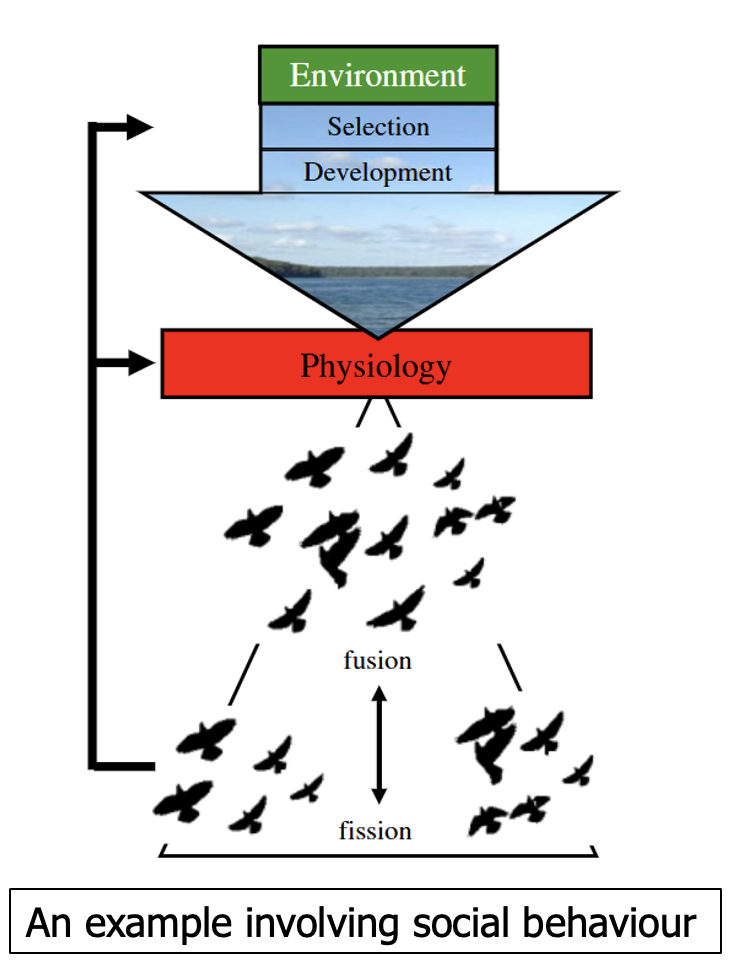
this random diagram to understand later

reaction norm
the way we expect a phenotype (x axis) to depend on an environment (y-axis)
used to understand behaviour (bc v plastic)
used in context of repeatability to understand how individuals vary in their bhval responses

reaktionism def
developed by richard woltereck in 1909
2 main ways individuals can differ in reaction norms
in their mean phenotype
in their plasticity
e.g.individuals differ in provocation :
baseline anger
sensitivity to provocation

circadian rhythms why
circa diem = about a day
response to a rhythmic envmt = earth cyclical 24h days
govern all bh & physio:
sleep/wale cycle, metabolism, immunity, core body tempeaature, hormones => peak and trough w 24h periodicity
circadian rhythms govern…
sleep/wake cycle
lowk all bh & physio
metabolism, immunity, core body tempeaature, hormones => peak and trough w 24h periodicity
why circadian rhythms are advantageous
cyanobacteria: Strain A better than Strain B if clock matches envmt
Coyote tabacco coordinates rhythms in flower movement ← pollination by nocturnal or diurnal birds
Guillemot fledging time-day predation risk lowest
===> advantageous for best time for reactions, for pollination++, predation - -
2 hypotheses for HOW (not why) circadian rhythms
endogenous clock hypothesis
biological clock acts independently of any cues from the organisms’ surroudnings
envimtal stimulus hypothesis
an organism’s NS responds to changes in the envmt
=> NOT mutually exclusive, both can be true
how are internal clocks organised in mammalian circadian system
central clock in the SCN in the brain
peripheral clocks in other organs and tissues
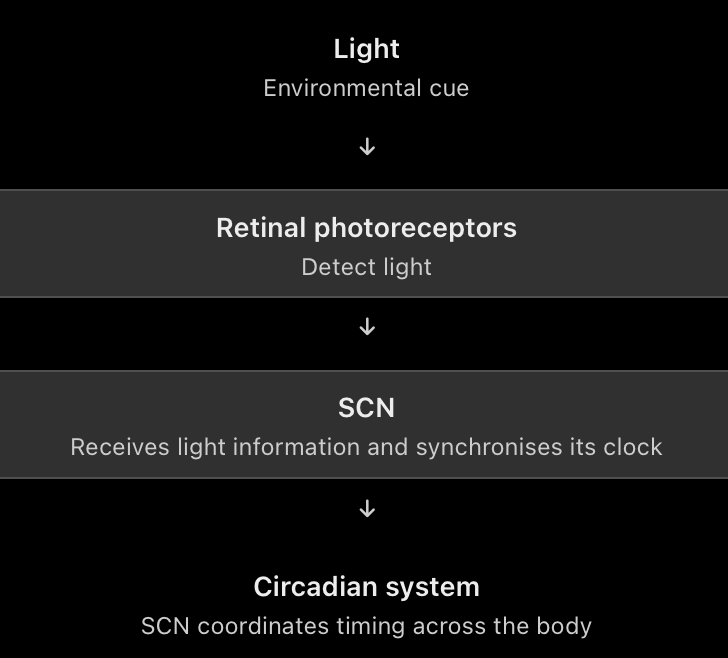
entrainment def + how
= synchronising an internal biological rhythm with an external environmental cue.
retinal pathway: light => retinal photoreceptors => SCN
TTFL def + how
= A transcription–translation feedback loop that generates cellular oscillations.
CLOCK/BMAL1 activate PER/CRY; PER/CRY then inhibit CLOCK/BMAL1.
The proteins produced by activated genes eventually inhibit their own production.
entailment + free-running + zeitgeber defs
Entrainment: the internal rhythm is synchronised with an external cue.
Free-running: the rhythm continues without that cue.
Zeitgeber = “time giver” = An external environmental cue that synchronises a biological rhythm = usually sunlight
entrainment/free-running period = 24h aka the cycle time

resource selection: how hunger affects movement
2 conflicting fx:
More food/resources → more energy available → greater ability to move and search.
More food/resources → less hunger → less motivation to search.
=>nonlinear r/s b/w hunger and mvm
How does food deprivation affect movement in griffon vultures?
Movement initially increases as vultures search more widely for food, but eventually decreases as prolonged food deprivation encourages energy conservation.
How can hunger influence risky behaviour in mountain lions
Increasing hunger is associated with a greater tendency to enter human environments, suggesting that food deprivation can increase willingness to take risks.
How can hunger generate collective movement in locusts?
Hungry locusts become cannibalistic and nip at the heels of others, stimulating them to move. Repeated interactions can produce continuous group movement and migration.
What does the locust nerve-cutting experiment demonstrate?
Severing the nerve involved in sensing rear interactions reduces movement in groups but not when locusts are alone, supporting the role of rear tactile stimulation in collective movement.
Hormones def
chemical messengers that transmit many messages from the NS outward
=> influence beh
HPA axis
hypothalamic pituitary adrenal axis
stress management
feedback loop
// w disorders

how does reproduction affect beh? examples
→ Reproductive events and associated physiological changes can alter:
dispersal = leave group to find breedings/avoid competition
parental care (brooding) = keeping eggs or young warm/protected
social status
infanticide
foraging (e.g. parents need to obtain food for offspring)
migration-related behaviour (smolting). = physiological transformation in young salmon that prepares them for migration from freshwater to seawater; involves changes in physiology and behaviour.
immunity response
more exposure / contacts => immune system more active
aka tweaked to envmt e.g. concerts / going out
density-dependent prophylaxis
adjusting immune defences according to population density / the number of nearby individuals.
e.g. caterpillar ++phenoloxidase levels // crowded + dark envmt

another thing that triggers immunity
SEEING a sick conspecific

sensory capacity & immunity
individuals in same envmt may have diff sensory capacity => perceive density differently
==> have diff responds
PERCIEVED density
aka in general sensory capacities affect a lot, not just the factual blah blah
Eye morphology and migration + Roach fish example
differences in sensory anatomy (here, eye/pupil morphology) can influence what an animal can perceive, potentially affecting behavioural decisions such as migration.
behaviour influencing physiology
The body needs to anticipate the physiological demands of future behaviour.
Repeated behaviours can produce physiological changes over time.
Examples: weightlifting → endorphins and muscle growth; stress bh (nail biting) and sleep also affect physiology
def ageing
Progressive decline in biological function over time.
Leads to reduced survival and reproductive capacity.
Key features: accumulated cellular damage, reduced physical performance, weaker responses to stress/injury, increased disease risk, reduced survival and reproduction.
why should ageing affect behaviour
learning
reduced mobility/other physical declines
decline in cog function
change in social position w age
shifting priorities
what’s up with the isle of rum red deers
researchers have unusually detailed longitudinal data, allowing them to study how individuals change as they age
population studied since 1973, censused 40x a year
deer and ageing (physical fx)
DECLINES IN
fecundity
offspring traits
raning bh
deer and ageing (social fx)
OLD deers = less group size than YOUNG deers
However this fx is seen BETWEEN individuals analysis so doesnt isolate other factors like personality
BUT after taking that account somehow YES ageing does reduce social connectedness
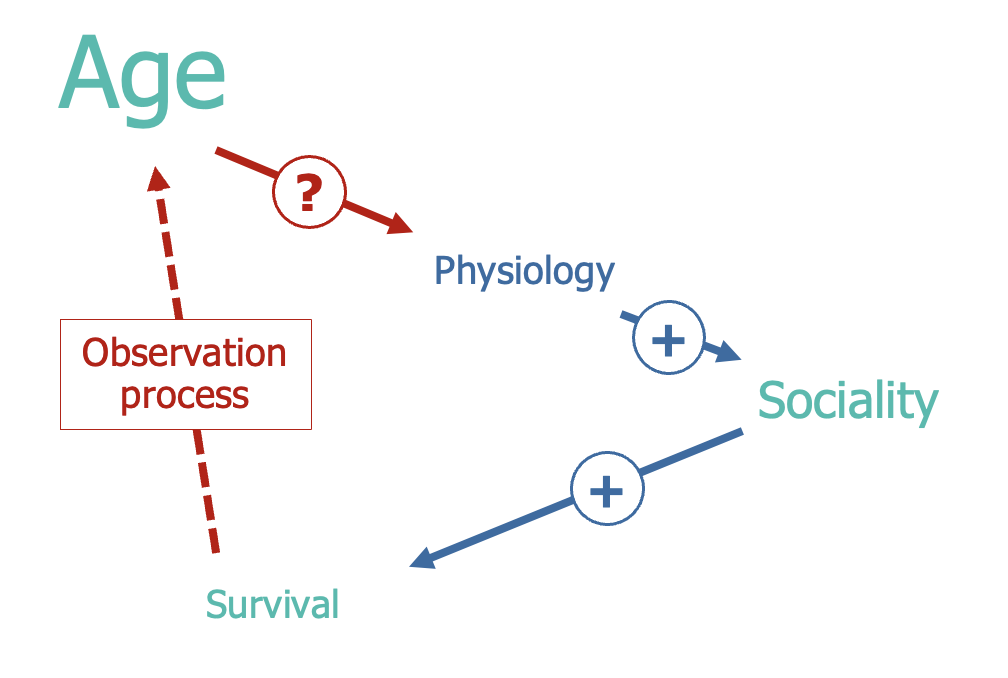
selective disappearance
Individuals with certain characteristics survive longer than others, changing the composition of the population observed at older ages.
hypotheses as to why deers ageing fx
lose friends as they age
move to areas of lower density
range less widely & therefore less social
become less social “actively”
which hypothesis is correct
become less social “actively”
H1) demographic ageing + tested
social networks depend on demography (aka theyre friends with peers their age)
=> the friends die obviously so thats why??
Research:
dead connections previous year //w greater sociality
=> dead friends readily replaced
=> no
H2-3) spatial & social behaviour
strong inherent link b/w spatial & social behaviour
ageing deer move out from the population centre
=> potentially

H4) age-related changes in sociality
YES more robust than 2-3