Chapter 6 Information Flow and Processing Study Guide
 Call Kai
 Learn
 Practice Test
 Spaced Repetition
 Match
 Flashcards
 Knowt Play
1/58

There's no tags or description
Looks like no tags are added yet.
59 Terms
DNA replication
The process in which DNA makes a duplicate copy of itself. This is semi-conservative, with the newly made double-stranded DNA consisting of 1 old strand and one new

Translation
(genetics) the process whereby genetic information coded in messenger RNA directs the formation of a specific protein at a ribosome in the cytoplasm
Genome
All the genetic information in an organism; all of an organism's chromosomes (and plasmids)
Purine
a nitrogenous base that has a double-ring structure; one of the two general categories of nitrogenous bases found in DNA and RNA; either adenine or guanine
Operon
A unit of genetic function common in bacteria and phages, consisting of coordinately regulated clusters of genes with related functions. One promoter controls the expression of several related genes
Primase
Specialized DNA dependent RNA polymerase that makes an RNA primer to provide the 3' OH for DNA polymerase to add dNTPs to.
Replisome
a complex of DNA polymerase III and other enzymes that catalyzes the synthesis of DNA. This is the "replication body"
Helicase
An enzyme that untwists the double helix at the replication forks, separating the two parental strands and making them available as template strands. (uses ATP to break hydrogen bonds joining base pairs of A-T and C-G)
ssDNA binding proteins
Proteins that bind single strand DNA to prevent it from rejoining while strand is being replicated
Nucleotide
Molecules that make up DNA and RNA - they each have 3 parts (sugar, phosphate, nitrogenous base)
Semiconservative
When DNA is replicated, the resulting strands are made of one parent (old) strand and one daughter (new) strand
DNA Ligase
A linking enzyme essential for DNA replication; catalyzes the covalent bonding of the 3' end of a new DNA fragment to the 5' end of a growing chain. This enzyme joins Okazaki fragments together by sealing the gap between the 3'OH (from DNA pol I) and the 5' Phosphate (from adjacent fragment)
Pyrimidine
a nitrogenous base that has a single-ring structure; one of the two general categories of nitrogenous bases found in DNA and RNA; thymine, cytosine, or uracil
DNA Gyrase
Enzyme that temporarily breaks the strands of DNA, relieving the tension caused by unwinding the two strands of the DNA helix. This acts ahead of the replication fork.
Plasmids
Circular pieces of DNA that replicate independently from the chromosome. These structures are mobile and often carry accessory genes (not required for life functions)
Primer
Short strand of RNA used as a starting point for DNA synthesis by a polymerase - these are located at the 5' end of all Okazaki fragments and the 5' end of the newly made leading strand
DNA polymerase 1
the enzyme that replaces RNA primers with DNA nucleotides and proofreads the new strand against the old during DNA replication
DNA polymerase III
Primary enzyme used to add nucleotides to growing strands during replication
Informational Molecules
Molecules that can be used as blueprints to build proteins and can be passed from one generation to the next
Phosphodiester Bond
Type of bond used to link nucleotides together to form DNA or RNA
Regulons
Collection of multiple operons under one regulatory protein
Antiparallel
The direction of the DNA strands relative to each other-- 5' to 3' and 3' to 5'
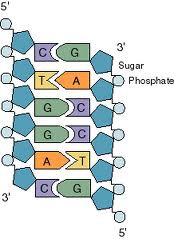
DNA Polymerases
Enzyme used to add nucleotides to a new DNA strand. These enzymes require a 3' OH that is provided by an RNA primer
RNA Polymerases
Enzymes that use a DNA template to make RNA. (they do not require a primer because they join two ribonucleotides together)
Leading Strand
The DNA strand that is replicated with no gaps or fragments
Lagging Strand
The DNA strand that is replicated with frequent gaps between primers-- fragments need to be joined together

Transcription
Process of converting DNA sequence to mRNA so it can be translated into a protein
3' end
End of the growing chain of RNA that new nucleotides are added to
sigma factor
protein that binds to the promoter first, recognizing consensus sequences at the -10 and -35 region to start transcription
mRNA
End product of transcription-- what will be used as a template in translation
Rho-independent Termination
A stem loop structure followed by a string of U's to disassociate the polymerase from the DNA strand and stop transcription
Rho-Dependent Termination
Protein used to terminate transcription by pushing the polymerase off the strand
Strong Promoter
Better matches consensus sequence, so the sigma factor binds better and more mRNA is made

Weak Promoter
Doesn't match consensus sequence as strongly, therefore sigma factors bind with less affinity and less mRNA is made
Promoter
Where the sigma factor and RNA polymerase bind to begin transcription
Consensus Sequence
How closely the promoter region matches this determines the amount of mRNA made
Polycistronic
Multiple genes are transcribed on the same mRNA under control of a single promoter
Processivity
The length of DNA that is replicated (or transcribed) by the core enzyme (DNA or RNA polymerases) before it detaches from the template

SecA Secretory System
System used to secrete proteins to periplasm via binding a signal sequence
degenerate
way of describing the genetic code that indicates there is more than one codon for most amino acids.
codon bias
multiple codons for the same amino acid are not used equally by all organisms, some are used much more frequently than others.
Aminoacyl tRNA Synthetase
Catalyzes the reaction to add the amino acid the the corresponding tRNA
tRNA
Matches to the codon currently being read on the mRNA and adds the right amino acid to the growing chain
Amino acid
Subunit of a polypeptide chain, which is then folded into a protein
Start Codon
fMet binds to this codon (AUG) and is the first codon read in the sequence
Chaperone
Assists in the folding of a polypeptide chain to the proper shape of a protein
Translocation
Movement of the ribosome along the mRNA
Codon
A 3 letter nucleotide sequence corresponding to an amino acid

Initiation Factors
These prevent the ribosome from binding without mRNA present, and promote binding to mRNA
rRNA
Ribosomal RNA, used to translate mRNA into a polypeptide chain

Termination
This occurs when a ribosome reaches a stop codon-- release factors cleave polypeptide chain so the ribosome can disassociate
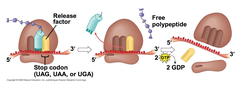
Release Factors
Bind to a stop codon and cleave polypeptide chain
Stop Codon
causes the ribosome to stop translation of mRNA; UAA, UAG, UGA (there is no tRNA with a matching anti-codon for these 3 codons)
Denaturation
In proteins, a process in which a protein unravels and loses its native conformation, thereby becoming biologically inactive. In DNA, the separation of the two strands of the double helix.
Wobble
Term used to describe flexibility in reading the 3rd nucleotide in a codon (it isn't read as tightly, causing the degeneracy of the genetic code)
Elongation Factors
Translation proteins that will bring charged tRNA to ribosome and help move the ribosome along the mRNA
Signal Sequence
"Address" of a protein, or how the cell knows where to send the protein after translation
Two-step translocases
Sec dependent for transport to periplasm, and then secreted to outer membrane via a pore
One-step translocases
Sec independent, acts as a single channel through both membranes