Soft Tissue Pathology- Sarcomas
 Call Kai
 Learn
 Practice Test
 Spaced Repetition
 Match
 Flashcards
 Knowt Play
1/11

There's no tags or description
Looks like no tags are added yet.
12 Terms
sarcomas
-malignant neoplasm of soft tissue or bone arising in fibrous, fatty, muscular, vascular, or neural tissue
-usually first manifested as a painless swelling
-<1% of the cancers in oral cavity
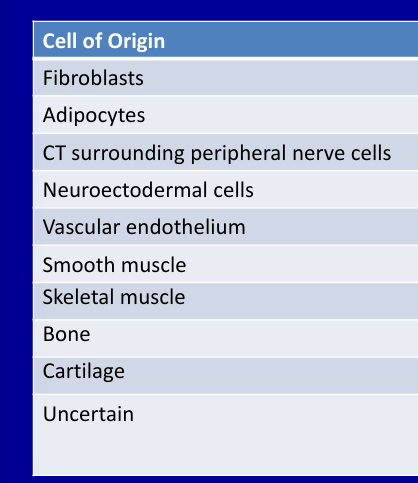
cell of origin → type of sarcoma

fibrosarcoma
-malignant tumor of fibroblasts
-location: anywhere in oral cavity
-age: young adults and children
-clinical features: slow-growing mass that reaches considerable size before producing pain
-histology: fascicles of spindle-shaped cells forming a “herring-bone” pattern (nuclei forming short, angular intersections), variable mitoses
-treatment and prognosis: surgical excision with a wide margin; 50% recurrence, 40-70% 5yr survival

liposarcoma
-malignant tumor of adipose tissue
-currently considered the most common soft tissue sarcoma in adults accounting for 20% of all soft tissue malignancies in adults
-head and neck cases are rare
-location: tongue and cheek
-age: 40-60yo
-clinical features: soft, slow-growing, ill-defined mass that may appear normal in color or yellow
-pain and tenderness may be present in advanced stage
-histology: vacuolated lipoblasts with pleomorphic nuclei ± less differentiated rounded cells
-treatment and prognosis: radical surgical excision, better prognosis for oral tumors due to smaller size and predominance of well-differentiated subtypes
-15-20% recurrence, rare metastasis and death
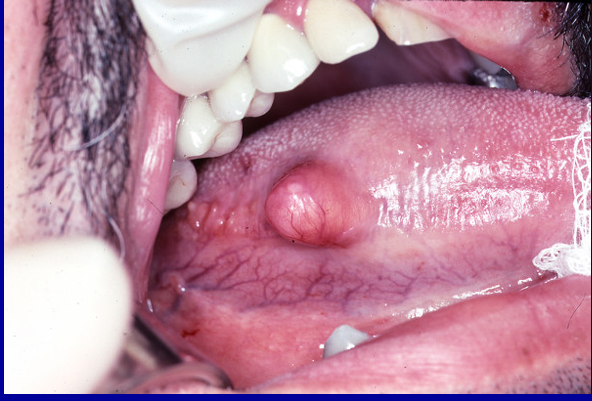
malignant peripheral nerve sheath tumor (MPNST)
-malignant tumor of the connective tissue surrounding nerves
-50% of MPNST cases occur in patients with NF Type I
-location: mandible, lips, buccal mucosa
-age: young adults, one decade younger for NF patients
-clinical features: enlarging mass that sometimes exhibits rapid growth, associated pain or a nerve deficit is common
-histology: fascicles of spindle-shaped cells with wavy or comma-shaped nuclei
-treatment and prognosis: radical surgical excision and adjuvant radiation and chemotherapy, 16% 5yr survival for NF patients, 53% 5yr survival rate for others


olfactory neuroblastoma
-malignant tumor of nasals neuroectodermal cells, similar to neuroblastomas seen elsewhere in body
-location: nasal cavity close to the cribriform plate
-age: adults, wide age range
-clinical features: nasal obstruction, anosmia, epistaxis, pain
-histology: small round to ovoid basophilic cells arranged in sheets and lobules, rosettes and pseudorosettes
-treatment and prognosis: surgical excision with adjuvant radiation therapy, chemotherapy for advanced cases, 50-90% 5yr survival depending on the size/stage of the lesion, death due to local recurrence, 20-40% metastasis

angiosarcoma
-malignant tumor of endothelium of blood or lymphatic vessels
-location: scalp, forehead, (oral is rare tongue and mandible)
-age: elderly
-clinical features: early lesions resemble a simple bruise, continues to enlarge and becomes elevated, nodular, or ulcerated, tend to be multifocal
-histology: infiltrative proliferation of blood vessels lined by atypical endothelium forming anastomosing network
-treatment and prognosis: radical surgical excision or radiation therapy or both, 21% 10yr survival for those in face and scalp, oral lesions with better prognosis


leiomyosarcoma
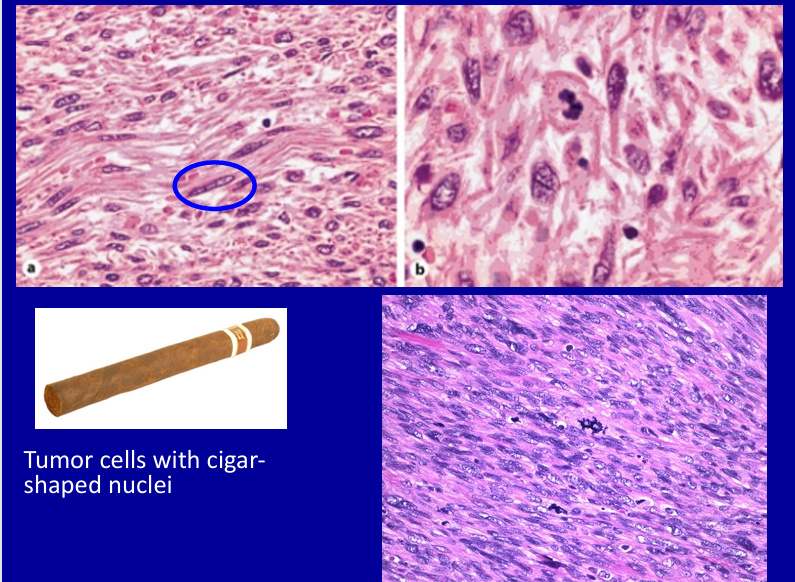
-malignant tumor of smooth muscle
-location: half of H&N cases occur in the jawbones
-age: middle age and older
-clinical features: enlarging mass that may or may not be painful
-histology: fascicles of spindle-shaped cells with abundant eosinophilic cytoplasm and blunt-ended, cigar-shaped nuclei
-treatment and prognosis: surgical excision + adjuvant radiation or chemotherapy, 62% 5yr survival
rhabdomyosarcoma
-malignant tumor of skeletal muscles, most common soft tissue sarcoma in children
-60% of soft tissue sarcomas in childhood, only 2-5% of soft tissue sarcomas in adults
-most frequent site is the H&N (35% of all cases)
-subtypes: embryonal, alveolar, undifferentiated, anaplastic- most oral lesions are embryonal and alveolar types
-location: in the head and neck- the face and orbit, followed by the nasal cavity; palate = most frequent intraoral site
-age: young children - young adults
-clinical features: painless, infiltrative mass that grows rapidly
-histology: embryonal- sheets of small round cells with hyperchromatic nuclei, alveolar- aggregates of round to oval cells separated by fibrous septa with a central loss of cohesiveness resembling alveoli
-treatment and prognosis: surgical excision + multiagent chemotherapy ± post-op radiation therapy, 50% recurrence, 66-95% (embryonal) and 53% (alveolar) 5yr survival

malignant fibrous histiocytoma
-sarcoma with both fibroblastic and histiocytic features
-location: anywhere in oral cavity
-age: older adults
-clinical features: expanding mass that may or may not be painful or ulcerated
-histology: fascicles of pleomorphic and spindle-shaped cells forming a “storiform” (pin-wheel) pattern
-treatment and prognosis: radical surgical excision, 40% recurrence, 40% metastasis within 2 yrs, poor survival especially for oral tumors

synovial sarcoma
-sarcoma of unknown origin, does not arise from synovium!!
-translocation between the X chromosome and chromosome 18; SYT-SSX fusion gene
-location: tongue, cheek
-age: teenagers and young adults, M>F
-clinical features: gradually enlarging mass associated with pain or tenderness
-histology: mostly biphasic with spindle cells and cuboidal to columnar epithelial cells that surround gland-like spaces or form nests, cords, or whorls
-treatment and prognosis: surgical excision and adjunctive radiation therapy or chemotherapy, high rates of recurrence and metastasis, 20-38% 10yr survival

alveolar soft-part sarcoma
-malignant tumor of uncertain origin
-translocation t(X;17)(p11.2;q25), ASPL-TFE3 fusion gene
-location: ~25% of all cases occur in the H&N, tongue = most frequent oral location
-age: young adults and children
-gender: 2x more common in female (1-20yo), male predilection for those developing after 30 yrs of age
-clinical features: slow-growing painless mass
-histology: alveolar collections of large, polygonal cells with granular cytoplasm
-treatment and prognosis: surgical excision + radiation or chemotherapy, poor prognosis due to late metastasis, 60% 5yr survival, >15% 20yr survival, better for young patients
