AERO 416 Exam 1
 Call Kai
 Learn
Learn Practice Test
 Spaced Repetition
 Match
Match Flashcards
 Knowt Play
1/53

There's no tags or description
Looks like no tags are added yet.
Name | Mastery | Learn | Test | Matching | Spaced | Call with Kai | Chat |
|---|
No analytics yet
Send a link to your students to track their progress
54 Terms
The Charpy test utilizes the difference in which of the following to determine fracture toughness and ductility?
Initial Potential Energy and Final Potential Energy.

From the given materials selection chart above, what trend can be seen?
Engineering Composites tend to have lower densities than the Engineering Alloys for approximately the same Young’s Modulus.
Which of the following is NOT one of the common fiber-reinforced polymer Engineering Composites used in industry?
QFRP

What is a good estimate for the Young’s Modulus of a reinforced polymer with the matrix and fiber having the following properties?
71 GPA
The options given below are all valid fiber configurations for a fiber reinforced composite EXCEPT:
Parabolic
The abstract of a paper should include how many numeric results?
One or two. Just enough to get them interested in reading the rest of the paper.
Which of the following is not a common mechanical property?
Surface finish.
Which of the following is given using the symbol r , and is often squared to provide a measure of how well a regression line fits its data set?
Correlation Coefficient
Which of the following is an example of an ancient application of composite materials?
Mud and straw bricks
Which of the following is true regarding composites vs. metals in application?
Although composites are stronger than metals on average, the significant variation in manufacturing can lead to some composite samples being weaker than metals.
Metallography refers to:
The use of microscopes to observe minute details within a sample to better understand its physical properties.

The above image is obtained by observing a fiber-reinforced composite material sample under a microscope. Which of the following is a justified conclusion based on this image?
The composite is likely constructed in a continuous-fiber configuration.
A Linear Variable Differential Transformer (LVDT) is commonly used for what?
Measurement of strain during tensile loading.
Which of the following are NOT tensile tested during the main portion of Lab 3?
Steel
One standard deviation can be thought of as what?
The average distance form the mean to a randomly selected point.
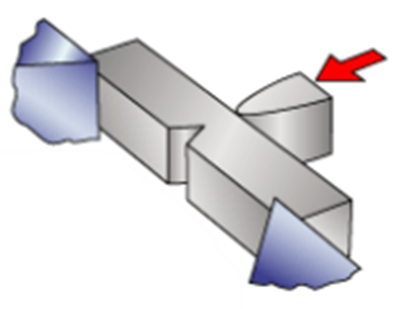
The primary purpose of the notch in a Charpy test sample shown above) is what?
Provide a location for crack propagation to occur.
Which of the followin are common classes of composite?
Foam Matrix
During the Torsion L2 Supplemental lab, the load cell on the Tinius Olsen testing machine is calibrated using which item?
Torque Wrench
Honeycomb-composite sandwich structures transfer the majority of internal stress through the .
Composite facing skin
A full Wheatstone bridge circuit is comprised of resistors.
4
Which group of material properties below are often defined in terms of one another (i.e. within a material property sheet, only two values are typically given and the third is computed from the other two)?
Modulus of Elasticity, Shear Modulus, and Poisson’s ratio.
A good example of an animal which applies lightweight, high strength materials we use in engineering is the:
Honeybee
What is the primary reason that testing standards are used to categorize materials and their properties?
To ensure engineers and designers can compare one material to another objectively without expensive tests.
The Rockwell Hardness test uses a scale relative to , the hardest material.
Diamond
Yield strength is defined by:
The intersection of the tensile stress-strain curve and a line with the same slope as the elastic region, offset by 0.2% strain.
A good example of an animal which applies energy absorption methods we use in engineering is the:
Woodpecker
Honeycomb is able to absorb incredible amounts of energy when undergoing loading.
Compressive
In order to remove the high initial peak stress when crushing honeycomb, engineers will often utilize .
Pre-crushing
The amount of energy absorbed per unit volume by crushing honeycomb can be calculated by:
Multiplying the plateau stress by the densification strain.
All of the following are methods to observe and/or measure surface strain except:
Dividing the applied load by the cross-sectional area of the test sample.
Wheatstone bridges are used to measure strain for the following reasons except:
They are cheaper to manufacture and set up than the traditional foil strain gage.
For a non-circular cross section undergoing torsion, the is often used in an estimation calculation of surface stress.
Inscribed circle
Use of I-beams and Composite sandwich structures are advantageous because they compared to solid counterparts.
Are lighter for the same relative strength
Which of the following issues is not a common issue when using honeycomb sandwich structures?
Rusting of outer surfaces after abrasion occurs.
Electrical strain gages measure strain through change in .
Resistance
During the Torsion L2 Supplemental lab, the load cell on the Tinius Olsen testing machine is calibrated using which item?
Torque wrench.
During the Rockwell L1 Supplemental lab, which of the following were not used to quench one of the samples?
Vinegar
What section do preliminary results go in?
Results
What section do equations go in?
Discussion
What is the order of a paper?
See image
Which of the following is not a common mechanical property?
Density
Who does not make testing standards?
AIAA-American Institute of Aeronautics and Astronautics
Who does not make testing standards?
IEEE - Institute of Electrical and Electronics Engineers
Why is A test sample is machined into a “dogbone” geometry and pulled in uniaxial tension
until it breaks.
The “dogbone” shape uniformly concentrates stress far away from where the sample
is gripped
What does a Charpy test not test?
strength
What force is exerted to slow a 75 kg falling from the sky?
750 N
Engineering stress formula?
Stress= Force/Cross Sectional Area
Engineering Strain Formula?
Strain= delta l/ l0
Modulus of Elasticity Formula?
Modulus of Elasticity Formula= Strain * Modulus of Elasticity
Poisson’s Ratio Formula?
Poisson’s Ratio= -latitudal strain/longitudal strain
How do you find yeild strength?
Draw a line parallel to the elastic loading line (but offset by 0.2% strain) to find the
0.2% offset