History of Psychology
 Call Kai
 Learn
 Practice Test
 Spaced Repetition
 Match
 Flashcards
 Knowt Play
1/98

There's no tags or description
Looks like no tags are added yet.
99 Terms
Epistemology
branch of philosophy concerned with a theory of knowledge
The logic of scientific discovery (1934/1959)
Karl Popper
The structure of scientific revolutions (1962)
Thomas Kuhn (nicht logischer Ansatz, sondern Pre-Science)
Criticism and the growth of knowledge (1970)
Imre Lakatos
Against method (1975)
Paul Feyerabend
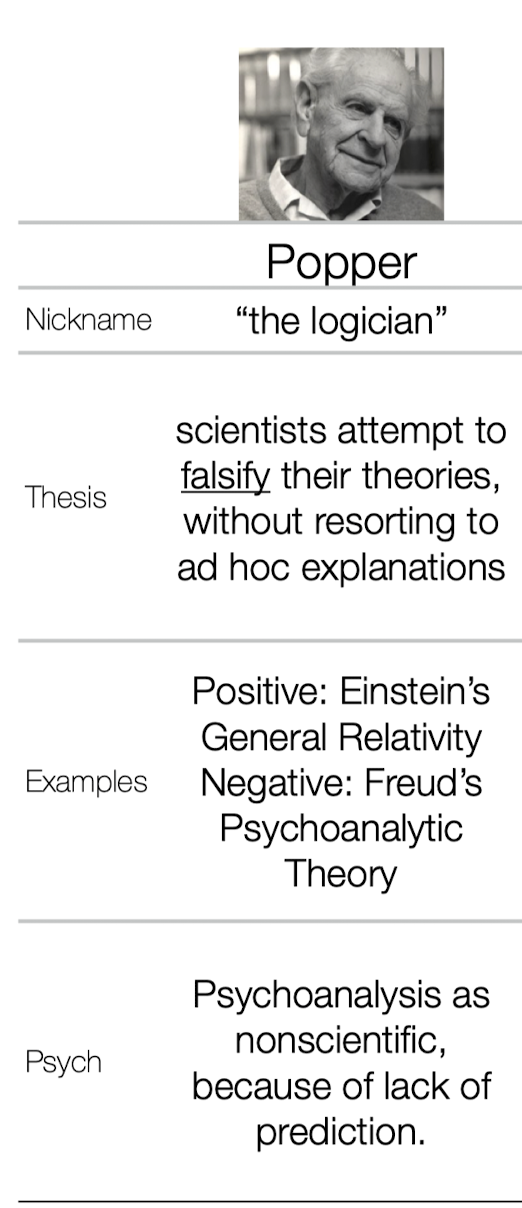
Falsificationism (Karl Popper)
The epistemological view asserting that empirical scientific theories cannot be conclusively proven, only subjected to decisive tests designed to potentially refute them.
The Problem of Induction
Schwanenproblem

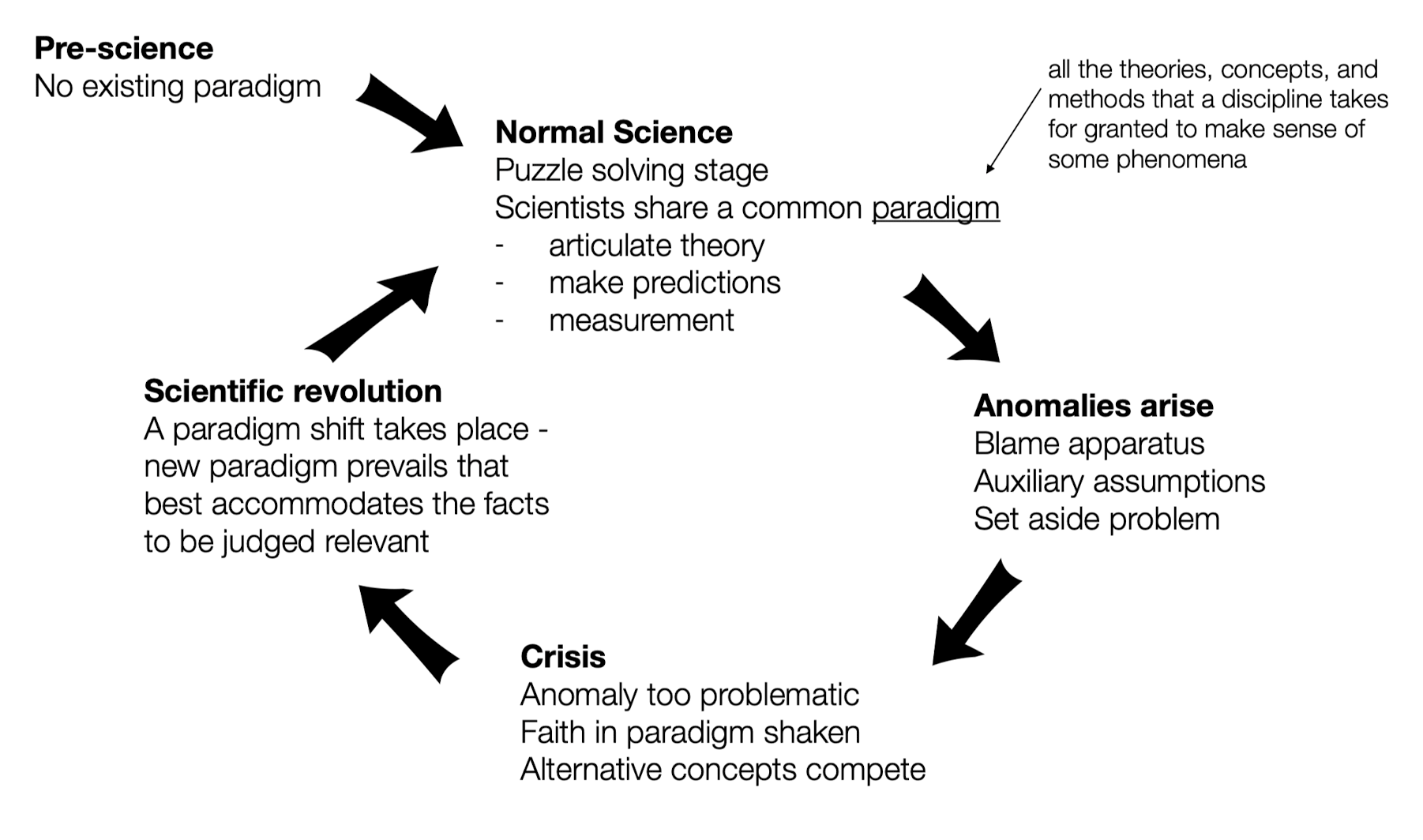
Kuhn's Cycle of Scientific Revolutions
Definition: A model describing science as moving from pre-science through periods of normal science guided by a paradigm, which are disrupted by anomalies and crises leading to a paradigm shift.
Scientific Revolutions // Paradigm shifts
Methodology of Scientific Research Programmes (Imre Lakatos)
Definition: A framework reconciling Popper and Kuhn by judging competing research programs on whether they are progressive (generating novel predictions) or degenerative (relying on ad hoc patches).
Epistemology and History of Science

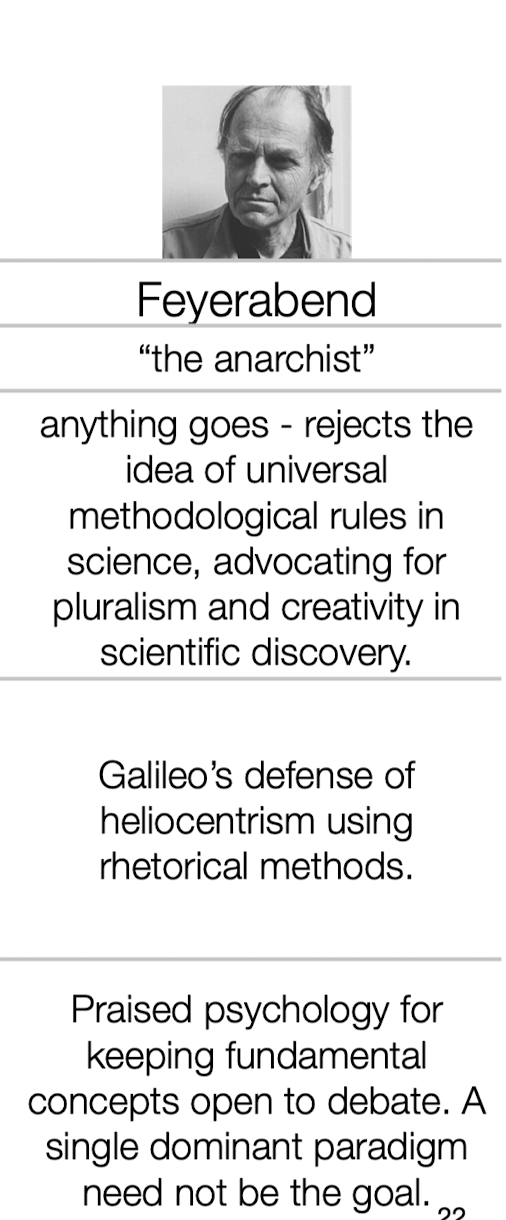
Epistemological Anarchism (Paul Feyerabend)
Definition: The stance rejecting universal methodological rules in science, epitomized by the phrase 'anything goes' and advocating methodological pluralism and creativity.
Archetypes of epistemologists…

Archetypes of epistemologists… Popper
Archetypes of epistemologists… Kuhn

Archetypes of epistemologists…Lakatos

Archetypes of epistemologists… Feyerabend
Plato
• Idealism and Theory of Forms
the idea that reality, or reality as we can know it, is fundamentally mental or mentally constructed; senses do not necessarily deliver a true picture of the physical world (cf. analogy of the cave)
• Dualist Views (separation of body and soul)
• Nativist Views (the soul possesses a priori knowledge that can be recalled; cf. Meno’s dialogue)
Aristotle
• Contributions to many different areas of knowledge (theoretical, practical, productive sciences)
- biology
- logic and causality
- psychology: memory, dreams, health
- emphasis on practical goals of philosophy
(rhetoric, ethics, the good life)
• Monist
body and soul are two interdependent parts that support and rely on each other; the body as a tool of the soul
Take-Home: Ancient Roots
• No “psychology” yet, but the questions are there: the nature
of knowledge and of the soul (psukhē = breath, life, soul) were central topics of Greek philosophy.
• Plato: idealism (reality as fundamentally mental), dualism (body and soul are separate) and nativism (knowledge is innate and recalled).
• Aristotle: wide empirical interests (biology, logic, memory, dreams) and monism (body and soul are interdependent).
Scientific Revolution: Galileo
power of and need for instrumentation in science/mathematics as the language of science/using data to distinguish theories (and science communication)
Scientific Revolution: Francis Bacon
Novum Organum Scientarium → popularise the scientific method (inductive method)
Scientific Revolution: Rationalism
The epistemological view that reason is the main source of knowledge, and, consequently, that there are significant ways in which concepts and knowledge can be gained independently of sensory experience— deduction.
Scientific Revolution: Empiricism
The epistemological view that experience is the main source of knowledge, and that emphasizes the role of evidence in the formation of ideas and beliefs — induction—over the notion of innate knowledge or deduction.
Take-Home: Scientific Revolution
• From authority (scholasticism) to data: instruments, mathematics and data challenged dogma and became the way to decide between theories.
• Induction: The scientific approach promotes building general claims step by step from systematic observation.
• Rationalism vs. empiricism: philosophical discussion about whether knowledge is gained mainly through reason (deduction) or through experience (induction)? The debate still shapes psychology today.
Evolutionary Theory
Charles Darwin
From Phrenology to Neuropsychology Personen
Franz Josef Gall (1758-1828)
Pierre Paul Broca (1824-1880)
From Phrenology to Neuropsychology “Tan“
The patient “Tan” (Louis Leborgne) was unable to clearly speak any words other than “tan” - and is often used as a classical example of Broca’s aphasia (expressive or non-fluent aphasia). Broca’s autopsy of Leborgne revealed an extensive lesion that involved the frontal lobe, specifically, the inferior frontal gyrus
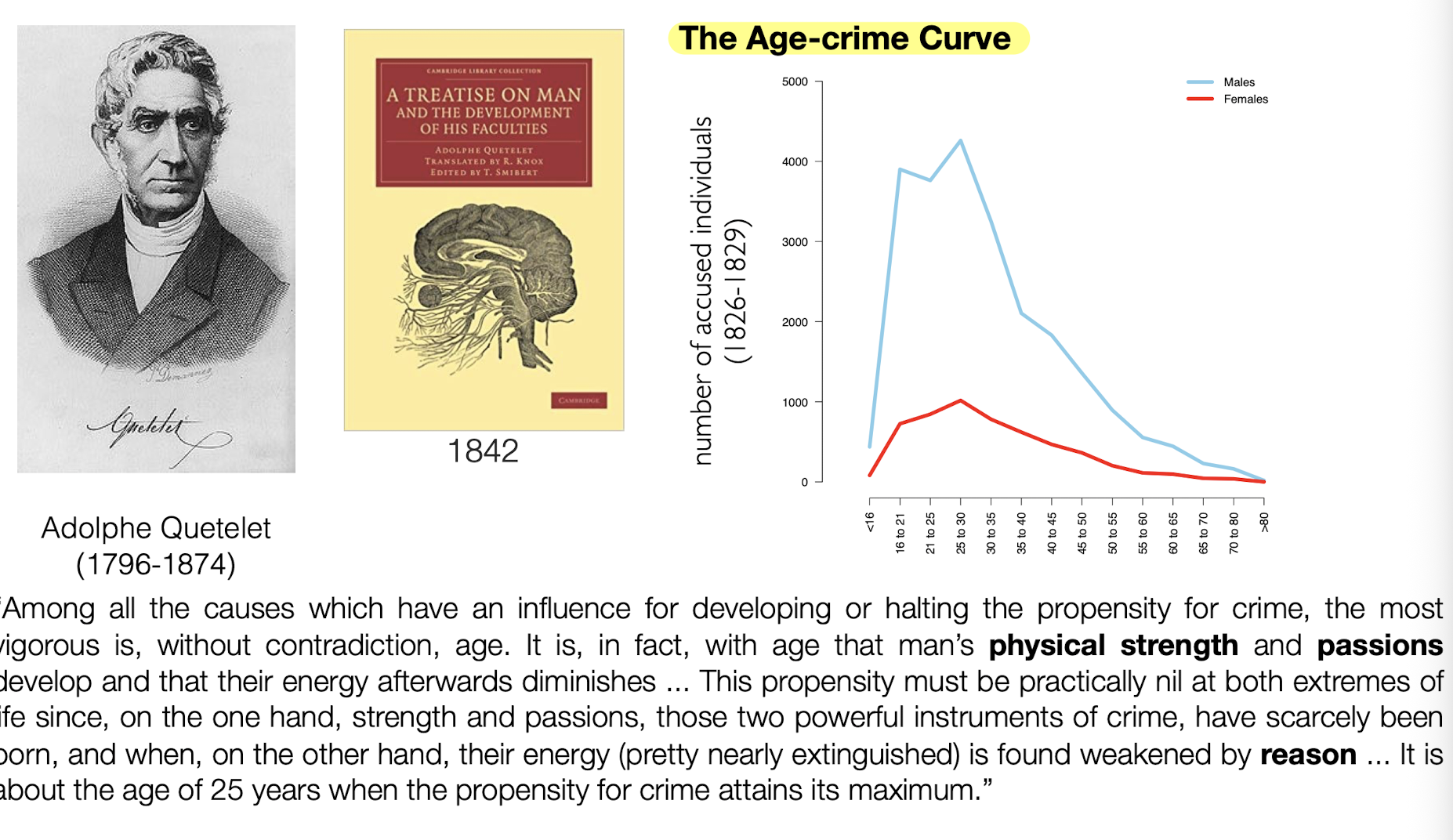
“Social physics“: Adolphe Quetelet
Take-Home: 19th-Century Currents
• Evolutionary theory: Darwin’s natural selection explains the origin of species and invites functional explanations of mind and behaviour.
• Neuropsychology: from Gall’s phrenology to Broca’s lesion studies, linking brain regions to psychological functions such as language.
• Social physics: Quetelet used statistics on large populations to describe regularities such as the age–crime curve.
Weber and Fechner

Psychophysics
The figure on the left provides an illustration of the Weber–Fechner law. On each side, the lower square contains 10 more dots than the upper one. However the perception is different: On the left side, the difference between upper and lower square is clearly visible. On the right side, the two squares look almost the same. The figure on the right depicts the relation between intensity (I) of a stimulus and the subjective experience or sensation (S).

Instrumentation: The brass-and-glass era
Brass “instrumentation came to symbolize this stage of development, for the new psychologists were self-consciously concerned with translating perennial problems of sensation and perception into terms amenable to experimentation and measurement”
Wilhelm Wundt: Methodological eclecticism
Pluralistic Use of Methods
Experimental Studies: psychophysical methods to study the connection between physical stimuli and subjective experience, reaction time measurements, accuracy of reproduction in memory tasks.
Introspection: self reports of sensations, feelings, and thoughts by trained individuals under controlled experimental situations.
Historical and Comparative Analysis: analysis of the products of human thought and culture through examination of different societies and their development.
Take-Home: The Birth of Scientific Psychology
1879: Wundt's Leipzig laboratory is often used as the symbolic birth of psychology as an independent, experimental science.
Measuring the mind: Weber and Fechner's psychophysics (S =
K • log I) and instrumentation (Hipp chronoscope) made mental processes quantifiable.Methodological eclecticism: Wundt combined experiments, trained introspection and historical/cultural analysis
Titchner and Structuralism
Laut Titchener is psychology the science of consciousness and that the only method which could adequately deal with the contents of consciousness
William James and Functionalism
American philosopher and psychologist who was trained as a physician. James was the first educator to offer a psychology course in the United States at Harvard in 1875. Considered to be one of the founders of functional psychology. James gained widespread recognition with his The Principles of Psychology (1890).
The First Schools: Structuralism vs. Functionalism
We have (2) the functionalism which deals with the problem of mind conceived as primarily engaged in mediating between the environment and the needs of the organism. and lastly we have functionalism described as psychophysical psychology, that is the psychology which constantly recognizes and insists upon the essential significance of the mind-body relationship for any just and comprehensive appreciation of mental life itself.
Take-Home: The First Schools
Structuralism (Titchener): what are the elements of consciousness? Studied with rigorous, trained introspection.
Functionalism (James, Angell): what is consciousness for? The mind as adaptation to the environment, inspired by evolutionary theory.
Shared methods: the two schools differed more in their questions than in their tools; both relied on controlled laboratory experiments using reaction-time
The origins and development of psychoanalysis
The relationship between trauma and mental illness was first investigated by the neurologist Jean Martin Charcot, a French physician who was working with traumatized (histeric) women in the Salpêtrière hospital, Paris. Hysterical symptoms were characterized by sudden paralysis, amnesia, sensory loss, and convulsions, and at the time, such symptoms were thought to originate in the uterus.
Until Charcot, the common treatment for hysteria was hysterectomy. Charcot was the first to understand that the origin of hysterical symptoms was not physiological but rather psychological in nature.
The origins and development of psychoanalysis from trauma to phantasy
Later, Freud stopped believing that every client who walked into his office with 'hysteria' had been sexually abused. Rather, he seemed to believe that symptoms resulted from repressed phantasies.
Psychoanalysis as …
– General theory of human psychology and behavior
– Method to diagnose and treat psychopathology
– Historical-cultural movement
Phases of Psychoanalytic Theory
– Pre-psychoanalysis (1881-1894)
– Trauma theory (1895-1899)
• repressed traumas
• reinterpretation as phantasies (castration complex, penis envy, Oedipus complex)
– Topographical Theory (1900-1922)
• Levels of conscious access
– Structural Theory (1923 onwards)
• Id, Ego, Super Ego
• Es = Eros (Desire) und Thanatos (Death)
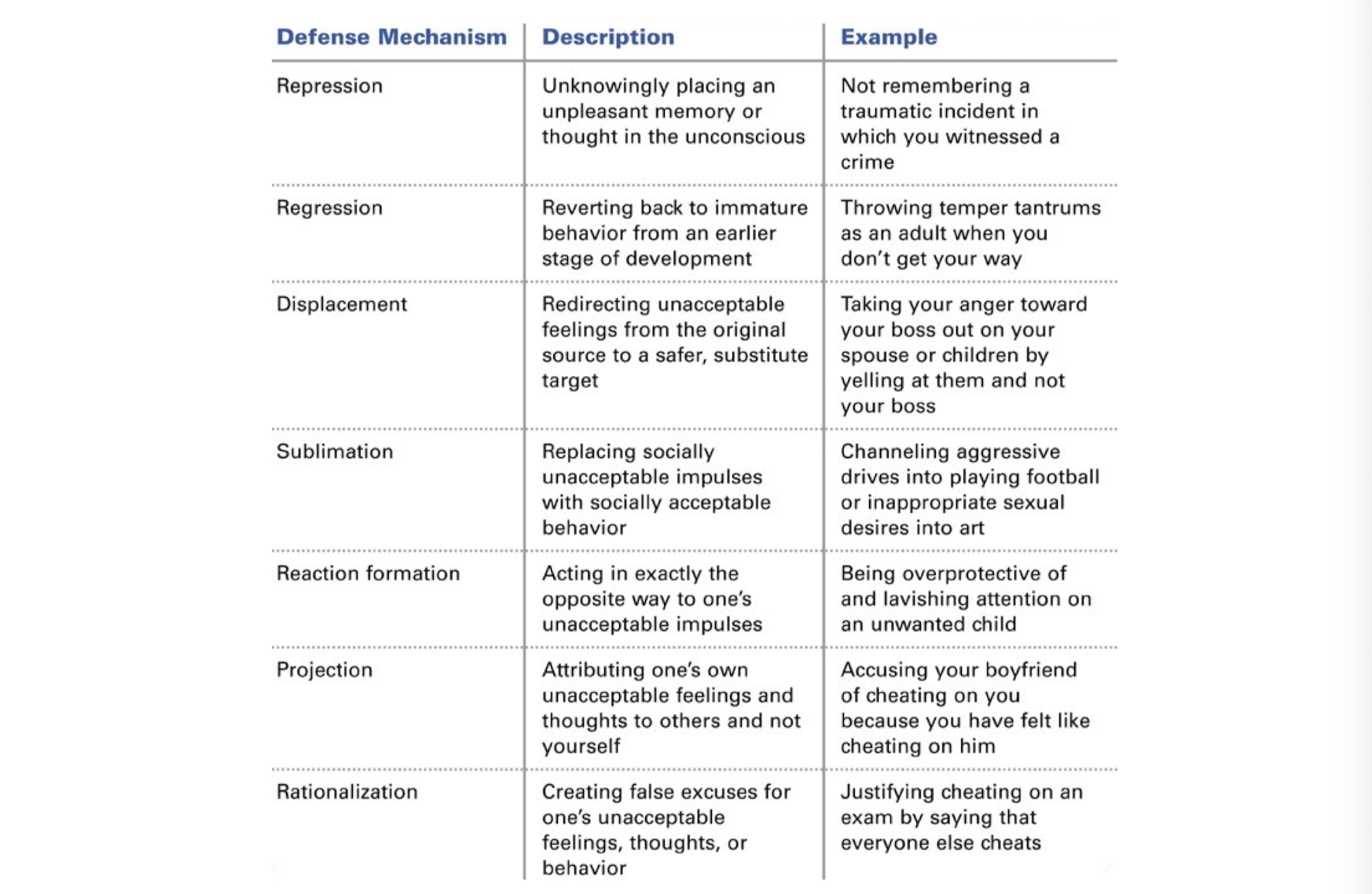
Psychoanalysis: Examples of Defense Mechanisms
Psychoanalysis: Methods (Anamnesis)
• Anamnesis: interpretation of patient biography in light of psychoanalysis, to reveal origins of trauma/conflict and defence mechanisms at play; bringing these to light and new framing may help resolve tensions
Psychoanalysis: Methods (Hypnosis)
Hypnosis: probe the unconscious and cure (hypnotic suggestion), abandoned
Psychoanalysis: Methods (Dream analysis)
dreams as “the royal road” to the unconscious (like hypnosis, represents an altered state of consciousness), dreams deal with wish fulfilment, unconscious desires and conflicts; dreams contain both manifest (conscious) and latent content, with the latter representing repressed, symbolic meaning. The therapist aims to uncover the meaning of the latent content and uses additional techniques (e.g., free association) to further probe the mental conflict
Psychoanalysis: Methods (Free association)
the analyst asks the individual to share thoughts, words, or images that come freely to mind or in reaction to some cue; the results are interpreted by the analyst to uncover unconscious thoughts and conflict
Psychoanalysis: Methods (Freudian slips)
(i.e., slips of the tongue; “bread and butter” -> “bed and butter”):
investigative technique to reveal sources of mental conflict
Psychoanalysis: Methods (Projective tests)
psychoanalysts aim to uncover unconscious drives and conflicts by interpreting responses to ambiguous cues (e.g., Rorschach ink blots)
Psychoanalysis: Impact (and Conflict)
Carl Gustav Jung
• Libido as a more general term to describe mental energy (as opposed to sexual energy)
• Collective unconscious: aspects of unconsciousness experienced by all people in different times and cultures
• Archetypes
– inherited images, symbols (e.g., giants, magicians, heroes)
– double-nature as instincts and cultural traditions
– as foundation of human communion
• Personality types
– distinguish introverts (focused on the internal world) and extroverts
(focused on the external world)
• Publication record
– little systematic treatment of theoretical ideas
– publications on religion, mystical topics, alchemy…
Psychoanalysis: Critique
• Freud seems to have paid little interest to systematic empirical research!
- Karl Popper critiqued psychoanalysis for being unfalsifiable, meaning it could not be empirically tested or disproven, a key criterion for scientific theories in his view
- Dodo bird verdict: Psychotherapie egal welcher Form führt zum gleichen Ergebniss