Biology Lab Digestive System

0.0(0)
Studied by 0 people
call kaiCall Kai
learnLearn
examPractice Test
spaced repetitionSpaced Repetition
heart puzzleMatch
flashcardsFlashcards
GameKnowt Play
Card Sorting

1/15

encourage image

There's no tags or description

Looks like no tags are added yet.

16 Terms

1
New cards
<ul><li><p><span style="line-height: 1.15;"><strong>Identify RED ARROW (specific part of whole organ):</strong> Fundus</span></p></li><li><p><span style="line-height: 1.15;"><strong>Function/s:</strong> Both for digestion and storage</span></p></li><li><p><span style="line-height: 1.15;"><strong>Initially digested chemically in this region:</strong> Proteins</span></p></li></ul><p></p>
  • Identify RED ARROW (specific part of whole organ): Fundus

  • Function/s: Both for digestion and storage

  • Initially digested chemically in this region: Proteins


2
New cards
<ul><li><p><span style="line-height: 1.15;"><strong>Identify RED ARROW (specific region):</strong> Pyloric end</span></p></li><li><p><span style="line-height: 1.15;"><strong>Type of muscle as to action:</strong> Sphincter</span></p></li><li><p><span style="line-height: 1.15;"><strong>Hormone produced by this:</strong> Gastrin</span></p></li></ul><p></p>
  • Identify RED ARROW (specific region): Pyloric end

  • Type of muscle as to action: Sphincter

  • Hormone produced by this: Gastrin


3
New cards
<ul><li><p><span style="line-height: 1.15;"><strong>Identify RED ARROW:</strong> Glottis</span></p></li><li><p><span style="line-height: 1.15;"><strong>Identify BLUE ARROW:</strong> Laryngeal prominence</span></p></li><li><p><span style="line-height: 1.15;"><strong>Passageway for food:</strong> Red (or esophagus region)</span></p></li></ul><p></p>
  • Identify RED ARROW: Glottis

  • Identify BLUE ARROW: Laryngeal prominence

  • Passageway for food: Red (or esophagus region)


4
New cards
<ul><li><p><span style="line-height: 1.15;"><strong>Identify RED ARROW:</strong> Rectum</span></p></li><li><p><span style="line-height: 1.15;"><strong>Opening leading to the outside:</strong> Cloacal opening</span></p></li><li><p><span style="line-height: 1.15;"><strong>Material that DOES NOT naturally exit from RED arrow:</strong> Blood</span></p></li></ul><p></p>
  • Identify RED ARROW: Rectum

  • Opening leading to the outside: Cloacal opening

  • Material that DOES NOT naturally exit from RED arrow: Blood


5
New cards
<ul><li><p><strong>Identify RED ARROW:</strong> Internal naris</p></li><li><p><strong>Identify BLUE ARROW (sharp edge):</strong> Maxillary teeth</p></li><li><p><strong>Function of both structures:</strong> For holding prey in position</p></li></ul><p></p>
  • Identify RED ARROW: Internal naris

  • Identify BLUE ARROW (sharp edge): Maxillary teeth

  • Function of both structures: For holding prey in position


6
New cards
<ul><li><p><span style="line-height: 1.15;"><strong>Identify the whole structure in bracket:</strong> Valve of Kerkring (plicae circulares)</span></p></li><li><p><span style="line-height: 1.15;"><strong>Identify the clear cells in RED arrows:</strong> Goblet cells</span></p></li><li><p><span style="line-height: 1.15;"><strong>Identify this organ:</strong> Small intestine</span></p></li></ul><p></p>
  • Identify the whole structure in bracket: Valve of Kerkring (plicae circulares)

  • Identify the clear cells in RED arrows: Goblet cells

  • Identify this organ: Small intestine


7
New cards
<ul><li><p><span style="line-height: 1.15;"><strong>Structure pointed in black bracket:</strong> Portal triad / bile duct</span></p></li><li><p><span style="line-height: 1.15;"><strong>Abundant cells found in the periphery:</strong> Pigmented granules</span></p></li><li><p><span style="line-height: 1.15;"><strong>Identify this organ:</strong> Liver</span></p></li></ul><p></p>
  • Structure pointed in black bracket: Portal triad / bile duct

  • Abundant cells found in the periphery: Pigmented granules

  • Identify this organ: Liver


8
New cards
<ul><li><p><span style="line-height: 1.15;"><strong>Identify RED ARROW (globular sac):</strong> Gall bladder</span></p></li><li><p><span style="line-height: 1.15;"><strong>Function:</strong> Stores bile</span></p></li><li><p><span style="line-height: 1.15;"><strong>Is the fluid stored acidic or alkaline:</strong> Alkaline</span></p></li></ul><p></p>
  • Identify RED ARROW (globular sac): Gall bladder

  • Function: Stores bile

  • Is the fluid stored acidic or alkaline: Alkaline


9
New cards
<ul><li><p><span style="line-height: 1.15;"><strong>Identify the structures in RED ARROW (spaces in between):</strong> Gastric pit</span></p></li><li><p><span style="line-height: 1.15;"><strong>Fluid secreted by these:</strong> Gastric juice</span></p></li><li><p><span style="line-height: 1.15;"><strong>Which layer are they found:</strong> Mucosa</span></p></li></ul><p></p>
  • Identify the structures in RED ARROW (spaces in between): Gastric pit

  • Fluid secreted by these: Gastric juice

  • Which layer are they found: Mucosa


10
New cards
<ul><li><p><span style="line-height: 1.15;"><strong>Identify specific name of connective tissue:</strong> Gastrohepatoduodenal ligament (or mesentery)</span></p></li><li><p><span style="line-height: 1.15;"><strong>Specific type of connective tissue:</strong> Aponeurosis</span></p></li><li><p><span style="line-height: 1.15;"><strong>The above structure suspends which organ:</strong> Stomach / small intestine</span></p></li></ul><p></p>
  • Identify specific name of connective tissue: Gastrohepatoduodenal ligament (or mesentery)

  • Specific type of connective tissue: Aponeurosis

  • The above structure suspends which organ: Stomach / small intestine


11
New cards
<ul><li><p><span style="line-height: 1.15;"><strong>Identify RED ARROW:</strong> Eyeball</span></p></li><li><p><span style="line-height: 1.15;"><strong>Identify BLUE ARROW:</strong> Opening of eustachian tube</span></p></li><li><p><span style="line-height: 1.15;"><strong>Identify BLACK ARROW:</strong> Tongue</span></p></li><li><p><span style="line-height: 1.15;"><strong>Which structure is part of the digestive system:</strong> Black</span></p></li></ul><p></p>
  • Identify RED ARROW: Eyeball

  • Identify BLUE ARROW: Opening of eustachian tube

  • Identify BLACK ARROW: Tongue

  • Which structure is part of the digestive system: Black


12
New cards
<ul><li><p><span style="line-height: 1.15;"><strong>Identify RED ARROW (specify region):</strong> Ileum</span></p></li><li><p><span style="line-height: 1.15;"><strong>Identify BLUE ARROW:</strong> Large intestine</span></p></li><li><p><span style="line-height: 1.15;"><strong>Function of RED ARROW:</strong> Nutrient absorption</span></p></li><li><p><span style="line-height: 1.15;"><strong>Are villi present in BLUE ARROW:</strong> No</span></p></li></ul><p></p>
  • Identify RED ARROW (specify region): Ileum

  • Identify BLUE ARROW: Large intestine

  • Function of RED ARROW: Nutrient absorption

  • Are villi present in BLUE ARROW: No


13
New cards
<ul><li><p><span style="line-height: 1.15;"><strong>Identify RED ARROW (specific region):</strong> Cardiac end</span></p></li><li><p><span style="line-height: 1.15;"><strong>Identify BLUE ARROW:</strong> Esophagus</span></p></li><li><p><span style="line-height: 1.15;"><strong>Which structure occurs the beginning of peristalsis:</strong> Blue</span></p></li><li><p><span style="line-height: 1.15;"><strong>Which prevents heartburn in humans:</strong> Red</span></p></li></ul><p></p>
  • Identify RED ARROW (specific region): Cardiac end

  • Identify BLUE ARROW: Esophagus

  • Which structure occurs the beginning of peristalsis: Blue

  • Which prevents heartburn in humans: Red

14
New cards
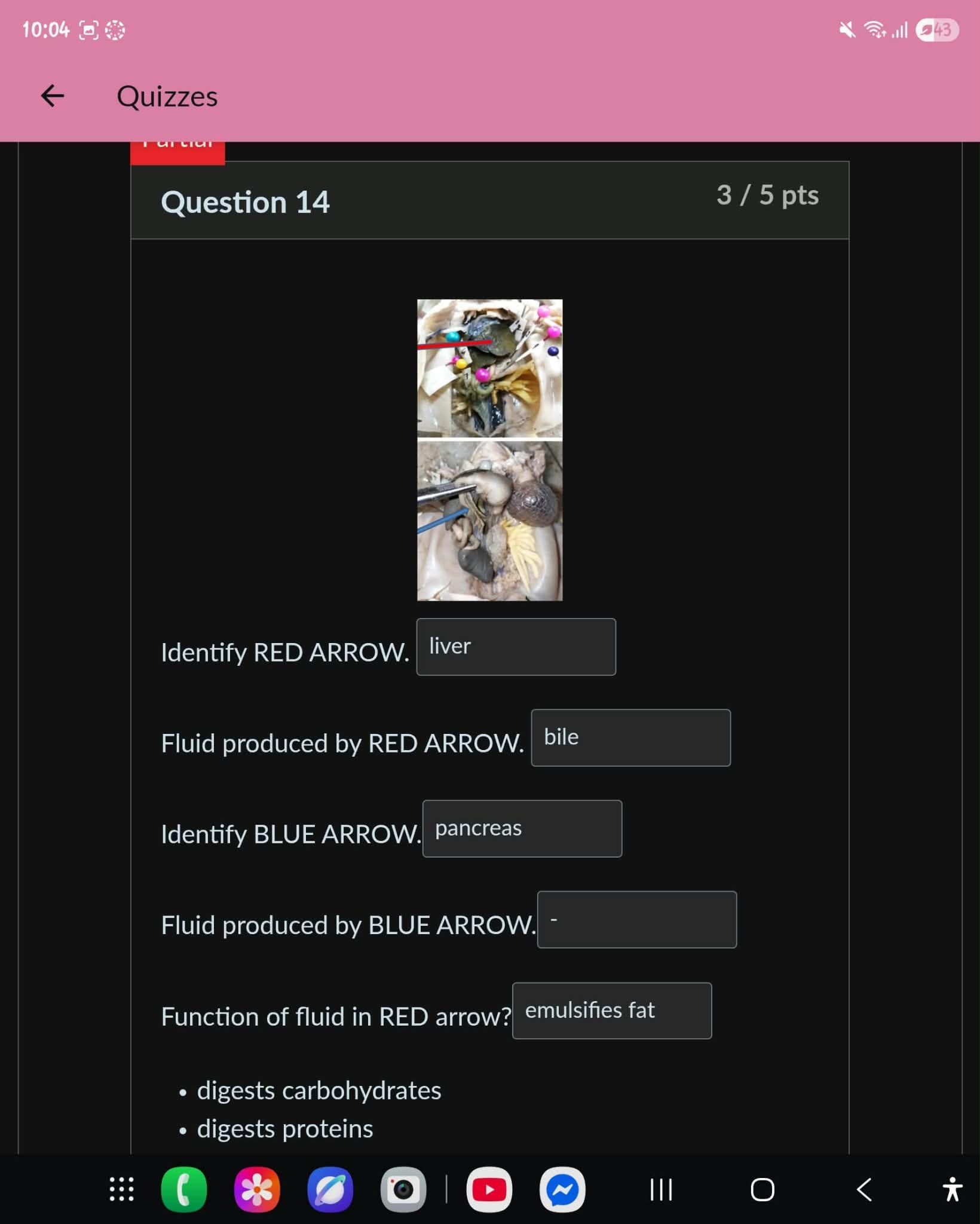
<ul><li><p><span style="line-height: 1.15;"><strong>Identify RED ARROW:</strong> Liver</span></p></li><li><p><span style="line-height: 1.15;"><strong>Fluid produced by RED ARROW:</strong> Bile</span></p></li><li><p><span style="line-height: 1.15;"><strong>Identify BLUE ARROW:</strong> Pancreas</span></p></li><li><p><span style="line-height: 1.15;"><strong>Fluid produced by BLUE ARROW:</strong> Pancreatic juice</span></p></li><li><p><span style="line-height: 1.15;"><strong>Function of fluid in RED arrow:</strong> Emulsifies fat</span></p></li></ul><p></p>
  • Identify RED ARROW: Liver

  • Fluid produced by RED ARROW: Bile

  • Identify BLUE ARROW: Pancreas

  • Fluid produced by BLUE ARROW: Pancreatic juice

  • Function of fluid in RED arrow: Emulsifies fat


15
New cards
<ul><li><p><span style="line-height: 1.15;"><strong>Identify RED ARROW (specific part of whole organ):</strong> Duodenum</span></p></li><li><p><span style="line-height: 1.15;"><strong>Function of red arrow:</strong> Chemical digestion</span></p></li><li><p><span style="line-height: 1.15;"><strong>Which of the following is initially digested chemically in this region:</strong> Lipids</span></p></li></ul><p></p>
  • Identify RED ARROW (specific part of whole organ): Duodenum

  • Function of red arrow: Chemical digestion

  • Which of the following is initially digested chemically in this region: Lipids


16
New cards
<ul><li><p><span style="line-height: 1.15;"><strong>Identify this organ:</strong> Stomach</span></p></li><li><p><span style="line-height: 1.15;"><strong>Identify the whole structure in bracket:</strong> Rugae</span></p></li><li><p><span style="line-height: 1.15;"><strong>Identify the layer in RED ARROW:</strong> Circular layer</span></p></li><li><p><span style="line-height: 1.15;"><strong>Identify the layer in BLUE ARROW:</strong> Longitudinal layer</span></p></li><li><p><span style="line-height: 1.15;"><strong>Type of muscle found BLUE ARROW:</strong> Smooth muscle</span></p></li><li><p><span style="line-height: 1.15;"><strong>How many different shapes/layers of muscles are found:</strong> 2</span></p></li></ul><p></p>
  • Identify this organ: Stomach

  • Identify the whole structure in bracket: Rugae

  • Identify the layer in RED ARROW: Circular layer

  • Identify the layer in BLUE ARROW: Longitudinal layer

  • Type of muscle found BLUE ARROW: Smooth muscle

  • How many different shapes/layers of muscles are found: 2


<ul><li><p><span style="line-height: 1.15;"><strong>Identify this organ:</strong> Stomach</span></p></li><li><p><span style="line-height: 1.15;"><strong>Identify the whole structure in bracket:</strong> Rugae</span></p></li><li><p><span style="line-height: 1.15;"><strong>Identify the layer in RED ARROW:</strong> Circular layer</span></p></li><li><p><span style="line-height: 1.15;"><strong>Identify the layer in BLUE ARROW:</strong> Longitudinal layer</span></p></li><li><p><span style="line-height: 1.15;"><strong>Type of muscle found BLUE ARROW:</strong> Smooth muscle</span></p></li><li><p><span style="line-height: 1.15;"><strong>How many different shapes/layers of muscles are found:</strong> 2</span></p></li></ul><p></p>



