03intrinsic motivation in the context of sports and volition in sports
 Call Kai
 Learn
 Practice Test
 Spaced Repetition
 Match
 Flashcards
 Knowt Play
1/44

There's no tags or description
Looks like no tags are added yet.
45 Terms
What is the definition of motivation according to Rheinberg?
motivation deals with explaining the direction, persistence, and intensity of goal-directed behavior. Desired goal states and what makes them attractive are the explanatory variables and are what characterize motivation
What ist motivation?
explains the direction of goal-directed behavior
influences the intensity of behavior
affects how long behavior is maintained
desired goal states give behavior direction
incentives determine why a goal appears attractive
what are the three motive themes?
achievement, affiliation, power
What is the definition of achievement?
need to increase or maintain one’s own proficiency in an activity in which a personal standard of excellence is considered binding (e.g. higher, better, faster)
What is the definition of affiliation motive?
need to establish, maintain, or restore positive social relationships with others (e.g. reach out to get to know some people)
What is the definition of power motive?
need to exert physical, psychological, or emotional influence over others (e.g. manager/coach enjoys leading a team and influencing important decisions)
What are the three parts of basic psychological need theory (BNT) according to Deci, 1975?
autonomy, competence, relatedness
What does autonomy (BNT) mean?
encourage decision making, ask for options and solutions, practice supportive behaviors, increase level of confidence
What does competence (BNT) mean?
offer opportunities for growth, provide constructive feedback, recognize accomplishments, offer support and resources
What does relatedness (BNT) mean?
encourage collaboration, foster open communication, build trust and respect, create a sense of belonging
What is a motive according to Sternberg and Schüler et al.?
stimulus that prompts a person to act in a particular way (Sternberg, 1995)
traits of people and provide the long-term energy for action (Schüler et al., 2023)
What is a motive according to McClelland (1987) and what have incentives to do with it?
motive is defined as a nonconscious, nonverbally represented, affect-based preference for certain classes of incentives that orient’s attention toward specific cue stimuli in the environment and energize behavior
Incentives promise + or - affective states linked to the activity itself (e.g., enjoying a task or social interaction) or its outcome (e.g. pride in mastering a challenge or forming a friendship)
What is an Implicit Motive according to McClellend and what three functions serve they?
unconscious, enduring preferences for certain incentive classes
Serve three functions: orienting attention toward potentially motive-satisfying cues, providing energy for action, and directing behavior toward stimuli relevant to motive satisfaction

What are motives for sport and exercise?
health and fitness
Well-being (fun, dealing with stress)
Appearance weight loss, trained body)
Achievement (effort, improvement, competition/comparison)
Bodily experience
Sense of community
Social contact
Experiencing excitement and novelty
Aesthetics of sporting activity
Self-presentation (oneself or team
What is the difference between implicit and explicit motives?
Implicit: unconscious motivational preferences that influence behavior
Explicit: conscious, self-attributed goals and preferences
example: someone unconsciously enjoys competition (implicit), but consciously says that career success is their main goal (explicit)
What is the aim of research on motives, and which motives are investigated?
Aim: To understand why people behave the way they do by investigating their underlying motives.
Three main motives:
Achievement motive — improving performance
Affiliation motive — being with others
Power motive — demonstrating power
Which assessment tools are used while research on motives?
TAT: Pictures and picture-based stories
MMG: Picture-based stories with predefined responses
LAT: Reaction times to stimuli and associative links
What is the Organismic Integration Theory (OIT) and what are its types of motivation and regulation?
OIT explains how extrinsic motivation can become increasingly self-determined (internalized).
Amotivation: No intention to act; lack of motivation.
External regulation: Acting for rewards or to avoid punishment.
Introjected regulation: Acting from guilt, shame or ego pressure.
Identified regulation: Acting because you personally value the activity.
Integrated regulation: The activity fits your values and identity.
Intrinsic motivation: Acting because the activity itself is enjoyable.
Key distinction:
Controlled motivation: External + introjected regulation.
Autonomous motivation: Identified + integrated regulation; intrinsic motivation is also autonomous.
Continuum: From non-self-determined to self-determined behavior.

Meta Theory taken together
When all these parts are fulfilled than it might be a person which is very passionately and highly motivated

How is motivation assesses in Sport?
Questionnaires assess experiences during an activity or reasons for participation
Distinguish between:
Contextual motivation: „Why do you practice your sport in general?“
Situational motivation: „Why are you doing this activity right know?“
Select the questionnaire according to the research question and level assessment
Practical strategies to promote intrinsic motivation
match task difficulty to individual skills to enable success and flow
Set realistic goals and make progress visible
Give informational feedback on controllable aspects of performance
Use praise to communicate competence; avoid pressure or manipulation
Vary drills and activities to maintain interest
Involve athletes in decisions about training and competition
How does Rheinberg‘s basic model explain motivation and action in sports?
motivation results from the interaction between Personal variables (need, motivation, goals) and situation variables (incentives in the environment)
This current motivation leads to achievement-motivated action (training, optimizing),resulting in an outcome evaluated by activity-related or purpose-related incentives

How can coaches support the three basic psychological needs in Self-determination Theory (BNT)?
Autonomy ("I have choice and ownership"): Offer meaningful choices, involve athletes in decisions, explain reasons for tasks.
Competence ("I can meet the challenge and improve"): Match challenges to skills, clarify goals, make progress visible, provide informative feedback.
Relatedness ("I belong and feel cared for"): Show personal interest, allow social interactions, value each individual, foster mutual support

How do motivation and volition differ, and what is the intention–behavior gap? (From motivation to action: Volition)
Motivation: Forming an intention ("I want to exercise") by evaluating desirability and feasibility.
Volition: refers to self-regulatory processes that helps us initiate and maintain intented actions, even when obstacles arise
Implementing that intention: ("I start exercising despite obstacles").
Intention–Behavior Gap: The phenomenon where strong positive intentions fail to translate into actual behavior due to internal (fatigue, anxiety) or external (distraction, competing activities) obstacles
What are the four phases of the Rubicon Model of Action Phases (Heckhausen & Gollwitzer, 1987)?
Predecisional (Motivation): Weighing desirability & feasibility to form an intention (Crossing the "Rubicon").
Preactional (Volition): Planning when, where, and how to act.
Actional (Volition): Initiating and maintaining action while managing obstacles.
Postactional (Motivation): Evaluating results and adjusting future behavior

What does McDougalls said with his Instinct Theroy? (1908)
Instincts→associated emotions
Instincts trigger specific emotions

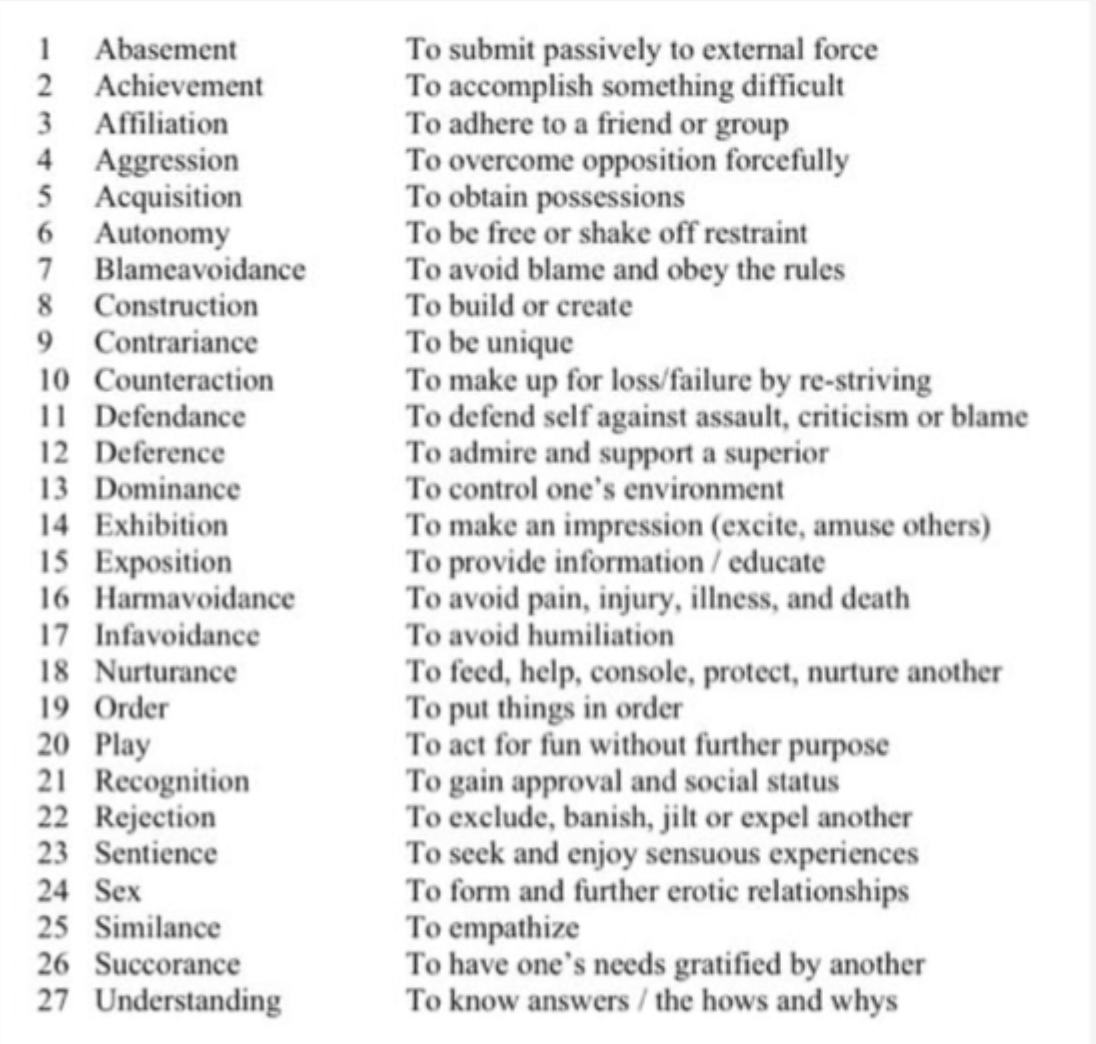
What does the Theory of needs say according to Murray (1938)?
Needs x Environmental Press → Behavior
What are the five levels of Maslow's Hierarchy of Needs (1943) from lowest to highest?
Physiological Needs: Air, water, food, shelter, sleep, clothing, reproduction (basic needs)
Safety Needs: Personal security, employment, property, health, resources.
Love and Belonging: Friendship, intimacy, family, sense of connection.
Esteem: Respect, self-esteem, status, recognition, strength, freedom
Self-Actualization: Desire to become the most that one can be
For Maslow the motive of behavior is the self-actualisation
1= fundament, 5 = peak (4,5 not reachable for everyone)

What are the suitable sport contexts and associated affective expressions for the Achievement, Affiliation, and Power motives?
1. Achievement Motive:
Suitable Sport Contexts: Possibility of improving personal performance (e.g., through feedback); individual engagement with a task; low time pressure and low pressure to compare with others; varied, joyful tasks; sports tasks one can cope with.
Associated Affects (Motive Satisfaction): Pride, efficiency.
2. Affiliation Motive:
Suitable Sport Contexts: Cooperative organizational forms; familiar social environments (Note: for individuals with high fear of rejection, cooperative settings can lead to poorer performance).
Associated Affects (Motive Satisfaction): Joy, calm, relaxation, harmony.
3. Power Motive:
Suitable Sport Contexts: Helping, supporting, or guiding others (e.g., in skill acquisition); gaining prestige; direct comparison; competition with others.
Associated Affects (Motive Satisfaction): Strength, excitement, enthusiasm
(Always associated with affects; associated affects = what you feel in that moment)
What is the TAT, and how does it assess motives?
Uses pictures and picture-based stories.
People invent stories about ambiguous pictures.
Their stories are analyzed to identify implicit motives.
Example: A person sees a picture of someone working and tells a story about striving to win a competition. This may indicate an achievement motive.
What is the MMG, and how does it differ from the TAT?
Uses picture-based stories with predefined responses.
Participants select responses that match a picture.
Assesses motives such as achievement, affiliation and power.
Example: A picture shows a person facing a challenge. The participant selects a response about succeeding, indicating an achievement-related motive.
Key difference: TAT = open-ended stories; MMG = predefined response options.
How does the LAT assess implicit motives?
Measures reaction times to stimuli and associative links
Faster responses can indicate stronger or more accessible associations.
Helps assess implicit preferences without relying only on self-reports.
Example: A participant responds faster when power-related words are paired with positive words than with negative words. This may suggest a positive association with power.
What is the difference between a motive and motivation?
Motive: relatively stable preferences
Motivation: The process that activates, directs, and sustains goal-oriented behavior, (influences direction, intensity and persistence of behavior)
Example: Motive = desire for achievement. Motivation = studying hard to pass an exam.
What are the main characteristics and conditions of the flow experience in sport psychology?
Core Concept: Flow is a state of deep absorption in an activity, driven by intrinsic motivation (engaging in behavior for its own sake).
Key Characteristics & Prerequisites:
Deep Absorption: Complete focus and immersion in the performance.
Challenge–Skill Balance: Triggered when task difficulty matches individual skill level (appropriate challenge).
Activity-Related Incentive: Driven by the intrinsic joy and feeling of movement rather than external rewards or outcome pressure
What is the difference between intrinsic and extrinsic motivation?
Intrinsic motivation involves enjoyment of the activity itself; extrinsic motivation involves separable outcomes
What is intrinsic motivation?
Definition: Doing an activity for its own sake because it is enjoyable or satisfying, independent of external factors or rewards or punishment
Key idea: The activity itself is the reward.
Sports example: An athlete plays basketball because they genuinely enjoy playing
What is extrinsic motivation?
Definition: Doing an activity to obtain external rewards, avoid punishment, or meet others' expectations.
Key idea: The reason lies outside the activity itself.
Sports example: An athlete trains to win prize money or please their coach
Can motivation change from intrinsic to extrinsic and vice versa?
Yes, athletes can shift between enjoying a sport itself and pursuing external rewards or outcomes
Intrinsic → extrinsic
Footballer plays for fun but later focuses mainly on price money
Extrinsic → intrinsic
Swimmer starts because of parental pressure but discovers genuine enjoyment
What is the corruption effect (overjustification effect)?
external rewards can reduce intrinsic motivation, especially when expected rewards are given for an already enjoyable activity
Example: child plays football for fun. When paid for every goal, they may become less interested in playing without payment
Do external rewards always reduce intrinsic motivation?
No, the effect depends on factors such as the reward and how it is perceived
What is the self-determination theory (SDT) as a Meta- Theory according to Deci&Ryan (1985)?
Self-determination considers how self-determined people‘s reasons for sport participation are. Intrinsic motivation ist the most self-determined form. SDT also predicts its determinants and implications for well-being and personal development
Which three other Theory’s take part at the Meta Theory from SDT?
Cognitive Evaluation Theory (CET)
Organismic Integration Theory (OIT)
Basic Needs Theory (BNT)
What is the Cognitive evaluation theory (CET)?
Explains how external events affect intrinsic motivation
intrinsic motivation is supported when people feel autonomous and competent
Effects depend on how an event is perceived: informational: supports competence→increase intrinsic motivation; Controlling: reduces autonomy→ decreases intrinsic motivation; amotivating: fosters incompetence→decreases intrinsic motivation
Undermining effect: rewards can reduce intrinsic motivation when they become the reason for an activity previously performed for its own sake
Key point: same reward can support or undermine intrinsic motivation depending on its perceived meaning