Skeletal Muscle Physiology Part I
 Call Kai
 Learn
Learn Practice Test
 Spaced Repetition
 Match
Match Flashcards
 Knowt Play
1/34

There's no tags or description
Looks like no tags are added yet.
Name | Mastery | Learn | Test | Matching | Spaced | Call with Kai | Chat |
|---|
No analytics yet
Send a link to your students to track their progress
35 Terms
Muscle fibers are composed of what three things?
T-tubules
sarcoplasmic reticulum
satellite cells
T-tubules
extensions of the sarcolemma (plasma membrane) that pass through a muscle fiber

What do T-tubules do?
carry action potentials along a cell
What does the sacroplasmic reticulum do?
it stores and releases calcium to initiate muscle contraction or relaxation
Satellite cells
precursor cells that play an important role in muscle growth and repair
they become activated following injury and can differentiate into muscle cells (to promote healing)
Myosin
a thick protein filament that interacts with actin during muscle contraction
Titan stabilizes ____.
myosin filaments
Titan is a third myofilament involved in muscle contraction. What does it do?
It increases stiffness: spanning from the Z-disc to the M-line in a sarcomere, titin stretches when a muscle lengthens and recoils to return the muscle to its resting length
it stabilizes sarcomeres and centers myosin
prevents overstretching of muscle fibers

Actin
thin protein filaments that interact with myosin during muscle contraction
contain tropomyosin and troponin
Tropomyosin
covers actin binding sites at rest

Troponin
moves tropomyosin off actin binding sites when calcium binds to it, allowing cross-bridges to form and muscle contraction to occur

Troponin consists of what three subunits? What do they do?
Troponin T (TnT): binds to tropomyosin
Troponin C (TnC): binds to calcium ions
Troponin I (TnI): inhibits actin-myosin interactions at rest

Differences in sarcomere ___ and ___ affect how much force and power a muscle can produce.
alignment
length
What are the two broad types of muscle fiber alignment?
fusiform
pennate
Fusiform muscle fibers
fibers run parallel to one another, spanning the length of the muscle

Pennate muscle fibers
fibers are angled to the line of pull

How do pennate muscles differ from fusiform muscles?
they contain shorter fibers (which makes sense b/c they don’t run the full length of a muscle)
possess more individual fibers
exhibit less ROM
Muscle fibers in parallel (side by side) allow for…
more forceful contractions due to having more attachment points
Muscle fibers in series (stacked on top of each other) allow for…
faster contraction speeds
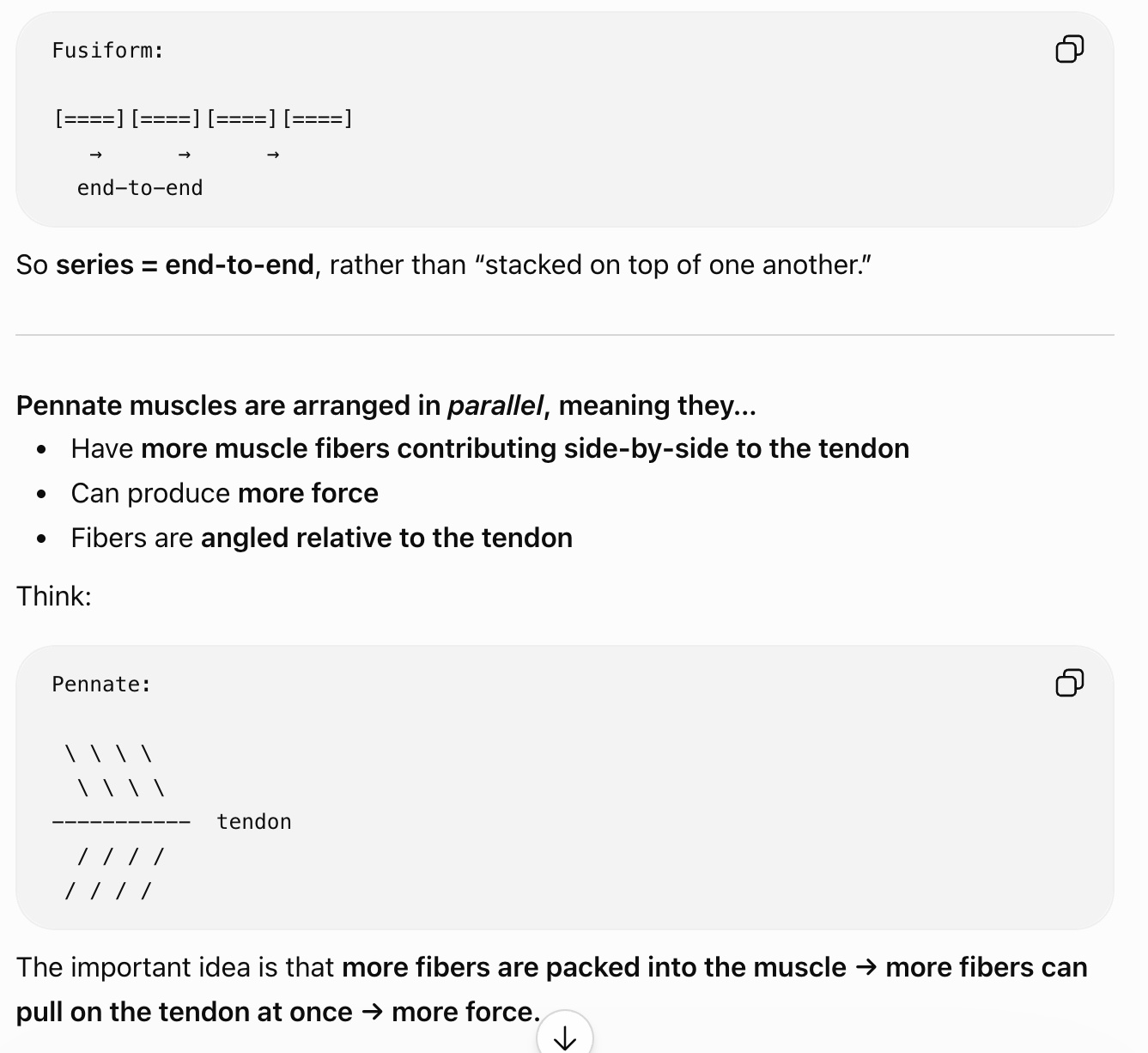
Fusiform muscles are arranged in ___, meaning they…
series: have more muscle fibers arranged end to end along the length of a muscle
produce faster contractions

Pennate muscles are arranged in ____, meaning they…
parallel: have more muscle fibers contributing side-by-side to the tendon
produce more force
What happens if you increase pennation angle?
you can put more fibers in parallel, which increases force production

Most larger muscles have a ____ ___.
pennation angle
What happens when pennate muscles contract?
they shorten and pull on the outer sheath of the muscle, which then pulls on the tendon
What happens when fusiform muscle contract?
they shorten and pull on the tendon directly
Cross sectional area (CSA)
tells us how many muscle fibers are present in a muscle
measured perpendicular to a muscle’s long axis
more fibers in parallel = more force produced

Physiological Cross Sectional Area (PCSA)
takes into account the angle of muscle fibers relative to a tendon
provides a better estimate of a muscle's force-generating capacity than CSA
Why is PCSA a better estimate of a muscle’s force-generating capacity?
bc it considers pennation angle
Fascicle Length
a fascicle is a bundle of muscle fibers
fascicle length measures the length of individual bundles
Muscle length
the overall length of a muscle from origin to insertion
Muscles that are capable of producing a high amount of force have what properties? Why?
large PCSA = more muscle fibers
low fascicle length to muscle length ratio: shorter fascicles mean more fibers can be packed side-by-side (in parallel) within the same overall muscle length.
Muscles that are capable of producing high velocity contractions have what properties? Why?
small PCSA = fewer muscle fibers
high fascicle length to muscle length ratio: longer fascicles allow greater muscle shortening, leading to higher contraction velocities
The quads have a higher PCSA than the hamstrings. Why does this make sense?
A large PCSA in the quadriceps —> indicates a greater number of muscle fibers —> which allow them to generate force
a smaller PCSA in the hamstrings —> indicates faster contraction speed —> which is important for sprinting
Why does it make sense that the soleus is short in length and has a low PCSA?
bc it is needed for walking and posture, and isn’t needed solely for speed
What are the steps of cross-bridge formation?
myosin binds to actin and an Pi is released
ATP is broken down, ADP is released and a power stroke occurs
myosin is in a low E state
a new ATP binds to the myosin head and myosin detaches from actin
myosin breaks down ATP, cocks its head back, and another cross-bridge forms
